How is AI reshaping software business models?
TL;DR
AI is driving a shift from subscription pricing to outcomes based models, a move challenging incumbents and opening opportunities for startups. Applied AI and vertical specialization are key growth paths as companies build AI agents to handle customer experiences and automate business processes.
Transcript
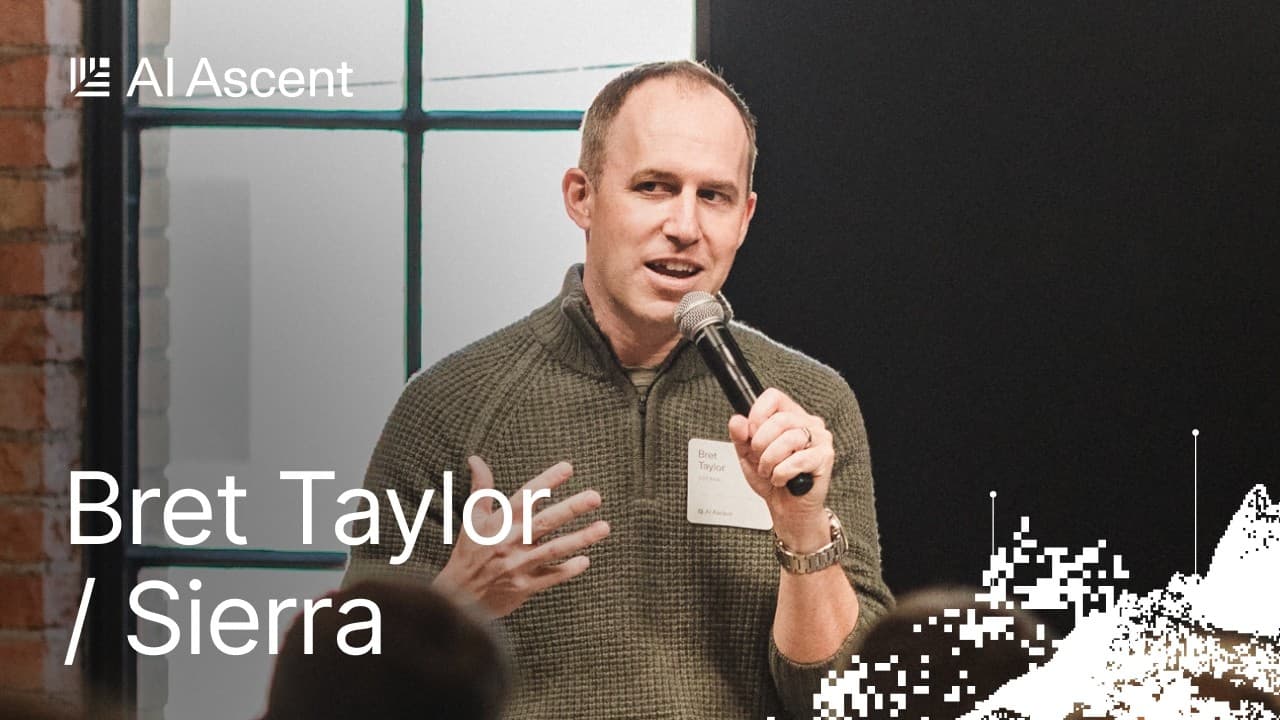
next up we have Brett Taylor he was part of the I think first APM program at Google where he famously rewrote all of Google Maps in a weekend then he founded a company then he went ahead and was just CTO of Facebook for a while and then he founded another company which we're lucky enough to be in business with him on which is redefining the front d... Read More
Key Insights
- AI agents will become the main customer facing interface for brands, replacing multiple digital touchpoints over time.
- Leaders should focus on what matters most for the job at hand rather than doing what is easiest or most comfortable.
- Foundations models are likely to consolidate into a few large players due to capital intensity and data center scale requirements.
- Tools and infrastructure for AI will be important, but face competition from large foundation model providers, making them riskier investments.
- Applied AI in customer experience, marketing, and other verticals represents a major software as a service opportunity.
- There is a three market framework for AI: foundation models, toolmakers, and applied AI agents, with the last category most closely matching traditional software delivery in the future.
- Entrepreneurs need self awareness to evolve their role as the company scales, shifting from personal strengths to what the team and product need.
- OpenAI is mentioned in context of governance and leadership, suggesting leadership roles influence the direction of AI adoption in enterprises.
Install to Summarize YouTube Videos and Get Transcripts
Explore YouTube Video Summarizer or Get YouTube Transcript Extractor
Questions & Answers
Q: What is the central thesis about AI and software pricing models?
The central thesis is that customer facing AI agents will change software pricing from subscription based to outcomes based models. This shift requires startups to prove what outcomes their AI delivers for customers, rather than charging for features or access. Enterprises may resist at first, but startups have a better chance to adopt this approach given agility and focus on measurable results.
Q: How should leaders handle team performance according to the interview?
Leaders should hold their team to high standards and avoid trying to do all the work themselves. By identifying and replacing underperforming teammates and prioritizing the most important tasks, leaders can scale effectively. The interview suggests this discipline helps leaders avoid what the speaker calls the dead cat bounce and maintain steady progress.
Q: What does Bret Taylor describe as the three big markets for AI?
The three markets are foundation models, tools for building on top of those models, and applied AI via agents. The foundation models are capital intensive with expected consolidation. Tools will compete with providers of model infrastructure, while applied AI agents will become the primary means of delivering AI capabilities to customers.
Q: Why are applied AI agents considered the future of software as a service (SaaS)?
Applied AI agents are considered the future of SaaS because they perform specific jobs for users in a conversational or task oriented way, replacing disparate tools and workflows. This aligns with how digital interactions will occur, enabling brands to offer a unified customer experience through a single agent.
Q: What role does self reflection play in leadership according to Bret Taylor?
Self reflection helps a leader evolve beyond their personal strengths to focus on what the job requires. This ongoing adjustment enables better impact, helps the leader scale as the company grows, and prevents stagnation by continuously aligning actions with strategic objectives.
Q: What example does the interview give to illustrate transitioning to broader leadership?
The interview describes a moment when Bret Taylor, then CTO of Facebook, shifted from doing tasks himself to building a team and setting higher standards. This transition is used to illustrate how leaders can scale their impact by changing how they work and who they rely on.
Q: How does the speaker view the future digital interface for brands?
The speaker believes that the future digital interface for brands will be an AI agent that represents the entire customer experience. Over time this agent will unify various touchpoints such as websites, apps, and social profiles into one primary, branded interaction.
Q: What is the envisioned role of Sierra in the AI market?
Sierra aims to help companies build customer facing AI agents that handle interactions such as security system alerts or pricing inquiries. By providing a platform to create branded agents, Sierra positions itself as a key facilitator of the applied AI market for customer experience.
Summary & Key Takeaways
-
Sierra co-founder Bret Taylor argues that customer facing AI agents will become the primary digital interface for brands, replacing many traditional touchpoints.
-
The conversation covers moving beyond individual engineering strengths to leadership and team scalability, highlighting the importance of directing effort toward the most impactful tasks for a growing company.
-
The discussion outlines three markets for AI: foundation models, tooling and application layer agents, with emphasis on the latter as the primary growth engine for software in the near term.
Read in Other Languages (beta)
Share This Summary 📚
Summarize YouTube Videos and Get Video Transcripts with 1-Click
Try YouTube Summary with ChatGPT & Claude or YouTube Transcript Generator
Explore More Summaries from Sequoia Capital 📚


Summarize YouTube Videos and Get Video Transcripts with 1-Click
Try YouTube Summary with ChatGPT & Claude or YouTube Transcript Generator