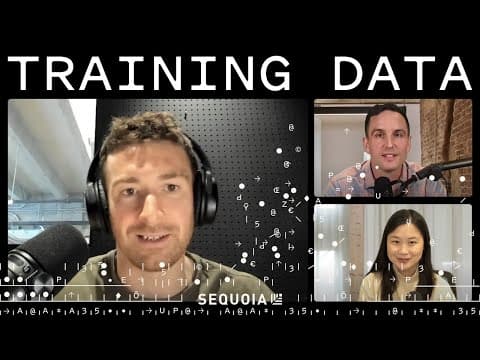
How is Crusoe building AI data centers fast?

TL;DR
Crusoe accelerates AI infrastructure by taking a vertically integrated approach that brings manufacturing in-house and cuts traditional lead times. They target cheap, clean energy in Abilene, Texas and pursue domestic and sovereign AI data strategies to scale 2 gigawatts under construction with 20 gigawatts in the pipeline, while rethinking traditional data center limits.
Transcript
very happy to welcome Chase Lockach Miller and my partner David Khan. And Chase is somebody um who I've gotten to meet a couple times over the years. And the two things that have stuck out to me and and why I'm excited to have him here. One, guy's brilliant. Good starting point. two, he has a really interesting and different point of view on this m... Read More
Key Insights
- Crusoe uses a vertically integrated, US-based manufacturing approach to expedite infrastructure deployment.
- Abilene, Texas is chosen for its energy landscape, including low-cost, clean energy from wind with curtailment opportunities.
- Switch gear lead times were 100 weeks before Crusoe stood up a factory that now delivers in 22 weeks.
- Crusoe can complete initial project phases in about 300 days and second phases in just over 200 days, dramatically shortening timelines.
- The company positions data centers as an industrial process requiring massive energy and specialized supply chains.
- Big tech benefits from Crusoe because they can move faster than traditional internal data center programs, which often have many approval layers.
- Crusoe compares the AI data center to a different vehicle than a traditional data center, highlighting different requirements and scale.
- Sovereign and domestic AI strategies are driving demand for localized, data-residency infrastructure and regional energy considerations.
- More videos from this channel:
- More from this channel: Sequoia Capital
Install to Summarize YouTube Videos and Get Transcripts
Explore YouTube Video Summarizer or Get YouTube Transcript Extractor
Questions & Answers
Q: How does Crusoe speed up data center construction compared to traditional models?
Crusoe accelerates construction by adopting a vertically integrated, domestic manufacturing approach and by standing up manufacturing in the US to reduce reliance on extended supply chains. This enables faster procurement and assembly, cutting switch gear lead times from 100 weeks to 22 weeks and delivering projects in hundreds of days rather than years.
Q: Why is Abilene, Texas chosen for Crusoe’s AI infrastructure?
Abilene is targeted because of an abundance of low-cost, clean energy, particularly wind with curtailment where energy can be abundant yet underused. Crusoe’s energy-first strategy leverages this landscape to power large AI infrastructure, aligning infrastructure growth with regions where renewable energy is overbuilt and inexpensive.
Q: What is the scale of Crusoe’s current and planned AI infrastructure?
Crusoe is currently working on about 2 gigawatts of capacity under construction with roughly 20 gigawatts in the pipeline. This reflects a shift toward massive, regional deployments designed to support large AI workloads and unprecedented GPU cluster scales.
Q: How does Crusoe view the data center as an industrial process?
Crusoe views AI data centers as an industrial process with heavy energy needs and complex supply chains. This perspective motivates a vertically integrated model and in-house manufacturing to accelerate timelines, optimize energy use, and streamline execution across large-scale GPU deployments.
Q: What advantage do big tech and AI labs gain by partnering with Crusoe?
Big tech and AI labs gain faster time-to-market for purpose-built infrastructure. Crusoe can deliver programs in about 300 days for initial phases and just over 200 days for subsequent phases, a dramatic improvement over traditional multi-year, multi-layer approval cycles that slow large-scale deployments.
Q: What role does energy play in Crusoe’s strategy?
Energy is central to Crusoe’s strategy. They locate projects where abundant, low-cost energy is available and emphasize an energy-first approach. This allows large AI workloads to be powered efficiently while leveraging renewable energy sources, particularly wind, to support the economics and sustainability of the data centers.
Q: How does Crusoe address sovereign and domestic AI data strategies?
Crusoe speaks to sovereign and domestic AI data strategies by enabling localization of data and infrastructure. This involves building data centers within regions where data cannot leave borders and supporting governance requirements, which drives demand for localized AI infrastructure and energy-optimized deployments.
Q: What is the relationship between hardware scale and energy constraints in Crusoe’s design?
Crusoe designs around the energy constraints of large GPU clusters by pursuing energy efficiency, regional energy access, and rapid deployment. The scale of hardware requires careful energy planning, which in turn motivates the company to locate projects near abundant energy sources and to accelerate logistics and manufacturing timelines.
Summary & Key Takeaways
-
Crusoe treats the AI data center as an industrial process and pursues vertical integration, speeding up assembly and deployment of large GPU clusters.
-
The company leverages abundant wind energy and curtailment in West Texas to power its facilities, framing energy as a primary constraint and opportunity.
-
Executive perspectives emphasize rapid decision making and reductions in traditional procurement timelines to deliver projects in hundreds of days rather than years.
Read in Other Languages (beta)
Share This Summary 📚
Summarize YouTube Videos and Get Video Transcripts with 1-Click
Try YouTube Summary with ChatGPT & Claude or YouTube Transcript Generator
Explore More Summaries from Sequoia Capital 📚





Summarize YouTube Videos and Get Video Transcripts with 1-Click
Try YouTube Summary with ChatGPT & Claude or YouTube Transcript Generator