How Close Is Artificial General Intelligence?
TL;DR
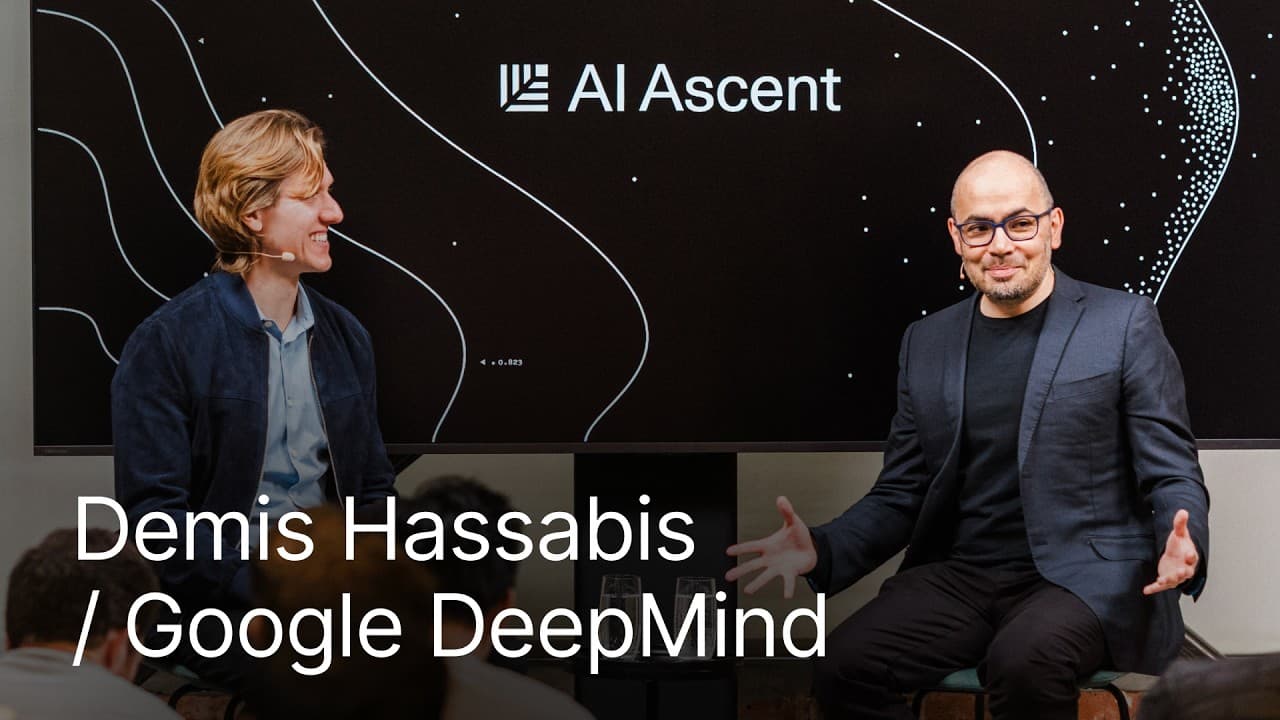
Artificial general intelligence could be achievable by 2030, matching the 20-year mission DeepMind envisioned around 2010. Demis Hassabis argues that progress came from combining deep learning, reinforcement learning, accelerated computing, and neuroscience, while games provided an early proving ground before these methods were applied to scientific challenges such as protein structure prediction and drug discovery.
Transcript
Dennis, thank you so much. >> Exciting to be here. Thanks everyone for coming. It's great to be here. >> We're so honored to have you at our chocolate factory. >> Yes, I just heard about that. Yeah, looking forward to the chocolate afterwards. >> Excellent. Well, Dennis, we're going to jump right in. We have one of the OGs in every way. Uh original... Read More
Key Insights
- Hassabis's varied career was organized around a long-term goal of building artificial general intelligence. He chose work in games, neuroscience, and entrepreneurship because each field could contribute technology, algorithms, scientific inspiration, or organizational experience needed to create a company like DeepMind.
- Games were an early proving ground for practical artificial intelligence. Theme Park simulated thousands of visitors who selected rides and made purchasing decisions, giving players an interactive experience built around an underlying economic AI model and reinforcing Hassabis's interest in pursuing AI professionally.
- The central startup lesson from Elixir Studios was to be approximately five years ahead of the market, not 50 years ahead. Republic attempted to simulate living cities and around a million people on a late-1990s home PC, making its vision difficult to execute successfully.
- DeepMind's founding thesis combined several developments that were largely separated at the time. Its team saw potential in joining deep learning with reinforcement learning, using GPUs for accelerated computing, and drawing algorithmic principles from computational neuroscience to pursue general intelligence.
- Skepticism from traditional AI researchers strengthened Hassabis's conviction that DeepMind was exploring a meaningfully different approach. Even if its research failed, he believed it would fail differently from the expert systems, logic systems, and language systems associated with earlier attempts at strong AI.
- DeepMind's original mission had two steps: solve intelligence by building AGI, then use that capability to address other problems. Hassabis viewed AI as both an important technology and a scientific instrument for investigating intelligence, consciousness, dreaming, creativity, and the nature of the mind.
- AI for science became a formal DeepMind effort after the AlphaGo match in Seoul. Hassabis regarded success at Go as evidence that the algorithms had become powerful and general enough to tackle important real-world scientific problems, eventually contributing to work such as AlphaFold.
- AGI could be achievable by 2030 according to Hassabis's stated outlook. DeepMind originally treated the effort as a 20-year mission beginning around 2010, and he believes the wider field remains broadly on track with that anticipated timeline.
- More videos from this channel:
- More from this channel: Sequoia Capital
Install to Summarize YouTube Videos and Get Transcripts
Explore YouTube Video Summarizer or Get YouTube Transcript Extractor
Questions & Answers
Q: How close are researchers to achieving AGI?
Demis Hassabis believes artificial general intelligence could be achievable by 2030. He says DeepMind viewed AGI as a roughly 20-year mission when it began around 2010 and considers the field broadly on track with that expectation. The title characterizes progress as approximately three quarters complete, while the description identifies the next year or two as a critical period for humanity.
Q: Why did Demis Hassabis move from games into AI research?
Hassabis says he decided during his teenage years that artificial intelligence was the most important and interesting field he could pursue. He then selected experiences that might eventually help him build a company like DeepMind. Game development offered exposure to advanced graphics, early GPUs, simulation, economic modeling, creativity, and AI systems that people could directly interact with and enjoy.
Q: How did game development prepare Demis Hassabis for DeepMind?
Game development provided Hassabis with a practical setting for combining AI, simulation, graphics, and creative design. Theme Park used an economic AI model to control thousands of visitors who chose rides and purchases. His later studio also pursued ambitious simulations. DeepMind subsequently used games as early proving grounds where learning algorithms could be developed and evaluated before addressing scientific problems.
Q: What startup lesson did Hassabis learn from Elixir Studios?
Hassabis learned that a startup should aim to be about five years ahead of its time rather than 50 years ahead. Elixir Studios pursued Republic, a game intended to simulate living cities and around a million people on a late-1990s home PC. The project showed that being too ambitious relative to available hardware and engineering capabilities can create serious execution problems.
Q: What ideas supported DeepMind's original AGI strategy?
DeepMind's early strategy rested on combining deep learning and reinforcement learning, two areas that were largely separated outside toy problems at the time. The founders also anticipated that GPUs and accelerated computing would become valuable, and they drew possible algorithmic principles from computational neuroscience. Together, these ingredients suggested a different route from the traditional expert and logic systems of earlier AI research.
Q: Why did skepticism about AGI encourage Hassabis?
Many academic researchers reportedly dismissed the possibility of major progress toward AGI because earlier approaches had failed. Hassabis interpreted that skepticism as evidence that DeepMind was pursuing a genuinely different path. He reasoned that even if the new approach failed, it would fail in an original way rather than simply repeat the limitations of expert systems, logic systems, and earlier language systems.
Q: What was DeepMind's original mission?
DeepMind's original mission consisted of two stages: first solve intelligence by building AGI, then use that intelligence to solve other problems. Hassabis considered AI important not only as a practical technology but also as a scientific tool. He believed constructed intelligence could help researchers compare systems and investigate questions involving consciousness, creativity, dreaming, the mind, science, and medicine.
Q: Why did DeepMind expand into AI for science after AlphaGo?
Hassabis viewed the AlphaGo match in Seoul as evidence that DeepMind's algorithms had become powerful and general enough for important real-world applications. The organization formally started its AI-for-science efforts shortly afterward. This work reflects his goal of building advanced AI first and then using it to pursue scientific and medical breakthroughs, including AlphaFold and potentially much faster drug discovery.
Summary & Key Takeaways
-
Hassabis traces his career from chess and game development through neuroscience to DeepMind, presenting these pursuits as parts of a long-term plan to build artificial general intelligence. Games exposed him to advanced graphics, early GPUs, simulation, economic modeling, and AI-driven interaction while providing a practical environment for testing ambitious computational ideas.
-
Elixir Studios taught Hassabis that innovators should aim to be approximately five years ahead rather than 50 years ahead. Its ambitious Republic project attempted to simulate living cities and roughly a million people on late-1990s home-computer hardware, demonstrating how technical vision can exceed the capabilities needed to produce a successful product.
-
DeepMind was founded around the belief that deep learning, reinforcement learning, accelerated computing, and ideas from neuroscience could combine to produce general intelligence. After AlphaGo demonstrated sufficiently powerful and general algorithms, DeepMind formalized its AI-for-science work, pursuing breakthroughs such as AlphaFold and potential improvements in medicine and drug discovery.
Read in Other Languages (beta)
Share This Summary 📚
Summarize YouTube Videos and Get Video Transcripts with 1-Click
Try YouTube Summary with ChatGPT & Claude or YouTube Transcript Generator
Explore More Summaries from Sequoia Capital 📚

Summarize YouTube Videos and Get Video Transcripts with 1-Click
Try YouTube Summary with ChatGPT & Claude or YouTube Transcript Generator