How Long-Horizon AI Agents Are Reshaping Work
TL;DR
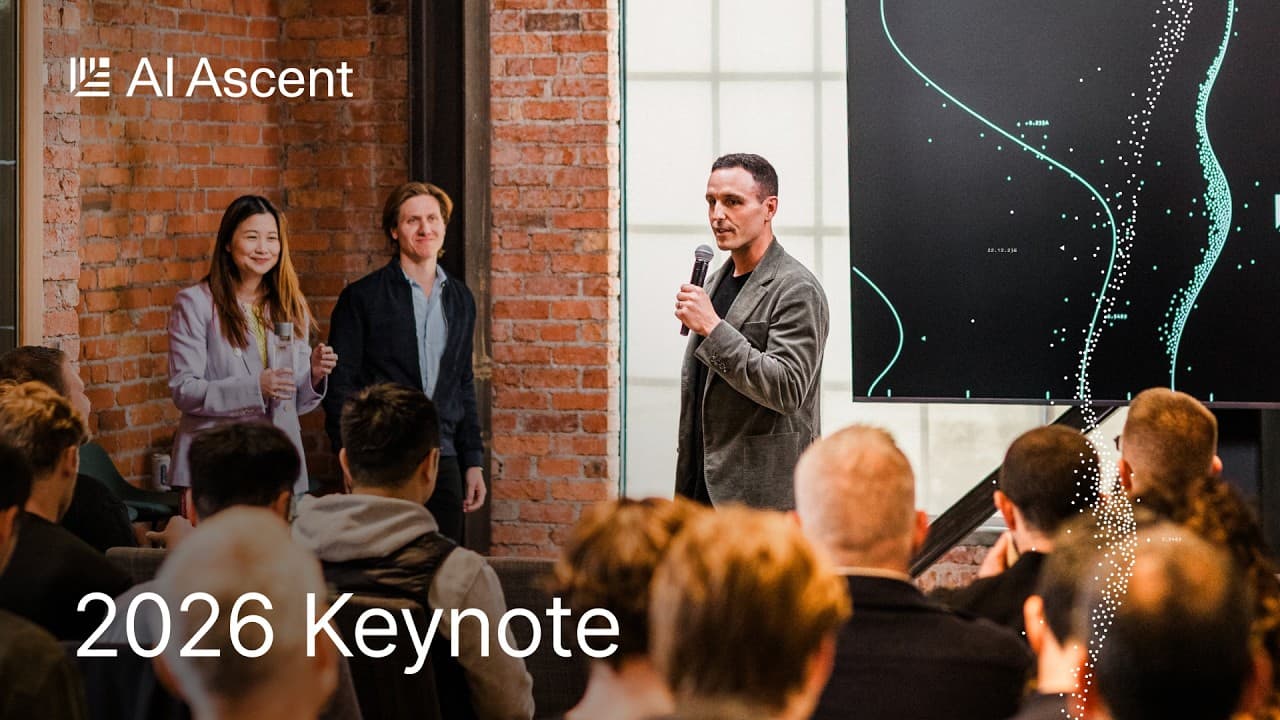
Long-horizon agents can perform jobs, recover from failures, and persist until the work is complete, creating what Sequoia describes as practical or commercial AGI. Builders should focus on customer-centered moats, intuitive affordances, and the diffusion gap between rapidly advancing foundation models and enterprises that adopt those capabilities more slowly.
Transcript
Good morning. How's everybody doing? >> All right. All right. A little bit better. Hey, thank you all for being here. We really appreciate it. We do this as a service to the community because we are living through important times and it's an honor for us to be able to serve as a bit of a gathering place for people to come together. And this is by f... Read More
Key Insights
- AI is a revolution in computation because it changes how information is processed, while the internet, cloud, and mobile primarily transformed how information is distributed. This difference makes the underlying technology foundation move continuously as new model capabilities emerge.
- The AI opportunity includes both software and services, expanding beyond the historical software market. Sequoia uses $10 trillion as a convenient estimate for services revenue, while acknowledging that the true figure could be $5 trillion, $10 trillion, or $50 trillion.
- Long-horizon agents represent a discontinuous shift because they can be assigned a job, recover from failure, and persist until completion. From a functional, practical, and commercial perspective, Sequoia argues that these characteristics feel like AGI even without proposing a technical definition.
- AI applications are moving from faster horses to cars, meaning productivity improvements can rise from roughly 10 or 40 percent to 10 or 40 times. Such applications can fundamentally alter workflows, the nature of work, and the structure of organizations.
- Customer-centered moats are more durable than features tied to rapidly changing model capabilities. Products and technology remain extremely important, but closely integrating with customer needs, workflows, and outcomes can provide protection when technical foundations and available capabilities change every day.
- Affordance is the quality that makes an object or product's intended use immediately understandable. Application builders can create value by turning powerful but inaccessible tools into simple paths of least resistance that help specific customers achieve specific business outcomes.
- The diffusion gap is the difference between how quickly foundation models gain capabilities and how slowly those capabilities spread into the market. Every day models advance faster than the average Fortune 500 enterprise, the opportunity for application-layer companies becomes larger.
- No competitive lead is safe during a rapid flow of new foundation-model capabilities. The instability that threatens current leaders also allows newer companies to overtake them, particularly when they use emerging capabilities to serve customers more effectively or simplify access to valuable outcomes.
- More videos from this channel:
- More from this channel: Sequoia Capital
Install to Summarize YouTube Videos and Get Transcripts
Explore YouTube Video Summarizer or Get YouTube Transcript Extractor
Questions & Answers
Q: What makes long-horizon AI agents commercially significant?
Long-horizon agents are commercially significant because they can be dispatched to perform a job, recover when something fails, and continue until the job is complete. Sequoia views this persistence as a practical, functional, or commercial form of AGI. It enables applications that can change entire workflows and organizations rather than merely improving an existing task by 10 or 40 percent.
Q: How is AI different from the internet, cloud, and mobile?
AI differs because it is described as a revolution in computation, meaning it transforms how information is processed. The internet, cloud, and mobile are characterized as revolutions in communication that changed how information is distributed. With AI, the technical foundation beneath applications keeps moving as new capabilities appear, forcing builders to adapt to a faster and less stable environment.
Q: What were the three major inflection points in recent AI development?
The first inflection point was the ChatGPT moment in November 2022, when the public saw the power of pre-training. The second came with reasoning models, which revealed another scaling law based on inference-time compute. The third was the arrival of long-horizon agents that can persist through complex work and recover from failure, creating a discontinuous shift from earlier systems.
Q: Why does Sequoia compare new AI applications to cars?
The comparison distinguishes incremental tools from systems that fundamentally change work. Earlier applications resembled faster horses because they could make users 10 or 40 percent more productive without changing the basic workflow. New agentic applications resemble cars because they may deliver 10 or 40 times greater productivity while changing how work is performed and how organizations are structured.
Q: What does the MAD framework mean for AI application builders?
MAD stands for moats, affordance, and diffusion. Moats come from approaching the business customer-first and wrapping the company closely around customer needs. Affordance means creating an obvious, low-resistance path to a desired outcome. Diffusion refers to the gap between rapidly advancing model capabilities and the slower rate at which enterprises adopt them, which creates application-layer opportunities.
Q: How can AI startups build durable competitive moats?
AI startups can build more durable moats by working backward from customers rather than relying only on newly released technical capabilities. Model features may change quickly or become irrelevant, while customer needs and organizational workflows change more slowly. Product quality remains extremely important, but deep alignment with customers can create lasting value as the underlying technical foundation continues to evolve.
Q: What is affordance in an AI product?
Affordance is a design quality that makes an object's use immediately apparent without requiring extensive explanation. A powerful terminal-based AI tool may offer limited affordance to an average Fortune 500 employee. Application companies can address this by creating simple, intuitive paths that connect advanced model capabilities to the specific outcomes their customers need for their businesses.
Q: Why does the diffusion gap create an opportunity for startups?
The diffusion gap exists because foundation-model capabilities are being created much faster than they are spreading through the market. Many enterprises, including the average Fortune 500 company, cannot adopt every new capability immediately. Application-layer startups can bridge that gap by packaging those capabilities into accessible products, aligning them with customer workflows, and reducing resistance between the technology and a useful outcome.
Summary & Key Takeaways
-
AI represents a revolution in computation because it changes how information is processed, unlike the internet, cloud, and mobile waves, which primarily changed information distribution. The current opportunity spans software and services, with the addressable services market estimated broadly around $10 trillion, though its exact size remains uncertain.
-
Three inflection points shaped the current AI era: pre-training became widely visible with ChatGPT in November 2022, reasoning demonstrated a second scaling law around inference-time compute, and long-horizon agents showed that systems can recover from failures and persist. Sequoia characterizes that last capability as functional, practical, or commercial AGI.
-
Application companies are advised to follow the MAD framework: moats, affordance, and diffusion. Durable moats come from wrapping closely around customers, affordance makes powerful capabilities easy to use for specific business outcomes, and the diffusion gap creates opportunity because foundation-model capabilities advance faster than typical Fortune 500 enterprises adopt them.
Read in Other Languages (beta)
Share This Summary 📚
Summarize YouTube Videos and Get Video Transcripts with 1-Click
Try YouTube Summary with ChatGPT & Claude or YouTube Transcript Generator
Explore More Summaries from Sequoia Capital 📚
Summarize YouTube Videos and Get Video Transcripts with 1-Click
Try YouTube Summary with ChatGPT & Claude or YouTube Transcript Generator