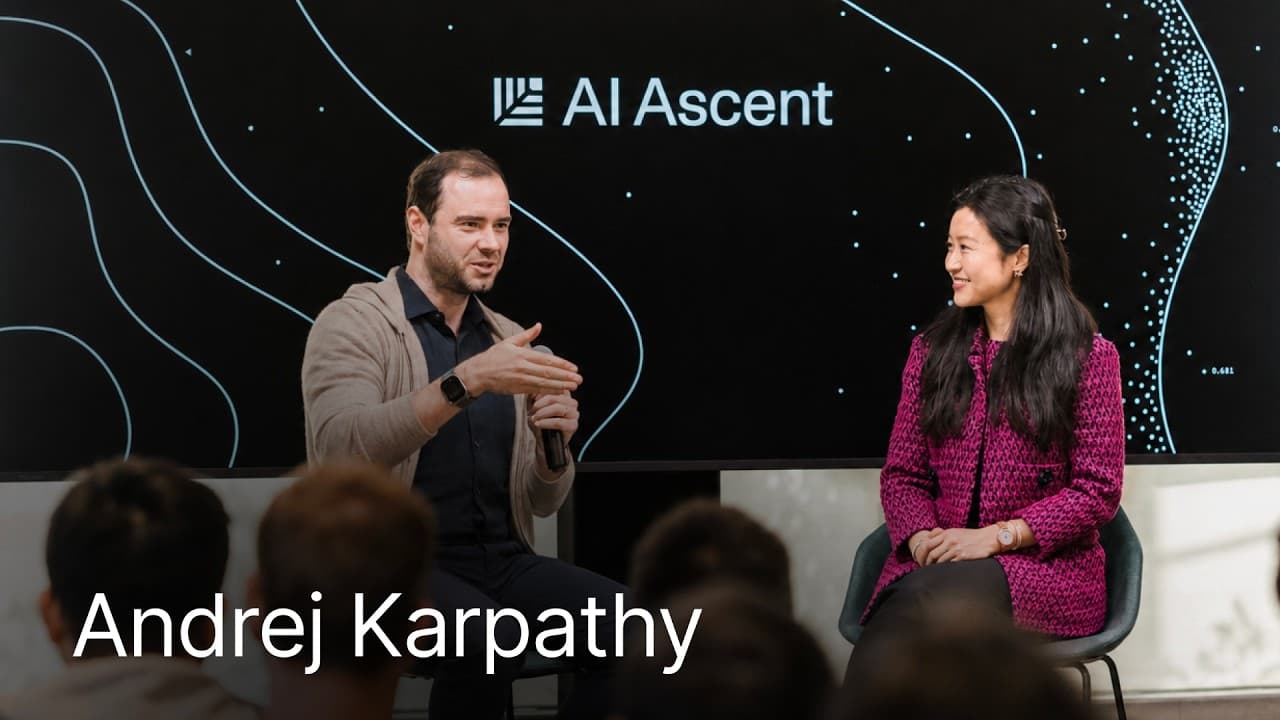
How Does Andrej Karpathy Describe the Shift From Vibe Coding to Agentic Engineering With Stephanie Zhan?
TL;DR
Agentic engineering transforms AI development by shifting programming from writing explicit code to prompting an LLM that interprets context, acts within an environment, and debugs in a loop. Andrej Karpathy calls this Software 3.0 and contrasts it with Software 1.0’s code and Software 2.0’s datasets and learned weights. Read on for his examples involving OpenClaw installations, agentic coding tools, and MenuGen.
Transcript
We're so excited for our very first special guest. He has helped build modern AI, then explain modern AI, and then occasionally rename modern AI. He actually helped co-ound open AAI right inside of this office. Was the one who actually got Autopilot working at Tesla back in the day, and he has a rare gift of making the most complex technical shifts... Read More
Key Insights
- Agentic engineering is a new discipline that focuses on maintaining quality while using AI agents to enhance software development.
- Vibe coding increases the accessibility of software development, but agentic engineering ensures the quality of professional software.
- Software 3.0 involves programming through prompts, allowing AI models to interpret and execute tasks based on context.
- AI agents can automate complex installations by interpreting generic instructions and adapting them to specific environments.
- The shift to agentic engineering requires a reframing of traditional programming paradigms, moving from explicit coding to leveraging AI capabilities.
- Verifiability in AI models is crucial for automating tasks, as models excel in domains where outputs can be easily verified.
- AI models are jagged entities, excelling in specific tasks based on their training data, but lacking the intrinsic motivations found in biological intelligences.
- Understanding remains a human domain, as AI can outsource thinking but not the deeper comprehension required to direct AI effectively.
Install to Summarize YouTube Videos and Get Transcripts
Explore YouTube Video Summarizer or Get YouTube Transcript Extractor
Questions & Answers
Q: How does agentic engineering transform AI development?
It shifts more implementation work from manually writing explicit code to directing AI agents with prompts and contextual instructions. The agents can inspect an environment, take intelligent actions, and debug problems in a loop, while human understanding, judgment, and quality control remain important.
Q: What does Andrej Karpathy mean by vibe coding?
Karpathy describes vibe coding as repeatedly asking an agentic tool to produce increasingly large chunks of code and trusting the results when they consistently work. He says his transition became stark in December, when he could no longer remember the last time he had corrected the generated code.
Q: Why did Andrej Karpathy say he had never felt more behind as a programmer?
He had seen the latest models become much more capable at sustained, coherent agentic workflows. The change felt both exhilarating and unsettling, and it led him into many side projects and frequent vibe coding.
Q: What is Software 3.0 according to Andrej Karpathy?
Software 3.0 is programming through prompts and context rather than only through explicit code or trained weights. The LLM acts as an interpreter that reads the context window and performs computation in the digital information space.
Q: How do Software 1.0, Software 2.0, and Software 3.0 differ?
In Software 1.0, the programmer writes explicit code. Software 2.0 involves arranging datasets, objectives, and neural-network architectures to train learned weights, while Software 3.0 uses prompts and contextual information to program an LLM.
Q: How can an AI agent simplify an OpenClaw installation?
Instead of relying on a large shell script that accounts for many platforms and computers, OpenClaw can provide a block of text for the user to copy and give to an agent. The agent follows those instructions, examines the specific computer environment, performs the required actions, and debugs problems in the loop.
Q: Why does Karpathy consider prompt-based installation more powerful than a shell script?
A shell script must precisely encode individual setup details and can become extremely complex across different platforms. An agent can combine general instructions with its own capabilities, adapt to the local environment, and work through installation problems dynamically.
Q: What is MenuGen, and why did Karpathy build it?
MenuGen is an app Karpathy vibe coded after noticing that restaurant menus often lack pictures and contain dishes he does not recognize. His idea was to photograph a menu and receive generic pictures showing what its items might look like.
Summary & Key Takeaways
-
Andrej Karpathy outlines the transition from vibe coding to agentic engineering, highlighting the need for quality control in AI-enhanced software development. He describes Software 3.0 as a paradigm shift where programming involves prompting AI models to perform tasks based on contextual understanding. This new approach requires developers to rethink traditional coding practices and embrace AI's potential to automate complex processes.
-
Karpathy emphasizes the role of verifiability in AI development, noting that models excel in areas where outcomes can be verified. He introduces the concept of jagged intelligence, where AI models display high competence in specific tasks due to their training data. Despite AI's capabilities, Karpathy stresses the importance of human understanding in directing AI effectively.
-
The discussion explores the future of AI-driven development, where agents handle more tasks autonomously. Karpathy envisions a world where AI agents facilitate complex installations and automate workflows, reducing the need for human intervention. However, he underscores the continued necessity for human oversight and judgment in guiding AI systems.
Read in Other Languages (beta)
Share This Summary 📚
Summarize YouTube Videos and Get Video Transcripts with 1-Click
Try YouTube Summary with ChatGPT & Claude or YouTube Transcript Generator
Explore More Summaries from Sequoia Capital 📚
Summarize YouTube Videos and Get Video Transcripts with 1-Click
Try YouTube Summary with ChatGPT & Claude or YouTube Transcript Generator