How Will Photonics Transform AI Data Centers?
TL;DR
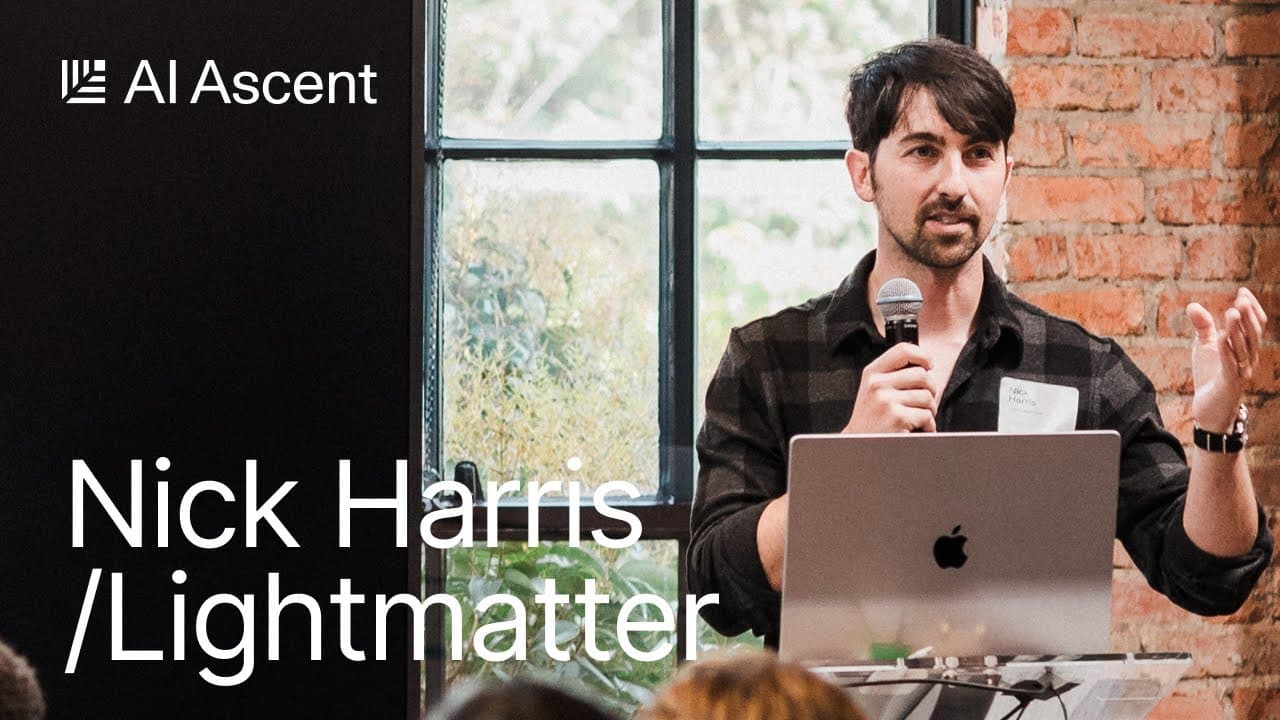
Photonics will significantly change AI data centers by enabling massive scalability and reducing energy consumption, driving the next generation of AI models. Lightmatter's innovative approach includes using optical interconnects to enhance efficiency, aiming for supercomputers with up to a million nodes, crucial for achieving artificial general intelligence.
Transcript
it's my privilege to introduce the first Speaker Nick Harris um who CEO of light matter we all know that a lot of AI progress has been driven by scaling laws and training very large Foundation models um Nick and his company light matter is a key player in that and he's building very very large data centers hundreds of thousands of gpus maybe millio... Read More
Key Insights
- Nick Harris, CEO of Lightmatter, discusses the future of data centers powered by photonics, emphasizing the need for scaling in AI models.
- The cost of deploying supercomputers for AI training is exorbitant, with estimates reaching billions of dollars for large-scale systems.
- Current scaling methods for AI models are reaching their limits, necessitating new technologies to achieve further advancements.
- Lightmatter's approach involves using light to move data between chips, allowing for larger and more efficient computing systems.
- The traditional data center setup with separate networking and computing racks is inefficient and limits performance scaling.
- Lightmatter proposes eliminating networking racks and implementing all-to-all interconnects to enhance data center efficiency.
- Their product, Passage, integrates optical interconnects with chips from major companies, reducing energy consumption and enabling massive scaling.
- The goal is to achieve AGI by building supercomputers with up to a million nodes using these advanced technologies.
Install to Summarize YouTube Videos and Get Transcripts
Explore YouTube Video Summarizer or Get YouTube Transcript Extractor
Questions & Answers
Q: What is the main focus of Nick Harris's talk?
Nick Harris focuses on the future of data centers and the role of photonics in scaling AI models. He discusses how Lightmatter's technology can overcome current limitations in scaling AI systems by using light to move data between chips, enabling larger and more efficient computing setups.
Q: Why is scaling AI models becoming increasingly expensive?
Scaling AI models is becoming expensive due to the high costs of deploying supercomputers. Large-scale systems require significant capital expenditure, with costs potentially reaching billions of dollars. The increasing demand for compute power to train advanced AI models adds to the financial burden on companies investing in this technology.
Q: What limitations are current AI data centers facing?
Current AI data centers face limitations in scaling due to inefficient setups that separate networking and computing racks. This setup results in weak interconnectivity and challenges in achieving optimal performance scaling. As AI models grow in complexity, these limitations hinder the ability to effectively train and deploy advanced systems.
Q: How does Lightmatter propose to overcome these limitations?
Lightmatter proposes overcoming these limitations by using photonics to move data between chips, eliminating the need for separate networking racks. Their product, Passage, provides an all-to-all interconnect, enhancing data center efficiency and enabling massive scaling. This approach reduces energy consumption and supports the development of supercomputers with up to a million nodes.
Q: What is the significance of Lightmatter's product, Passage?
Passage is significant because it integrates optical interconnects with chips from leading companies, reducing energy consumption and enabling massive scaling in AI data centers. By using light to move data, Passage allows for more efficient and larger computing setups, paving the way for advancements towards achieving AGI and supporting next-generation AI models.
Q: How does Lightmatter's technology impact energy consumption in data centers?
Lightmatter's technology impacts energy consumption by using optical interconnects to move data between chips, significantly reducing the energy required for data transfer. This reduction in energy consumption is crucial for scaling AI models efficiently and sustainably, allowing data centers to handle larger workloads without proportionally increasing their energy footprint.
Q: What are the potential benefits of achieving AGI with Lightmatter's technology?
Achieving AGI with Lightmatter's technology offers potential benefits such as unprecedented advancements in AI capabilities, enabling machines to perform complex tasks with human-like intelligence. This could revolutionize various industries, leading to innovations in healthcare, finance, and more. Additionally, the efficient scaling provided by Lightmatter's technology could make AGI development more accessible and cost-effective.
Q: What role do partnerships play in Lightmatter's strategy?
Partnerships play a crucial role in Lightmatter's strategy by allowing them to integrate their optical interconnect technology with chips from major companies like AMD, Intel, Nvidia, and Qualcomm. These collaborations enable Lightmatter to leverage existing expertise and infrastructure, facilitating the development and deployment of their innovative solutions in AI data centers, thereby accelerating the transition to photonics-powered computing.
Summary & Key Takeaways
-
Nick Harris from Lightmatter discusses the future of AI data centers at Sequoia Capital's AI Ascent. He highlights the need for new technologies, such as photonics, to enable further scaling of AI models and achieve AGI.
-
The cost of deploying AI supercomputers is high, with billions of dollars needed for large-scale systems. Current scaling methods are reaching their limits, prompting the need for innovative solutions like Lightmatter's optical interconnects.
-
Lightmatter's product, Passage, uses light to move data between chips, reducing energy consumption and enabling massive scaling. This technology aims to replace traditional data center setups and achieve unprecedented levels of computing power.
Read in Other Languages (beta)
Share This Summary 📚
Summarize YouTube Videos and Get Video Transcripts with 1-Click
Try YouTube Summary with ChatGPT & Claude or YouTube Transcript Generator
Explore More Summaries from Sequoia Capital 📚


Summarize YouTube Videos and Get Video Transcripts with 1-Click
Try YouTube Summary with ChatGPT & Claude or YouTube Transcript Generator