How Do Cells Transport Materials Across Membranes?
TL;DR
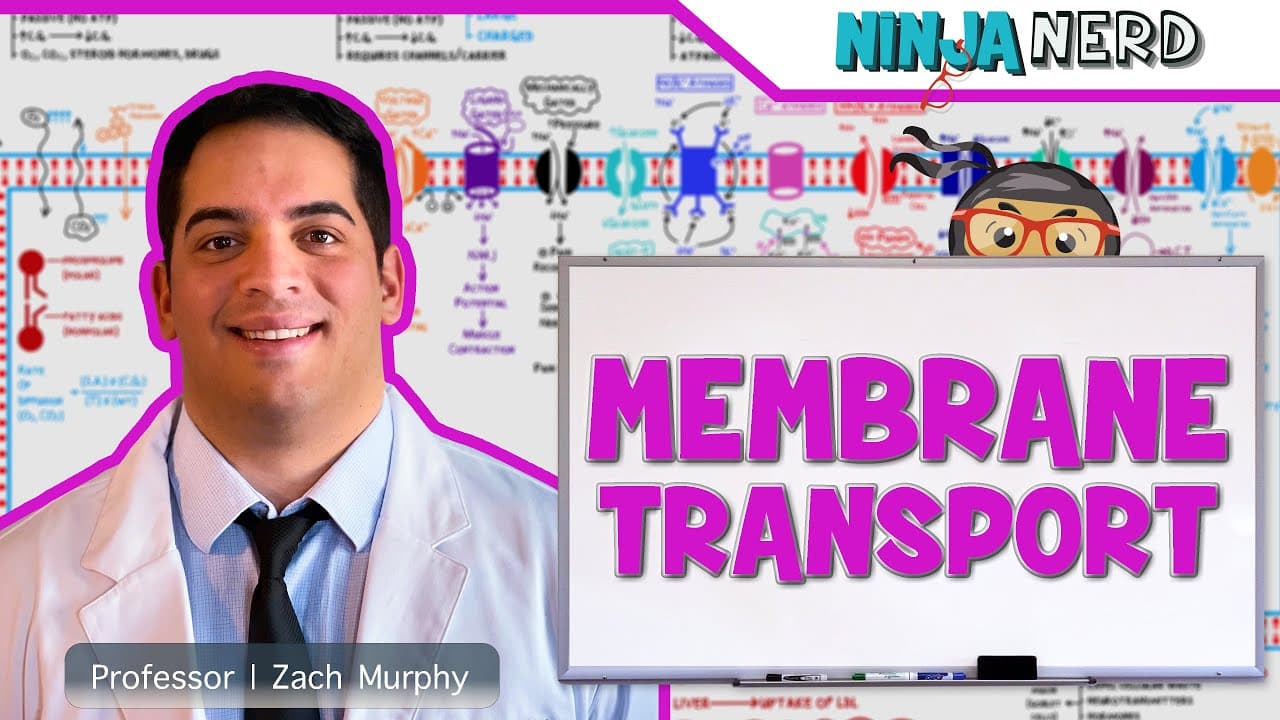
Cells transport substances passively when materials move down concentration gradients without ATP, while active transport uses energy to move molecules against their gradients. Small nonpolar or lipid-soluble molecules can cross the phospholipid bilayer directly, whereas other substances rely on transport proteins or vesicles through facilitated diffusion, osmosis, endocytosis, and exocytosis.
Transcript
what's up ninja nerds in this video today we're going to be talking about membrane transport before we get started though please make sure you hit that like button comment down in the comment section and please subscribe also down in the description box with links to our facebook instagram patreon account go check those out all right ninjas let's g... Read More
Key Insights
- Simple diffusion is a passive membrane transport process that requires no ATP and moves molecules from areas of high concentration to areas of low concentration without using specialized transport proteins.
- Oxygen and carbon dioxide are respiratory gases that cross the cell membrane by simple diffusion. Oxygen moves from blood into tissues, while carbon dioxide produced by aerobic cellular respiration leaves cells, enters the blood, and is transported toward the lungs for exhalation.
- Steroid hormones are cholesterol-derived, lipid-soluble molecules that can cross cell membranes without transport proteins. Examples identified in the lecture include testosterone, estrogen, progesterone, aldosterone, cortisol, and vitamin D.
- The phospholipid bilayer is composed of polar phospholipid heads and nonpolar fatty acid tails. Charged molecules are hindered by the membrane, while nonpolar substances can dissolve through its lipid environment according to the principle that like dissolves like.
- The rate of simple diffusion increases as membrane surface area increases. A larger available surface gives oxygen, carbon dioxide, and other diffusible molecules more space through which movement across the cell membrane can occur.
- A larger concentration gradient increases the rate of diffusion because the difference between high and low concentrations is greater. More oxygen or carbon dioxide therefore moves in its corresponding direction when its concentration difference across the membrane is larger.
- Greater membrane thickness decreases the rate of diffusion because molecules must travel a longer distance. Greater molecular weight also decreases diffusion rate, so heavier molecules cross the membrane more slowly than lighter molecules under the described conditions.
- Facilitated diffusion is usually a passive process that does not directly require ATP. Like simple diffusion, it moves substances from high concentration to low concentration, but it uses membrane transport proteins instead of allowing molecules to pass directly through the bilayer.
Install to Summarize YouTube Videos and Get Transcripts
Explore YouTube Video Summarizer or Get YouTube Transcript Extractor
Questions & Answers
Q: What is simple diffusion across a cell membrane?
Simple diffusion is a passive transport mechanism in which molecules move across the cell membrane from an area of high concentration to an area of low concentration. It does not use ATP or require a specialized transport protein. Molecules described as using this route include oxygen, carbon dioxide, steroid hormones, and lipid-soluble drugs.
Q: Which molecules can cross membranes by simple diffusion?
Oxygen, carbon dioxide, steroid hormones, and lipid-soluble drugs can move through the cell membrane by simple diffusion. These substances do not need specialized carrier proteins because they are nonpolar, lipid-soluble, or uncharged. Steroid hormone examples given include testosterone, estrogen, progesterone, aldosterone, cortisol, and vitamin D.
Q: Why can lipid-soluble molecules cross the cell membrane?
Lipid-soluble molecules can cross because the phospholipid bilayer contains nonpolar fatty acid tails. Nonpolar substances dissolve within this nonpolar membrane environment, following the stated principle that like dissolves like. The molecules are also not charged, so they can pass through the bilayer without relying on a specialized membrane transport protein.
Q: What factors increase the rate of simple diffusion?
Increasing membrane surface area and increasing the concentration gradient both raise the rate of simple diffusion. A larger surface provides more area for molecules to cross. A larger concentration difference creates stronger movement from the high-concentration region toward the low-concentration region, increasing transport in the molecule's corresponding direction.
Q: What factors decrease the rate of simple diffusion?
Increasing membrane thickness and increasing molecular weight decrease the rate of simple diffusion. A thicker membrane creates a longer distance for molecules such as oxygen and carbon dioxide to travel. A heavier molecule also diffuses more slowly than a lighter substance, making molecular weight another limiting factor for movement across the membrane.
Q: How is facilitated diffusion different from simple diffusion?
Facilitated diffusion and simple diffusion are both passive processes that generally move substances from high concentration to low concentration without directly using ATP. The principal difference is the route across the membrane. Simple diffusion occurs directly through the phospholipid bilayer, while facilitated diffusion depends on specialized membrane transport proteins.
Q: How does active transport differ from passive transport?
Passive transport does not require cellular energy and relies on concentration gradients and membrane permeability. Active transport uses ATP to move molecules against their gradients. The mechanisms identified include primary and secondary active transport, with the sodium-potassium ATPase and sodium-glucose cotransporters presented as transporter examples in the lecture description.
Q: What are endocytosis and exocytosis?
Endocytosis and exocytosis are vesicular transport mechanisms used for moving large materials across the plasma membrane. Endocytosis brings materials into cells and includes phagocytosis, pinocytosis, and receptor-mediated endocytosis. Exocytosis expels materials from cells through vesicle fusion events involving vesicles and the plasma membrane.
Summary & Key Takeaways
-
Passive transport moves substances down their concentration gradients without directly using ATP. Simple diffusion carries oxygen, carbon dioxide, steroid hormones, and lipid-soluble drugs directly through the membrane. Facilitated diffusion also moves substances from high to low concentration, but it differs by relying on specialized membrane transport proteins.
-
The phospholipid bilayer determines which molecules can cross directly. Its polar phospholipid heads hinder charged substances, while its nonpolar fatty acid tails permit nonpolar, lipid-soluble molecules to dissolve through the membrane. This explains why respiratory gases, steroid hormones, and lipid-soluble drugs can cross without carriers.
-
Active transport uses ATP to move substances against their gradients through mechanisms such as primary and secondary active transport. The lecture also covers vesicular transport: phagocytosis, pinocytosis, and receptor-mediated endocytosis bring materials into cells, while exocytosis expels materials through vesicle fusion with the plasma membrane.
Read in Other Languages (beta)
Share This Summary 📚
Summarize YouTube Videos and Get Video Transcripts with 1-Click
Try YouTube Summary with ChatGPT & Claude or YouTube Transcript Generator
Explore More Summaries from Ninja Nerd 📚






Summarize YouTube Videos and Get Video Transcripts with 1-Click
Try YouTube Summary with ChatGPT & Claude or YouTube Transcript Generator