How does insulin lower blood glucose in the body?
TL;DR
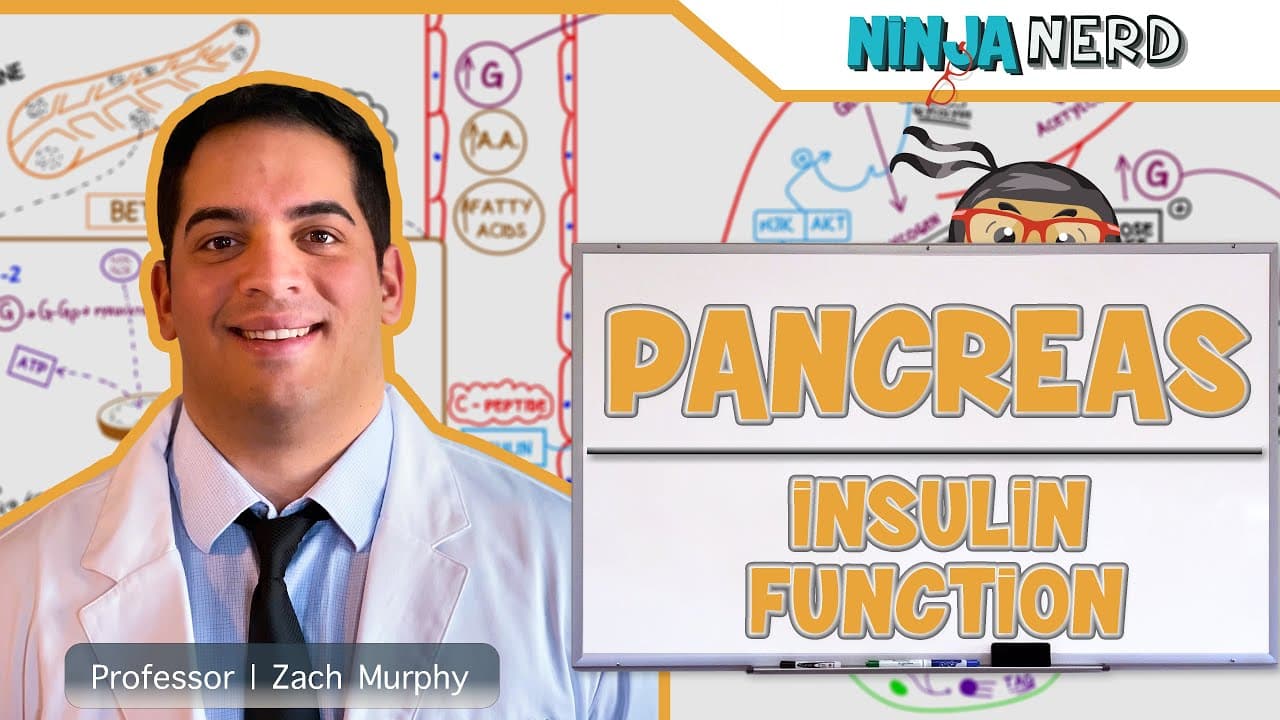
Insulin is released by pancreatic beta cells in response to high blood glucose and promotes glucose uptake in liver, muscle, and fat tissues. It triggers GLUT4 translocation and stimulates glycogen, fat, and protein synthesis while suppressing glucose production. This insulin signaling helps return blood sugar to normal after meals.
Transcript
All right, Ninja Nerds. In this video, we're going to talk about the pancreas, but specifically we're going to focus on the hormone insulin. So, let's take a look here at the pancreas. If you look at the pancreas, the pancreas is actually referred to as a heterocrine gland. Okay? So, what is it referred to as? It's referred to as a heterocrine glan... Read More
Key Insights
- The pancreas is a heterocrine gland consisting of endocrine and exocrine tissue.
- The endocrine pancreas contains alpha and beta cells that secrete glucagon and insulin respectively.
- Insulin lowers blood glucose by promoting uptake in liver, muscle, and adipose tissue and by suppressing glucose production.
- Glucose stimulates beta cells via GLUT2 transporters, triggering ATP production and insulin release.
- Insulin release involves vesicle fusion mediated by calcium signaling at the cell membrane.
- Pro insulin is processed in the rough ER and Golgi into mature insulin and C peptide.
- During insulin secretion, zinc is co-packaged with insulin in vesicles.
- The Islets of Langangerhan are a small part of the pancreas but central to insulin biology.
Install to Summarize YouTube Videos and Get Transcripts
Explore YouTube Video Summarizer or Get YouTube Transcript Extractor
Questions & Answers
Q: What cells secrete insulin in the pancreas?
Insulin is secreted by beta cells located in the Islets of Langangerhan, which are clusters within the pancreatic tissue. These beta cells respond to elevated blood glucose by transforming glucose metabolism into signaling that leads to insulin synthesis, packaging in vesicles, and eventual exocytosis to enter the bloodstream. This release lowers blood sugar and coordinates metabolic responses across tissues.
Q: What triggers insulin release after a meal?
Insulin release is triggered by hyperglycemia, meaning higher-than-normal blood glucose levels. The beta cells detect this rise through their glucose sensing machinery, including GLUT2 transporters, which allow glucose to enter the cell. The resulting metabolic changes increase ATP, close potassium channels, open calcium channels, and promote vesicle fusion with the membrane to secrete insulin.
Q: How does insulin affect liver, muscle, and fat tissues?
Insulin promotes glucose uptake and storage in liver, muscle, and adipose tissue. In the liver it stimulates glycogen synthesis and inhibits glucose production, while in muscle and fat it enhances glucose uptake and supports synthesis of glycogen, fats, and proteins. These actions help reduce circulating glucose levels and store energy after feeding.
Q: What is the role of C peptide in insulin biology?
C peptide is produced as a byproduct during insulin production from proinsulin. It is cleaved to form active insulin and additional C peptide remains in the secretory vesicles. Although not directly involved in glucose regulation, C peptide serves as an indicator of endogenous insulin production in clinical assessments and reflects beta cell activity.
Q: Why are calcium ions important for insulin secretion?
Calcium influx into the beta cell is a key trigger for insulin vesicle fusion with the cell membrane. When the membrane depolarizes in response to ATP-sensitive potassium channel closure, voltage-gated calcium channels open, allowing calcium to enter. The calcium ions then drive the docking and fusion of insulin-containing vesicles with the membrane to release insulin.
Q: What happens to insulin after it is secreted into the bloodstream?
After secretion, insulin travels through the bloodstream to target tissues such as liver, muscle, and fat. It binds to insulin receptors, triggering intracellular signaling that promotes glucose uptake via GLUT4 translocation and activates metabolic pathways for glycogen, lipid, and protein synthesis while suppressing glucose production, thereby lowering blood glucose levels.
Q: What is the relationship between GLUT2 transporters and insulin secretion?
GLUT2 transporters enable glucose entry into beta cells independent of insulin, making them critical for sensing blood glucose levels. The glucose entering via GLUT2 is metabolized to generate ATP, which modulates ion channels and initiates calcium signaling that leads to insulin-containing vesicle exocytosis. This direct glucose sensing links intake to insulin release.
Q: How do alpha and beta cells coordinate pancreatic function?
Alpha cells secrete glucagon, which raises blood glucose when it is low, while beta cells secrete insulin to lower blood glucose when it is high. Together, they regulate glucose homeostasis by opposing actions that balance energy availability and storage, ensuring stable blood sugar levels across fed and fasting states. This coordination is essential for metabolic health.
Summary & Key Takeaways
-
Insulin is produced by beta cells within the Islets of Langangerhan, while alpha cells produce glucagon. Insulin’s main role is to lower blood glucose by aiding uptake into tissues and by promoting storage pathways after a meal.
-
Beta cells respond to hyperglycemia by increasing insulin synthesis, processing, and secretion into vesicles, enabling rapid release when glucose rises.
-
The glucose sensor mechanism in beta cells relies on GLUT2 transporters which allow glucose entry independent of insulin, linking high blood glucose directly to insulin release through metabolic signals.
Read in Other Languages (beta)
Share This Summary 📚
Summarize YouTube Videos and Get Video Transcripts with 1-Click
Try YouTube Summary with ChatGPT & Claude or YouTube Transcript Generator
Explore More Summaries from Ninja Nerd 📚




Summarize YouTube Videos and Get Video Transcripts with 1-Click
Try YouTube Summary with ChatGPT & Claude or YouTube Transcript Generator