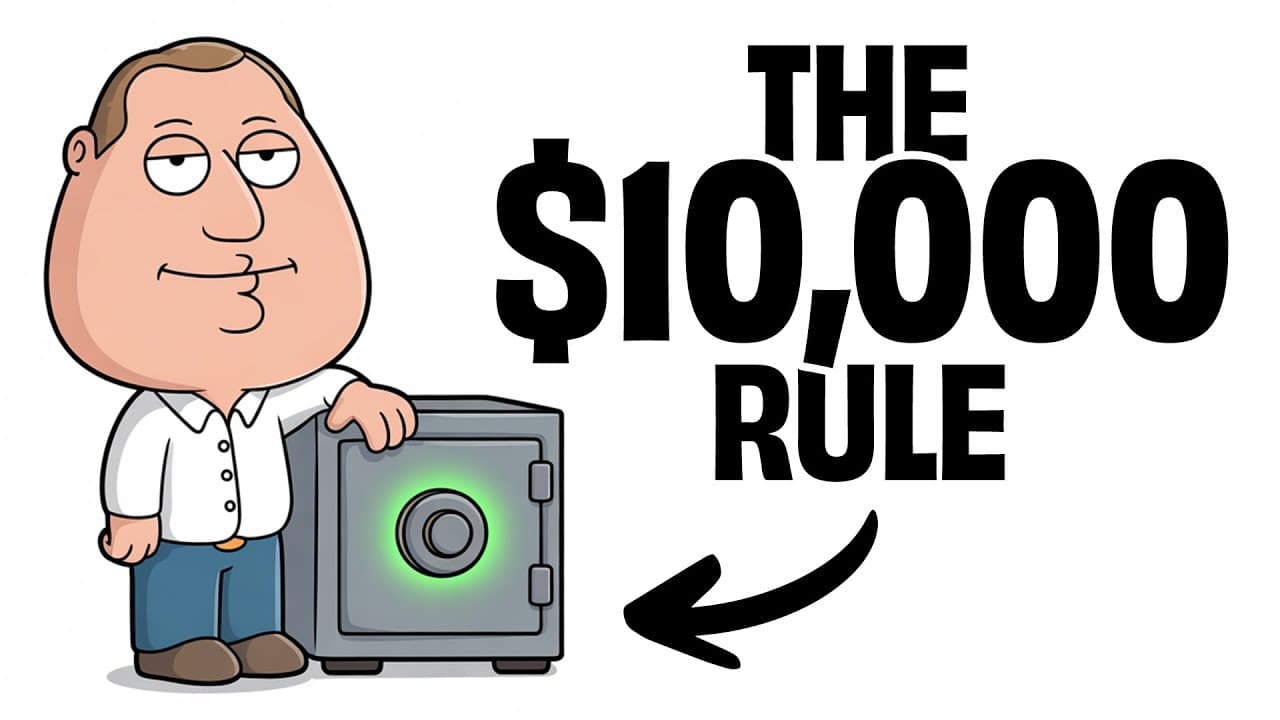
How to save your first $10,000
TL;DR
Saving ten thousand dollars changes how you view money and reduces stress. It makes risk easier to manage, lowers stress hormones, and frees up mental bandwidth to pursue opportunities like education, new jobs, or better investments. The emergency fund effect is the core benefit of reaching this milestone.
Transcript
Picture this scenario. You're lying awake at 3 in the morning, staring at the ceiling, and your mind is racing through every possible financial disaster that could strike tomorrow. Your car could break down. Your laptop might die. You could lose your job. Maybe your pet needs emergency surgery. Sound familiar? Well, what if I told you there's a spe... Read More
Key Insights
- The first real game changer isn’t a million dollars or even $100,000, it’s $10,000.
- With $10,000 saved, risk decisions feel more manageable and you can pursue promotions or self funded education.
- Neuroscience shows financial security reduces cortisol levels, changing how you respond to daily challenges.
- The emergency fund effect means most people don’t spend the $10,000 on emergencies but use it to seize opportunities.
- Saving money is about adopting an identity of a saver, not just temporary discipline.
- The act of saving creates a confidence boost that improves negotiations and decision making.
- Having $10,000 makes you more likely to think long term and explore investments or side incomes.
- The $10,000 benchmark covers many common emergencies, such as car repairs and medical events, reducing the likelihood of disaster.
- More videos from this channel:
- More from this channel: Nick Invests
Install to Summarize YouTube Videos and Get Transcripts
Explore YouTube Video Summarizer or Get YouTube Transcript Extractor
Questions & Answers
Q: How does reaching $10,000 change everyday risk decisions
Reaching $10,000 changes everyday risk decisions by transitioning from a survival mindset to one where stress is reduced and options feel more attainable. The saver can consider promotions, training, and new opportunities rather than just avoiding calamity, leading to better career and personal growth choices.
Q: What is the emergency fund effect
The emergency fund effect describes how simply knowing money is there changes behavior more than spending it. People with $10,000 saved tend to invest in education, new ventures, or relocation rather than depleting the fund on emergencies. The peace of mind enables freedom to act and plan long term.
Q: Why is $10,000 described as a game changer
$10,000 is described as a game changer because it provides a cushion for unexpected expenses, reduces stress, and alters risk tolerance. It allows pursuing opportunities like courses or certifications, and shifts money from scarcity to a tool that creates more options and potential income.
Q: How does the saver’s mindset develop
The saver develops an identity shift from temporary frugality to a long term saver. This identity fuels ongoing habit formation, making it easier to cut expenses and find additional income. The process compounds as you reach $1,000, then $2,000, and continues toward $10,000.
Q: What practical benefits does $10,000 provide
Practically, $10,000 covers many emergencies such as car repairs and medical bills and offers 3 to 6 months of income replacement during job transitions. This cushion makes emergencies manageable and supports job search resilience and more selective opportunities rather than rushed acceptance.
Q: How does $10,000 affect money mindset
The $10,000 milestone shifts money from something that disappears to a tool that multiplies options. You begin to see investments, side hustles, and savings as pathways to growth, rather than just covering current expenses, which changes long term financial planning and life strategy.
Q: What role does sleep and stress play in this milestone
Reducing financial stress improves sleep and overall well being, allowing you to be more productive and patient. Lower cortisol levels from financial security change how you respond to small problems, reducing overreactions and helping you allocate energy toward productive activities.
Q: Can people with lower income still benefit from $10,000
Yes, people with lower income can still benefit because reaching $10,000 creates the habit and mindset to manage money more effectively, identify savings opportunities, and pursue additional income streams. The focus is on building a sustainable saver identity, not just hitting a specific income threshold.
Summary & Key Takeaways
-
Saving your first $10,000 marks a major shift in money mindset and reduces daily financial anxiety, allowing more confident decisions and long term planning.
-
The milestone creates a safety net that lowers stress and opens up opportunities such as education, career moves, and smarter budgeting while changing how you think about money as a tool.
-
Reaching $10K helps you manage emergencies and pursue growth, with the psychological and practical benefits compounding as you build wealth and confidence over time.
Read in Other Languages (beta)
Share This Summary 📚
Summarize YouTube Videos and Get Video Transcripts with 1-Click
Try YouTube Summary with ChatGPT & Claude or YouTube Transcript Generator
Explore More Summaries from Nick Invests 📚




Summarize YouTube Videos and Get Video Transcripts with 1-Click
Try YouTube Summary with ChatGPT & Claude or YouTube Transcript Generator