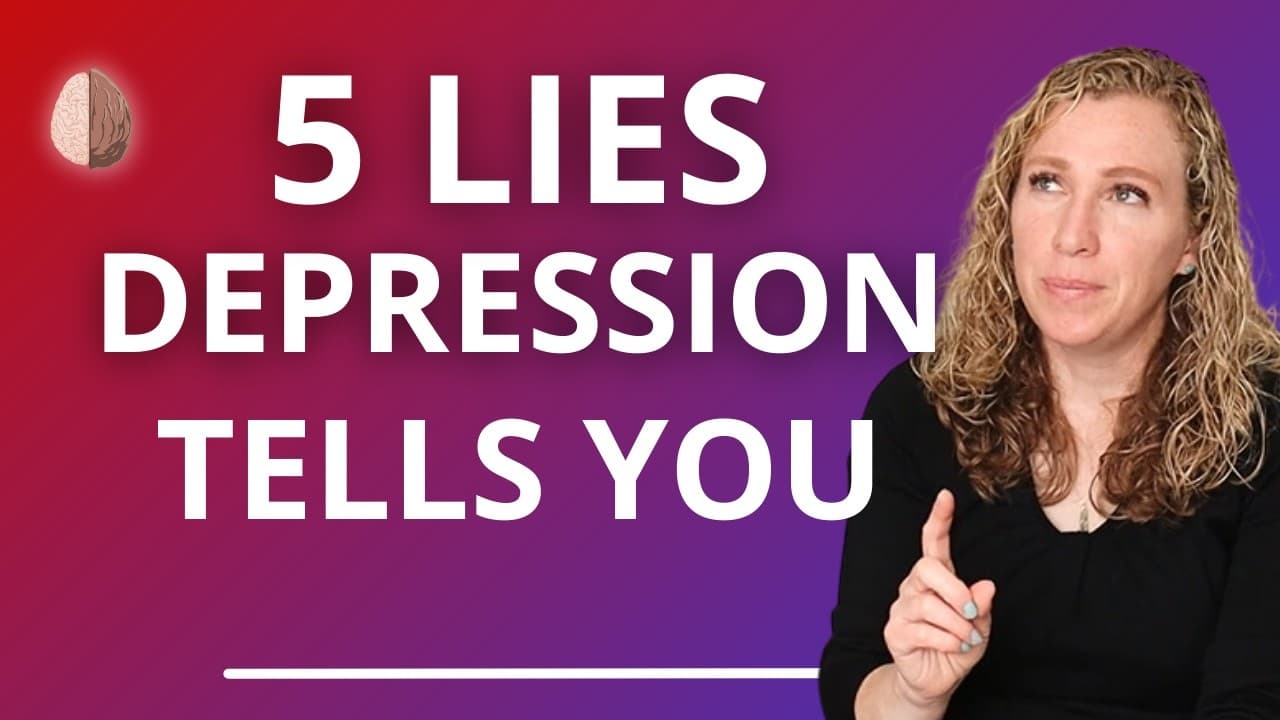
How to Challenge Five Lies Depression Tells You
TL;DR
Depression can distort perception, making hopelessness, shame, weakness, burdensomeness, and isolation feel like facts when they are not. Do one helpful thing before waiting for motivation, such as contacting someone you trust, seeking professional or crisis support, moving your body, journaling, or completing one small act of care.
Transcript
All right! You're really depressed. Let's chat! You've probably been hurting for a long time and you just want the pain to stop and you haven't found a way to escape that pain that follows you around yet and I want to emphasize the yet part there because there is something we can do about this. Maybe you've gone through some really difficult th... Read More
Key Insights
- Depression is described as a distortion of perception that makes painful thoughts feel unquestionably true. It can narrow awareness of alternatives and positive outcomes, so the inability to imagine improvement should not be treated as proof that improvement is impossible.
- Feelings and life circumstances can change even after depression has lasted a long time. The belief that happiness will never return reflects depression's tunnel vision, while seeking treatment or taking one small action preserves the possibility of a different outcome.
- Several treatment options are identified for people who feel stuck. The transcript says ECT, TMS, and ketamine may improve depression within hours or weeks and reports remission rates of 40–70%, while morning light therapy is presented as another accessible option.
- The belief that someone is a burden is presented as a depressive lie. Loved ones can value a person for who they are rather than what they do, and a person's death can deeply affect family members, acquaintances, children, and others in the community.
- Every person deserves support simply because they are human. Depression may claim that problems are not severe enough or should be handled privately, but help does not need to be postponed until rock bottom, and therapy can address shame and emotional pain.
- Struggling with depression is not evidence of weakness or personal failure. Strength can mean honestly facing pain, continuing despite difficulty, and learning emotional processing skills instead of pretending to be fine or blaming oneself for not being able to snap out of it.
- Feeling alone does not establish that nobody cares. Depression can block awareness of love and support, making care difficult to feel, which is why contacting a trusted person, therapist, support group, hospital, or crisis hotline can provide an outside perspective.
- Small actions are more workable than trying to repair everything at once. Walking, showering, journaling, listening to music, resting without alcohol, petting an animal, breathing gently, organizing one area, or creating something can serve as an immediate next step.
Install to Summarize YouTube Videos and Get Transcripts
Explore YouTube Video Summarizer or Get YouTube Transcript Extractor
Questions & Answers
Q: What are the five main lies depression tells you?
The five lies are that you will never be happy again, that you are a burden, that you do not deserve help, that struggling means you are weak, and that nobody cares about you. The transcript presents each belief as a distortion created by depression rather than a reliable description of your future, worth, strength, or relationships.
Q: Why does depression make improvement feel impossible?
Depression can produce tunnel vision that limits a person's ability to imagine alternatives, treatment options, or positive outcomes. Pain may therefore feel permanent even though feelings and life circumstances can change. The transcript advises treating hopeless predictions as symptoms of distorted perception and taking one small constructive action without waiting to feel certain that recovery will happen.
Q: What should you do if depression says you are a burden?
Treat the thought as a depressive distortion rather than an established fact. The transcript emphasizes that loved ones value people for who they are, not merely for what they accomplish, and that a person's loss affects more people than they may realize. Reaching out to someone trustworthy allows another person to challenge the isolation and offer support.
Q: Do you need to reach rock bottom before seeking help?
No. The transcript states that support is deserved simply because you are human, and problems do not need to become worse before they justify assistance. Depression may create shame or insist that you should cope alone, but a therapist, trusted person, online support group, hospital, or crisis hotline can help you examine those beliefs and begin responding to the pain.
Q: Does having depression mean you are weak or broken?
No. The transcript distinguishes being hurt from being broken and describes honest engagement with suffering as a form of strength. Continuing, acknowledging difficulty, and learning to process emotions are stronger responses than pretending to be fine. Struggling may reflect a lack of previously learned emotional skills, not a defective character or a personal failure.
Q: What small actions can help when depression limits energy?
Possible small actions include taking a short walk, dancing, sitting outside, showering, washing your face, sending a funny video to a friend, journaling without judgment, listening to music, resting without alcohol, hugging someone, petting an animal, breathing gently, trying self-compassion meditation, organizing one small area, or expressing yourself creatively. Only one step is required to begin.
Q: Should you wait for motivation before taking action?
No. The transcript says action can come before motivation and that taking action prompts the brain to release dopamine, which it calls the motivation chemical. When energy is low, the practical goal is one helpful behavior rather than a complete solution. A manageable action can create enough movement to support another step, including reaching out for professional help.
Q: What treatment options does the transcript mention for depression?
The transcript mentions hospitals for people who are desperate, along with ECT, TMS, ketamine, light therapy, therapy, online support groups, crisis hotlines, BetterHelp, and Psychology Today. It reports that ECT, TMS, and ketamine may help within hours or weeks with 40–70% remission rates, and that 60–70% of people using morning light therapy for 15 minutes feel better.
Summary & Key Takeaways
-
Depression narrows a person's view of possible outcomes, making temporary pain seem permanent and improvement seem impossible. The response is not to solve everything immediately, but to recognize that feelings and circumstances can change, explore available treatments, and take one manageable action even before hope or motivation returns.
-
Depression can falsely portray a struggling person as burdensome, undeserving of help, weak, or uncared for. The central correction is that suffering does not make someone defective or shameful. Honest acknowledgment, emotional skills, trusted relationships, therapists, support groups, and crisis services can provide essential perspective and practical assistance.
-
Recovery can begin with very small actions, including walking, sitting outside, washing your face, journaling, listening to music, sleeping without alcohol, breathing gently, creating something, or contacting a friend. Action can precede motivation, and a single helpful step can open the way toward further support and sustained therapeutic work.
Read in Other Languages (beta)
Share This Summary 📚
Summarize YouTube Videos and Get Video Transcripts with 1-Click
Try YouTube Summary with ChatGPT & Claude or YouTube Transcript Generator
Explore More Summaries from Therapy in a Nutshell 📚




Summarize YouTube Videos and Get Video Transcripts with 1-Click
Try YouTube Summary with ChatGPT & Claude or YouTube Transcript Generator