What Is the Fourier Transform and How Does It Work?
TL;DR
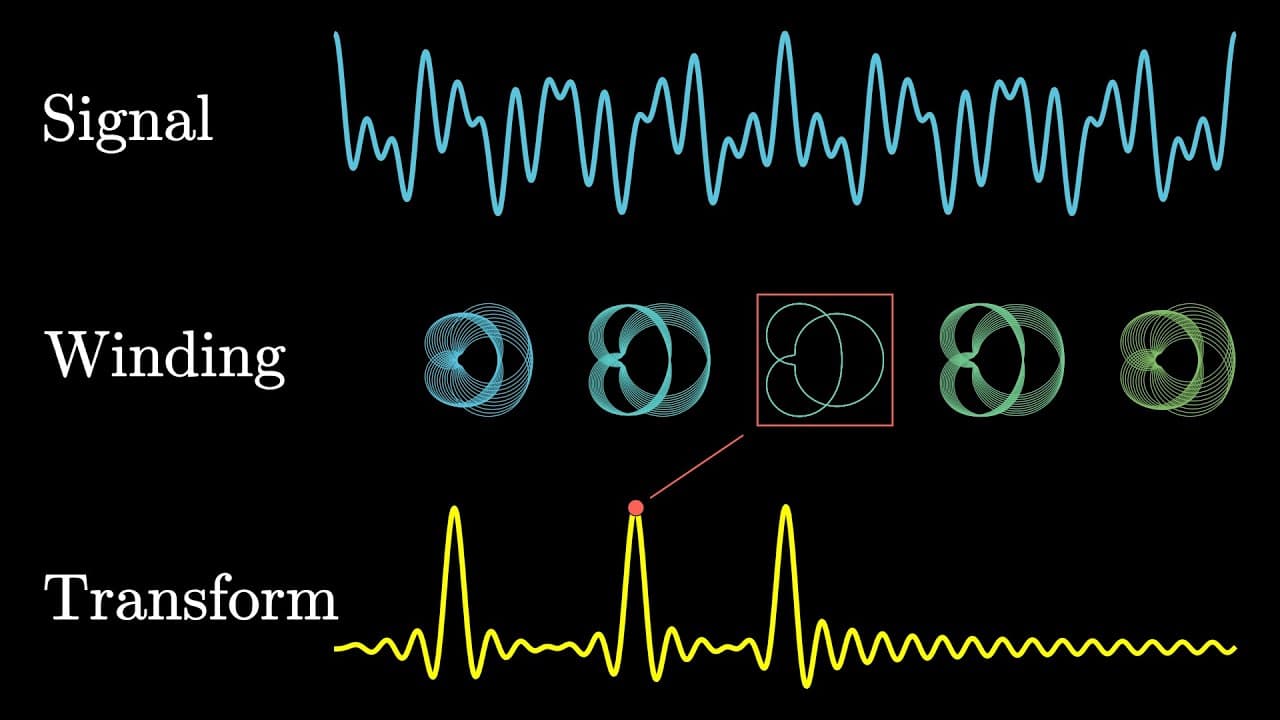
The Fourier transform decomposes a complicated signal into the pure frequencies that make it up, much like unmixing paint colors that have been stirred together. It works by winding a signal's graph around a circle at different winding frequencies and tracking the wound-up graph's center of mass, which lurches away from the origin only when the winding frequency matches a frequency hidden in the signal. Built up visually from a pure 440-beats-per-second 'A' note and simple 3-beats-per-second examples, this introduction shows what each piece actually looks like.
Transcript
This right here is what we're going to build to this video, a certain animated approach to thinking about a super important idea from math, the Fourier transform. For anyone unfamiliar with what that is, my number one goal here is just for the video to be an introduction to that topic. But even for those of you who are already familiar with it, ... Read More
Key Insights
- 🔨 The Fourier transform is a mathematical tool to decompose signals into their frequency components.
- 👻 The winding frequency machine wraps the signal graph around a circle, allowing the extraction of frequency information from the center of mass position.
- 👂 The Fourier transform is extensively used in various fields, including sound editing and signal processing.
- #️⃣ Complex numbers are employed to describe rotation and the winding process in the Fourier transform.
- 💆 The Fourier transform operates by taking the integral of a complex-valued function, similar to calculating the center of mass.
- 🍵 The Fourier transform can handle both continuous and discrete signals, enabling its application in different domains.
- 🔨 The transform is a powerful tool for data analysis, compression, and visualization.
Install to Summarize YouTube Videos and Get Transcripts
Explore YouTube Video Summarizer or Get YouTube Transcript Extractor
Questions & Answers
Q: What is the Fourier transform?
The Fourier transform is a mathematical machine that takes a signal and decomposes it into the pure frequencies that make it up. When several notes are played at once, a microphone only records the summed air pressure over time, and the transform is what pulls that combined signal back apart into its individual frequency components.
Q: How does the winding frequency machine work?
You take a finite portion of the signal's graph and wrap it around a circle using a rotating vector whose length equals the graph's height at each moment. High points of the graph sit farther from the origin and low points closer to it. You can choose how fast to wind the graph around the circle, and that winding frequency determines what the wound-up graph looks like.
Q: What happens when the winding frequency matches the signal's frequency?
Something special happens: all the high points of the signal end up on the right side of the circle and all the low points on the left. In the video's example of a 3-beats-per-second signal, once the winding frequency also reaches 3 cycles per second, the wound-up graph's center of mass shifts unusually far to the right, which is how the machine detects that frequency.
Q: Why does the transform track the center of mass?
Imagine the wound-up graph as a metal wire with mass, and mark its center of mass with a dot. As you change the winding frequency, that center of mass wobbles around. For most winding frequencies the peaks and valleys are spread evenly around the circle, so the center of mass stays near the origin. It only moves far out when the winding frequency lines up with a real frequency in the signal, so plotting its position for each winding frequency reveals the signal's frequencies.
Q: How can two notes played at the same time be separated?
A pure A is 440 oscillations per second, and a lower note like a D has the same wave structure with fewer beats per second. When both play at once, the pressure at any moment is the sum of what each note would produce individually, so the peaks sometimes reinforce and sometimes cancel, giving a complicated wave. The Fourier transform is the tool that takes that mixed signal and recovers the individual frequencies inside it.
Q: What are the practical applications of the Fourier transform?
The central example is decomposing frequencies from sound, which makes the transform useful for sound editing and signal processing. The video also notes that the same idea extends well beyond sound into many seemingly disparate areas of math and even physics. More broadly it supports tasks like data analysis, compression, and visualization.
Q: How do complex numbers relate to the Fourier transform?
The center of mass on the wound-up graph is a two-dimensional point, so it naturally takes two coordinates to track. Complex numbers give an elegant way to describe this rotation and winding, representing the center of mass with a real and an imaginary part. Euler's formula lets you describe the winding rotation using complex exponential functions.
Summary & Key Takeaways
-
The video introduces the concept of the Fourier transform and its application in decomposing frequencies from sound.
-
It explains how the winding frequency machine can decompose signals into pure frequencies by wrapping the signal graph around a circle.
-
The video highlights the usefulness of the Fourier transform in sound editing and the ability to extract frequencies from mixed signals.
Read in Other Languages (beta)
Share This Summary 📚
Summarize YouTube Videos and Get Video Transcripts with 1-Click
Try YouTube Summary with ChatGPT & Claude or YouTube Transcript Generator
Explore More Summaries from 3Blue1Brown 📚
Summarize YouTube Videos and Get Video Transcripts with 1-Click
Try YouTube Summary with ChatGPT & Claude or YouTube Transcript Generator