How to Improve Your IELTS Speaking Band Score
TL;DR
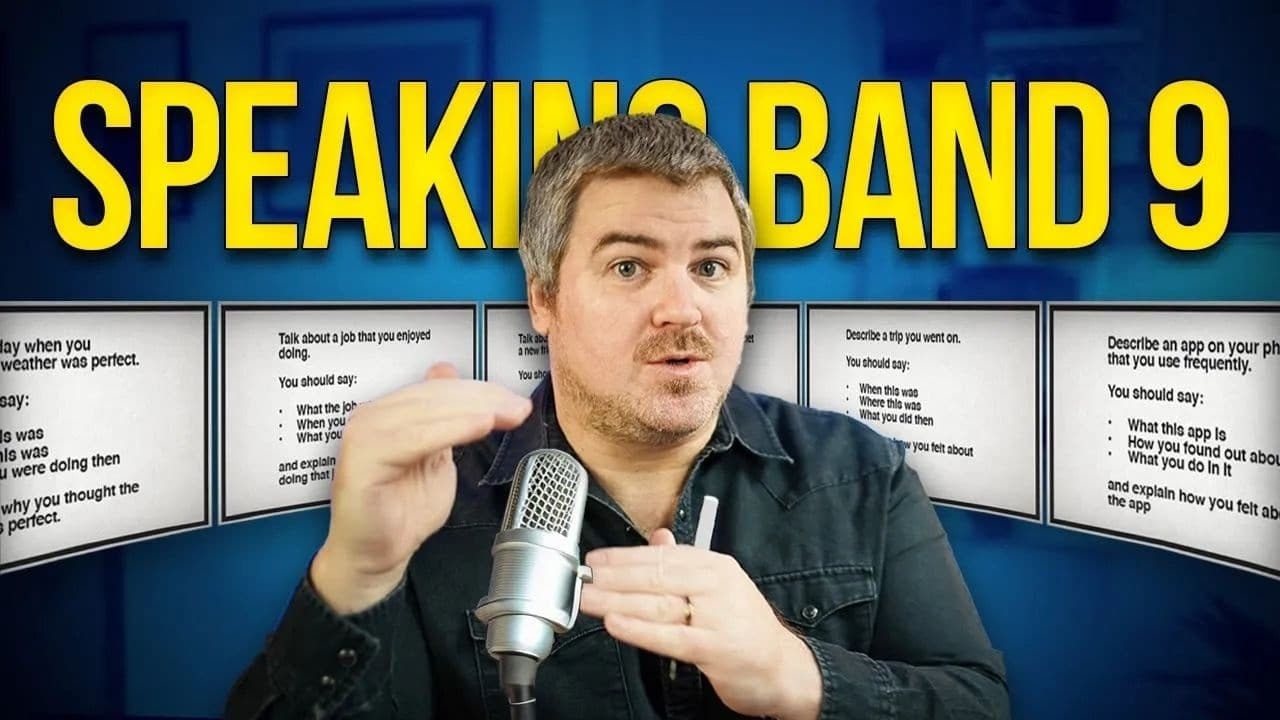
Answer questions directly, naturally, and with enough relevant detail to sound like a normal conversation rather than a memorized performance. In Part 1, avoid long, formal, or off-topic responses; in Part 2, use the cue-card bullets flexibly, prepare for one minute, and continue speaking until the examiner stops you near the two-minute mark.
Transcript
you've just found the Ultimate Guide to I speaking this is the longest most detailed guide to I speaking you'll find anywhere on the Internet it's going to help you understand things about the format of the test how you can improve your speaking at home for free and give you the same strategies thousands of my students have used to get a band nine ... Read More
Key Insights
- Memorized Part 1 answers are easy for examiners to identify because common questions about work, studies, home, and hometown are predictable. Relying on prepared scripts can lower a candidate’s score, particularly when an unexpected follow-up question exposes limited flexibility.
- Strong Part 1 answers are direct, relevant, and conversational. A candidate should answer the exact question first, then add enough development through an explanation, example, short story, or extra detail without turning a simple exchange into an excessively long response.
- Unexpected Part 1 questions can reveal dependence on memorized material. Questions about hats, birthday cakes, or other unusual subjects test whether candidates have enough English and flexibility to respond naturally to something they did not specifically prepare beforehand.
- Formal or robotic speech is not required for IELTS Speaking. Stress, nerves, or misguided preparation can make candidates sound unnatural, while Band 7, 8, and 9 students tend to create the feeling of an ordinary conversation with a friend or colleague.
- Natural answer length is more useful than a fixed sentence target. Candidates should not enter the test calculating whether every response requires two, three, or four sentences because that adds unnecessary thinking and interferes with spontaneous communication.
- IELTS Speaking Part 2 is a monologue with one minute of preparation and up to two minutes of speaking. The examiner does not interact during the response, creating an opportunity to focus closely on fluency, pronunciation, relevance, grammar, and vocabulary.
- Cue-card bullet points are intended to help candidates rather than restrict them. Following each point too rigidly can cause hesitation, weak idea development, and an early finish, sometimes leaving a candidate without material after only about 30 seconds.
- Rigid frameworks can make Part 2 more difficult by increasing the amount of planning required. The past-present-future template may not suit every topic because the past can be irrelevant and candidates may not know what to say about the future.
Install to Summarize YouTube Videos and Get Transcripts
Explore YouTube Video Summarizer or Get YouTube Transcript Extractor
Questions & Answers
Q: How should I answer IELTS Speaking Part 1 questions?
Answer the question directly, stay on topic, and add a natural amount of supporting detail. That development might be an explanation, an example, a short story, or another relevant fact. Avoid memorized scripts, excessively long responses, and formal delivery. The goal is to sound as though you are having a normal conversation with a new colleague, friend, or other person you have just met.
Q: Why should I avoid memorized IELTS Speaking answers?
Memorized answers are easy for examiners to notice, especially in Part 1, where questions about work, studies, home, and hometown are predictable. Examiners may introduce an unusual question, such as one about hats or a birthday cake, that does not fit the prepared material. If a candidate cannot adapt, the contrast can reveal reliance on memorization and lower the speaking score.
Q: How long should an IELTS Speaking Part 1 answer be?
A Part 1 answer should be long enough to answer the question and provide some useful development, but it should not become an extended speech. There is no fixed requirement to use two, three, or four sentences. Candidates should respond naturally, as they would in an ordinary conversation, instead of counting sentences or forcing every answer into the same predetermined length.
Q: How can I make IELTS Speaking answers sound natural?
Speak as though you are talking to a friend or meeting a new colleague, answer the exact question first, and then add relevant detail. Avoid an overly formal voice, robotic delivery, and memorized templates. For example, a question about where you live can be answered with the location plus a brief detail about recently moving there or what the area is like.
Q: What happens in IELTS Speaking Part 2?
In Part 2, the candidate receives a cue card, has one minute to prepare, and then speaks for up to two minutes. Unlike Parts 1 and 3, this section is a monologue, so the examiner does not ask questions or interact during the main response. The candidate should continue speaking until the examiner stops the answer at around the two-minute point.
Q: How should I use the cue-card bullet points in Part 2?
Treat the bullet points as prompts that help generate ideas, not as rigid instructions that limit the response. Moving mechanically from the first point to the second, third, and fourth can cause hesitation or make ideas run out quickly. A stronger approach is to develop the topic naturally and keep speaking until the examiner stops you near the expected two-minute mark.
Q: Why can the past-present-future method hurt Part 2 answers?
The past-present-future method can increase the amount of thinking required during a Part 2 response. It may force candidates to discuss a past that is not relevant or a future they have never considered. Because it is not a natural way to answer every question, the framework can make speaking more complicated instead of helping ideas flow clearly and continuously.
Q: What does the examiner assess during IELTS Speaking Part 2?
Part 2 gives the examiner an extended opportunity to listen without interacting with the candidate. During that monologue, the examiner can focus on the candidate’s fluency, pronunciation, response to the topic, grammar, and vocabulary. Speaking for the full period is therefore important, while stopping after roughly 30 seconds because ideas have run out can negatively affect the performance.
Summary & Key Takeaways
-
IELTS Speaking rewards natural communication rather than memorized performances. Strong Part 1 responses answer the question immediately, remain relevant, and add a suitable explanation, example, story, or detail. Candidates should imagine an ordinary conversation with a new colleague instead of trying to sound excessively formal or following a fixed sentence count.
-
Part 2 gives candidates one minute to prepare and asks them to speak for up to two minutes without examiner interaction. The examiner can concentrate on fluency, pronunciation, relevance, grammar, and vocabulary. Candidates should keep speaking until stopped and treat the cue-card bullets as helpful prompts rather than mandatory restrictions.
-
Average candidates often memorize predictable Part 1 answers, speak too formally, or rely on rigid Part 2 templates. Unexpected questions can expose this preparation style. Higher-scoring candidates have enough flexibility to answer unfamiliar questions directly, develop their ideas naturally, and avoid complicated frameworks that create unnecessary thinking during the test.
Read in Other Languages (beta)
Share This Summary 📚
Summarize YouTube Videos and Get Video Transcripts with 1-Click
Try YouTube Summary with ChatGPT & Claude or YouTube Transcript Generator
Explore More Summaries from IELTS Advantage 📚
Summarize YouTube Videos and Get Video Transcripts with 1-Click
Try YouTube Summary with ChatGPT & Claude or YouTube Transcript Generator