How to solve hard problems in brownfield codebases with AI
TL;DR
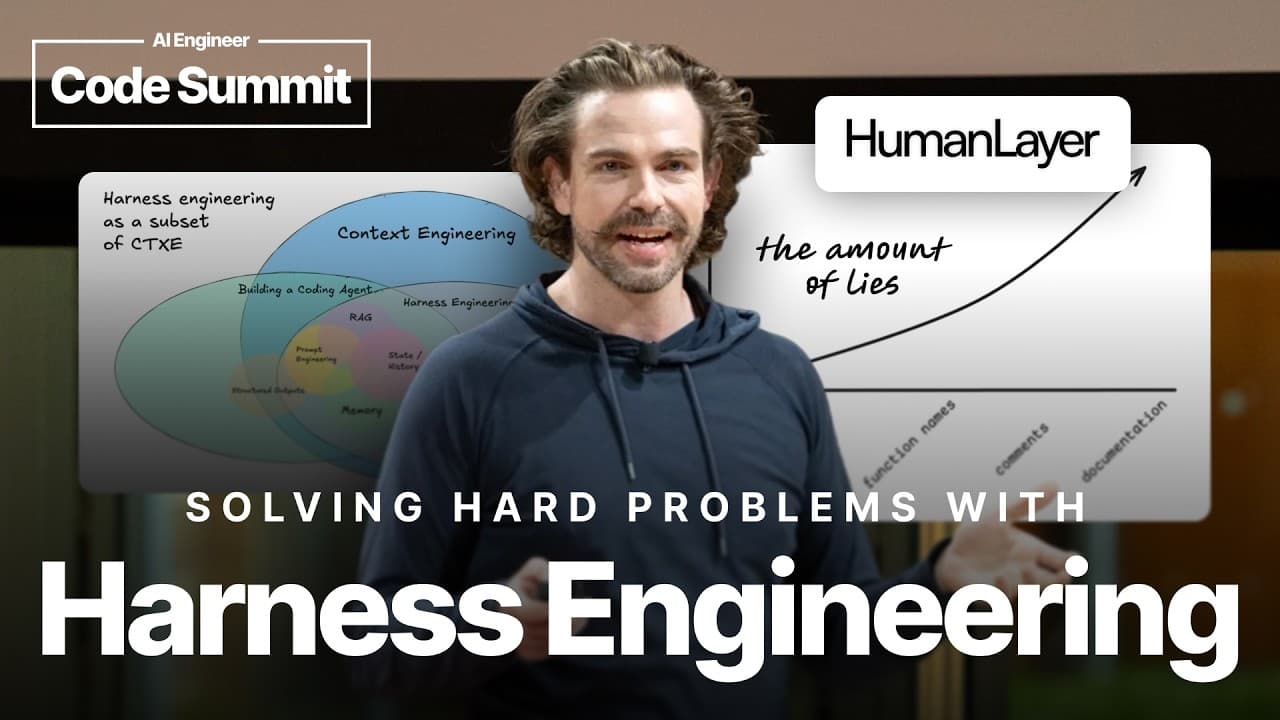
AI coding tools can work in brownfield codebases when you apply context engineering. By using intentional compaction, sub agents to control context, and a research plan followed by explicit planning and implementation, you can achieve high throughput and maintain code quality, even on large Rust codebases.
Transcript
Hi everybody. How y'all doing? It's exciting. I'm Dex. Uh, as they did in the great intro, I've been hacking on agents for a while. Um, our talk 12 factor agents at AI engineer in June was one of the top talks of all time. Uh, I think top eight or something. One of the best ones from from AI engineer in June. May or may not have said something abou... Read More
Key Insights
- No slop is the guiding principle for high-value AI code work, focusing on clean, relevant context rather than reworking yesterday’s outputs.
- Context window management is critical; better tokens in lead to better tokens out, so compact and curate what the AI sees.
- Intentional compaction compresses the current context to a succinct, reviewable Markdown digest to speed up handoffs to new agent instances.
- Sub agents should be used to steer focus and avoid anthropomorphizing roles, instead they help partition context and findings.
- Workflow design emphasizes frequent intentional compaction to keep the context within useful limits and avoid the dumb zone of diminishing returns.
- A three-phase approach—research, plan, implement—keeps the model engaged on the right tasks and enables testable, incremental progress.
- Brownfield codebases require strategies that maintain mental alignment between human and AI, reducing slop and improving reliability of results.
- The approach has demonstrated substantial throughput gains on large codebases, shipping work more quickly while preserving quality and alignment.
- More videos from this channel:
- More from this channel: AI Engineer
Install to Summarize YouTube Videos and Get Transcripts
Explore YouTube Video Summarizer or Get YouTube Transcript Extractor
Questions & Answers
Q: How can AI coding tools be effective in brownfield codebases?
AI coding tools can be effective in brownfield codebases by using a disciplined context engineering approach that emphasizes keeping the AI within a tight, relevant context, avoiding unnecessary history, and applying intentional compaction to generate concise, actionable outputs. This reduces slop and ensures the model works on the most important factors, enabling accurate problem solving without being overwhelmed by legacy code details.
Q: What is the role of intentional compaction in this workflow?
Intentional compaction is used to compress the current, potentially large context into a concise, reviewable digest such as a Markdown file. This digest is then fed to new agent instances, allowing them to jump straight into the problem without re-reading entire files. It helps manage context window limits and speeds up problem solving by removing noise.
Q: Why are sub agents recommended and how should they be used?
Sub agents help control context by handling specific parts of the task, such as frontend, backend, or data analysis, without anthropomorphizing them as separate people. They can fork a new context window to read and understand a targeted portion of the codebase, then return a succinct result to the parent agent, improving focus and efficiency.
Q: What is the three-phase workflow mentioned in the talk?
The three-phase workflow is research, plan, and implement. In research, the system gathers understanding and files. Planning outlines exact steps with file references and testing criteria. Implement is executing the plan, with continual context management to keep the model in the smart zone and minimize wasted iterations.
Q: What is meant by the dumb zone and why is it important?
The dumb zone refers to a range of the context window where adding more information yields diminishing returns due to model limits. Staying out of this zone is important because it prevents performance degradation from overloaded context, enabling more accurate and efficient problem solving with AI agents.
Q: How does the talk describe achieving 2 to 3x throughput?
Throughput gains come from a combination of no slop, effective context management, and the frequent use of compaction to keep the context window lean. By structuring workflows to maximize high-leverage tasks for the AI and minimize irrelevant data, teams can ship more work in less time while maintaining quality.
Q: What evidence is provided that these methods work on large codebases?
The speaker cites experience shipping 35,000 lines of code in a PR and working with a 300k LOC Rust codebase, with plans that became part of a real release. These outcomes illustrate that disciplined context engineering can handle large, complex codebases and maintain alignment.
Q: What should teams avoid when using AI for coding tasks?
Teams should avoid overwhelming the AI with noise, outdated context, or irrelevant data. They should also avoid treating sub agents as autonomous people and instead use them to control and partition context. Failing to manage context, trajectory, and testing can lead to poor results and wasted effort.
Summary & Key Takeaways
-
AI coding tools falter in large, legacy code without proper context management but can succeed with disciplined workflows.
-
A three-phase workflow of research, plan, and implement keeps context small and focused, enabling effective use of today’s models.
-
The strategy centers on no slop, intentional compaction, and controlled sub-agents to maintain alignment and throughput in complex projects.
Read in Other Languages (beta)
Share This Summary 📚
Summarize YouTube Videos and Get Video Transcripts with 1-Click
Try YouTube Summary with ChatGPT & Claude or YouTube Transcript Generator
Explore More Summaries from AI Engineer 📚





Summarize YouTube Videos and Get Video Transcripts with 1-Click
Try YouTube Summary with ChatGPT & Claude or YouTube Transcript Generator