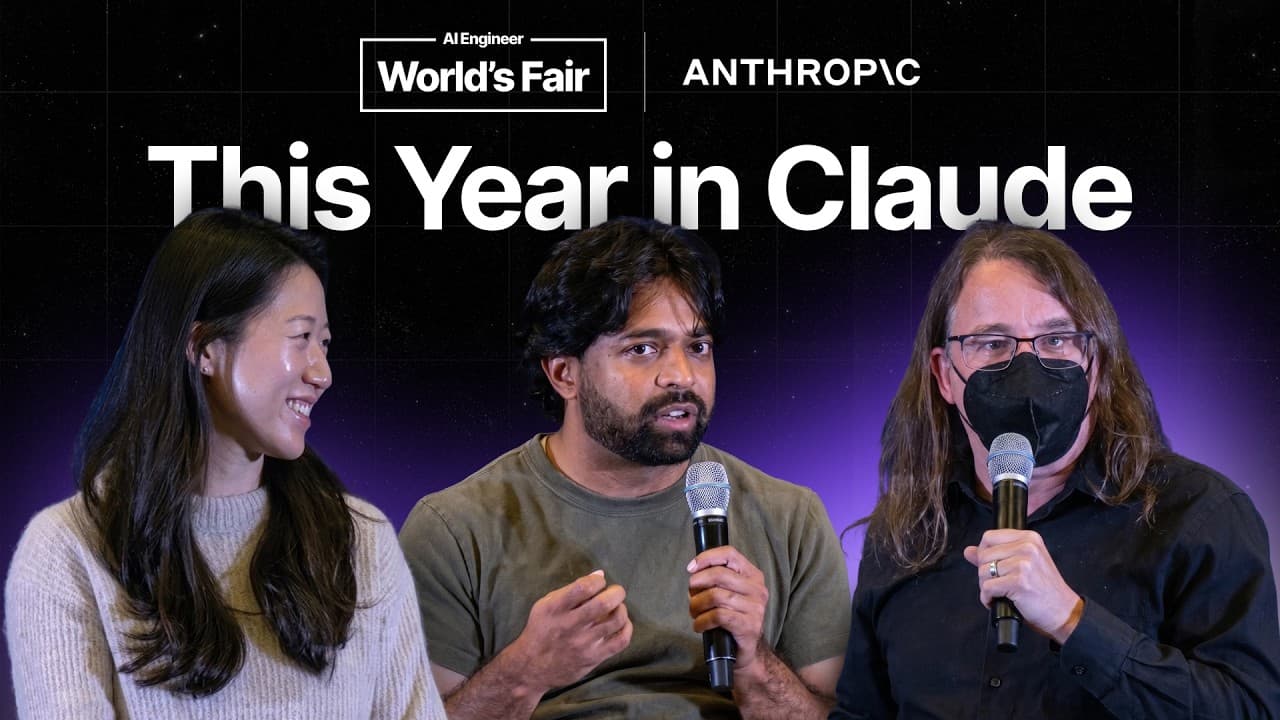
How do Claude Code and Claude Tag transform team coding
TL;DR
Claude Code shifts work from low level implementation to higher level strategy by delegating tasks to AI. Claude Tag adds multiplayer, proactive collaboration in Slack with team memory, and now lands the majority of internal product PRs, enabling faster, safer iteration across teams.
Transcript
Welcome to this uh fireside chat. Um we're going to I have with me uh Theik Shihipa and Cat Woo from Anthropic. We are going to be diving deep into claude code and we'll probably talk a little about this Fable thing that's been going on that that's that's been out there in the news. Actually, on the subject of Fable, literally a minute and a half a... Read More
Key Insights
- Claude Code lets engineers delegate implementations to an AI agent, freeing time for creative work and user experience refinement.
- The first generation of Claude Code required careful permission prompts, but recent updates have significantly reduced micromanagement and expanded capability.
- Fable enables onetime feature implementations, accelerating the delivery of new capabilities and allowing more ambitious projects to be attempted.
- Rewrites are now viewed as valuable for ensuring better code quality, with testing as a key enabler for multiple implementation options.
- Claude Tag introduces multiplayer collaboration in Slack, enabling team members to contribute to PRs and decisions in real time.
- Claude Tag uses memory to remember team preferences, reducing repetitive setup and enabling consistent behavior across projects.
- Internal use shows Claude Tag lands about 65 percent of product PRs, illustrating its effectiveness for proactive code management.
- The discussion emphasizes shifting away from strict waterfall-like planning toward rapid prototyping and strong product sense to decide what is worth building.
- More videos from this channel:
- More from this channel: AI Engineer
Install to Summarize YouTube Videos and Get Transcripts
Explore YouTube Video Summarizer or Get YouTube Transcript Extractor
Questions & Answers
Q: What is Claude Tag and how does it work in Slack?
Claude Tag is a collaborative assistant that lives in Slack channels, enabling multiplayer interaction by letting team members chime in and collectively work on PRs. It is proactive, able to monitor bug reports and draft fixes, and it remembers channel preferences to tailor its behavior for future tasks. This makes it a central part of team workflows, reducing manual handoffs.
Q: How has Claude Code changed the day-to-day workflow for engineers?
Engineers previously needed to micromanage prompts and permissions while coding with Claude Code. Now, there is a shift toward delegating more to the agent, freeing engineers to focus on higher level decisions and design. This transition enables faster iteration and allows engineers to concentrate on quality and user experience rather than low level command execution.
Q: What role does Fable play in the Claude ecosystem according to the speakers?
Fable enables one-shot delivery of many features, accelerating the pace at which new capabilities can be implemented. This reduces the need for prolonged manual development and allows teams to prototype and test ideas rapidly, while still maintaining high output quality addressed to brand standards.
Q: Why are rewrites considered valuable in this context?
Rewrites are valuable because they help ensure correctness and quality by allowing multiple implementation approaches to be tested against a shared test suite. This approach recognizes code as a living artifact that can evolve, be improved, and better reflect current requirements, ultimately leading to more robust software.
Q: What shift in engineering norms is discussed in the talk?
The talk suggests moving away from long multi month PRDs and waterfall planning toward rapid prototyping, strong product sense, and timely decision making. The emphasis is on what to build and why, with fast iteration cycles and continuous refinement guided by real user feedback and business impact.
Q: How does Claude Tag contribute to non coding needs within a company?
Claude Tag acts as a knowledge and task processor for non coding scenarios by indexing team conversations, monitoring outputs like metrics and releases, and surfacing relevant information. This allows non engineers, such as marketing or design teams, to access contextual insights and collaborate more efficiently with the coding efforts.
Q: What evidence is provided about Claude Tag’s impact on internal workflow at Anthropic?
Anthropic reports that Claude Tag lands around 65 percent of their product PRs, indicating a substantial influence on how work is coordinated and executed. This demonstrates the practical value of proactive, memory aware AI assistants in streamlining collaboration and accelerating feature delivery.
Q: What safety considerations are highlighted for long running agent tasks?
Safety is addressed through investments in evals and red teaming to mitigate risks like prompt injection and data exfiltration. The concept of Auto Mode is discussed as a preferred approach to safely manage long running agent based tasks, ensuring that automated actions stay under control and aligned with safety standards.
Summary & Key Takeaways
-
Claude Code shifts engineers toward higher level product thinking by delegating implementation tasks to AI, freeing time for creative work and better user experience design.
-
Claude Tag enables proactive, multiplayer collaboration within team channels, remembers preferences, and can automatically draft or monitor PRs, changing how teams coordinate and ship features.
-
The combination of Claude Code and Claude Tag supports rapid prototyping, rewrites, and safer long running tasks through internal evaluations and structured safety practices.
Read in Other Languages (beta)
Share This Summary 📚
Summarize YouTube Videos and Get Video Transcripts with 1-Click
Try YouTube Summary with ChatGPT & Claude or YouTube Transcript Generator
Explore More Summaries from AI Engineer 📚

Summarize YouTube Videos and Get Video Transcripts with 1-Click
Try YouTube Summary with ChatGPT & Claude or YouTube Transcript Generator