How to Unlock Fable's Full Agentic Capability
TL;DR
Fable works best when it receives useful tools, relevant context, and room to explore instead of an oversized set of restrictive instructions. To benefit from its broader capabilities, identify gaps between your plan and the real environment, ask the model to expose blind spots, and raise expectations for quality, speed, and cost rather than accepting familiar tradeoffs.
Transcript
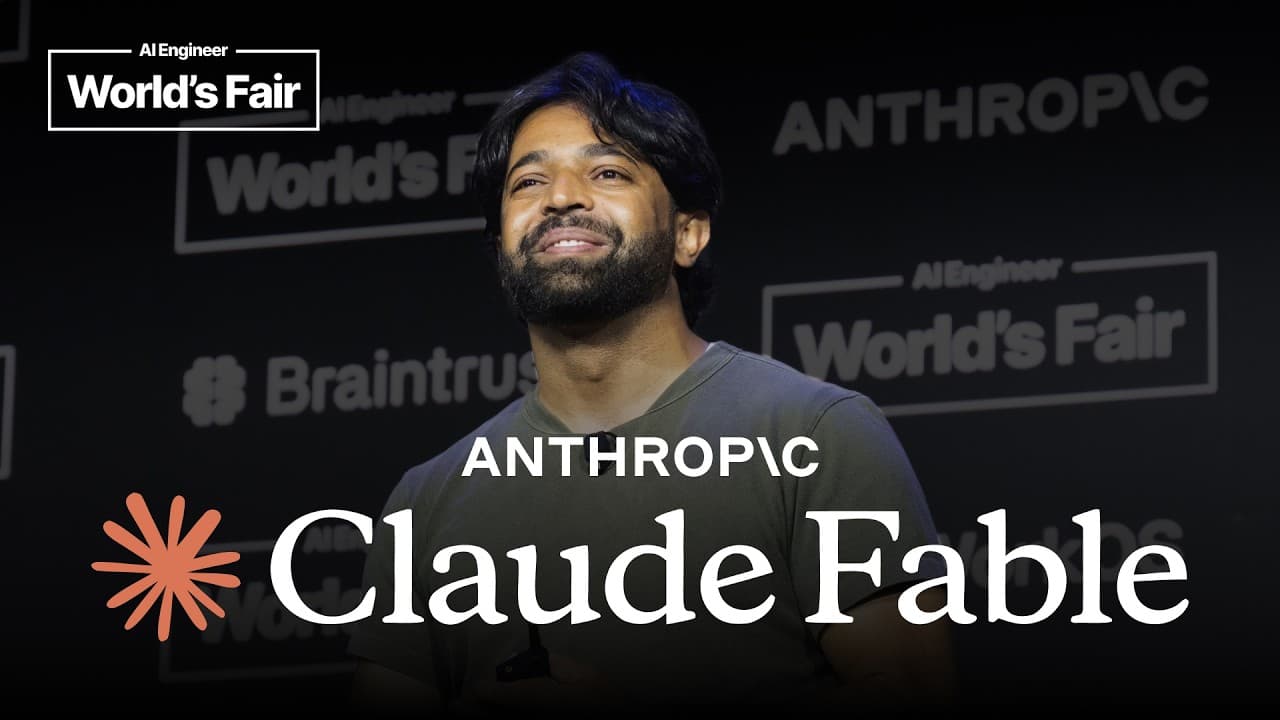
[music] >> Please welcome to the stage member of technical staff at Anthropic, Tarik Shaupar. >> [music] >> Hey everyone, I'm Tarik. I work at Anthropic on Claude Code. Before we get started, we have a tradition on Claude Code where we take a selfie before a talk. So, if you don't mind, if you strike a pose with me, I'll take a quick selfie at AI e... Read More
Key Insights
- Capability overhang is the gap between what a model appears able to do in ordinary chat and what it can accomplish when equipped with suitable tools. Claude Code can fetch a complete Pokémon list and programmatically filter it, solving a question that a chat model may answer incorrectly.
- Model capability is spiky rather than uniformly distributed. Improvements can suddenly unlock specific behaviors, such as autonomous context gathering, proactive work, effective interviewing, or interactive report creation, without making every task improve in the same way or according to a simple predictable rule.
- Tools can be more valuable than an enormous context window. Claude Code uses Bash and environmental access to search for and construct the context it needs, instead of requiring a user to paste an entire codebase into a chat prompt before work can begin.
- Smaller system prompts can better support newer models. Claude Code removed 80 percent of its system prompt because extensive examples and constraints could limit models that were more imaginative than the demonstrations supplied to them, while contextual information remained useful for guiding their work.
- Question-asking ability has advanced across model generations. A tool that Opus 4 could barely invoke later enabled Opus 4.5 to conduct a 40-question specification interview, while Opus 4.8 and Fable could produce HTML reports with questions embedded directly inside them.
- The map is a user's prompt, plan, or specification, while the territory is the actual codebase, environment, and real-world constraints. An unknown appears whenever the model encounters a decision point in the territory that the user's map did not specify.
- Unknowns can be divided into known knowns, known unknowns, unknown knowns, and unknown unknowns. This framework helps users distinguish explicit requirements from unresolved issues, unstated expectations they would recognize on sight, and important considerations they have not yet imagined.
- A blind spot pass is a practical method for discovering unknown unknowns. Fable can inspect relevant modules, code changes, Slack context, or an unfamiliar field to identify hidden constraints and recurring problems, enabling the user to create a better prompt before execution begins.
Install to Summarize YouTube Videos and Get Transcripts
Explore YouTube Video Summarizer or Get YouTube Transcript Extractor
Questions & Answers
Q: What is capability overhang in AI models?
Capability overhang is the difference between the abilities visible in a basic chat interaction and the stronger abilities exposed by an effective tool harness. A chat model may fail to identify every Pokémon name ending in “aw,” even if it knows the names. Claude Code can instead fetch the complete list, write a filtering script, and obtain the answer reliably.
Q: How can tools unlock abilities that a chat model hides?
Tools let a model transform a difficult reasoning or recall problem into a concrete operation. With Bash, code execution, search, and access to an environment, Claude can collect information, build its own context, test assumptions, and filter results. The resulting system may solve tasks that the same underlying knowledge cannot reliably handle through unaided conversational recall.
Q: Why did Claude Code reduce its system prompt by 80 percent?
Claude Code reduced its system prompt because newer models benefited from fewer restrictive instructions. Earlier models often needed detailed examples, numerous tools, and explicit prohibitions. More capable models could follow broader context while producing approaches more imaginative than the examples provided, so excessive demonstrations and constraints risked narrowing what the model attempted rather than improving its performance.
Q: How has Claude's ability to ask users questions improved?
The question tool progressed from a capability that Opus 4 could barely invoke to a richer method for gathering requirements. By Opus 4.5, Claude could interview a user with 40 questions about a specification. With Opus 4.8 and Fable, it could create a complete HTML report containing embedded questions, enabling a more structured and interactive exchange.
Q: What does the map is not the territory mean for AI coding?
The map is the prompt, plan, or specification a user holds in mind, while the territory is the real codebase and its actual constraints. When Claude encounters something in the environment that the plan did not cover, it reaches an unknown and must make a decision. Better results depend on making the map correspond more closely to that territory.
Q: What are the four types of unknowns in a project?
Known knowns are explicit requirements that usually appear in the prompt. Known unknowns are unresolved matters the user already recognizes. Unknown knowns are expectations that feel too obvious to document but would be recognized when seen. Unknown unknowns are considerations the user has not identified at all, even though discovering them could materially change the prompt or plan.
Q: How do you run a blind spot pass with Fable?
Ask Fable to inspect the relevant sources of context and identify unknown unknowns before beginning the main task. For a new authentication provider, that might include examining the authentication module, searching the Git diff, and reviewing relevant Slack context if access is provided. The goal is to surface hidden constraints, recurring dead ends, and important gotchas.
Q: Why should teams demand good, fast, and cheap AI results?
Fable expands what can be produced within a limited amount of time, including the speaker's example of building a full keynote deck in four hours. That shift supports a more ambitious standard for AI-assisted work. Instead of automatically selecting only two qualities from good, fast, and cheap, teams can test whether the model enables all three at once.
Summary & Key Takeaways
-
Fable represents a broader class of model capability that can feel like entering an open world after completing a tutorial. Its potential is exciting but initially difficult to navigate because users still need to discover which tools, prompts, interaction patterns, and environmental access allow its strongest abilities to emerge consistently.
-
Claude's capabilities are shaped by its harness as well as by the underlying model. Code execution, Bash access, proactive operation, question tools, and rich HTML outputs reveal abilities that ordinary chat interfaces may conceal. As models improve, smaller prompts with context can outperform lengthy prompts filled with examples and prohibitions.
-
Effective work with Fable requires identifying unknowns before the model traverses a large problem space. A blind spot pass can inspect relevant code, diffs, Slack context, or unfamiliar subject areas for hidden constraints and gotchas. The broader lesson is to demand results that are simultaneously good, fast, and cheap.
Read in Other Languages (beta)
Share This Summary 📚
Summarize YouTube Videos and Get Video Transcripts with 1-Click
Try YouTube Summary with ChatGPT & Claude or YouTube Transcript Generator
Explore More Summaries from AI Engineer 📚

Summarize YouTube Videos and Get Video Transcripts with 1-Click
Try YouTube Summary with ChatGPT & Claude or YouTube Transcript Generator