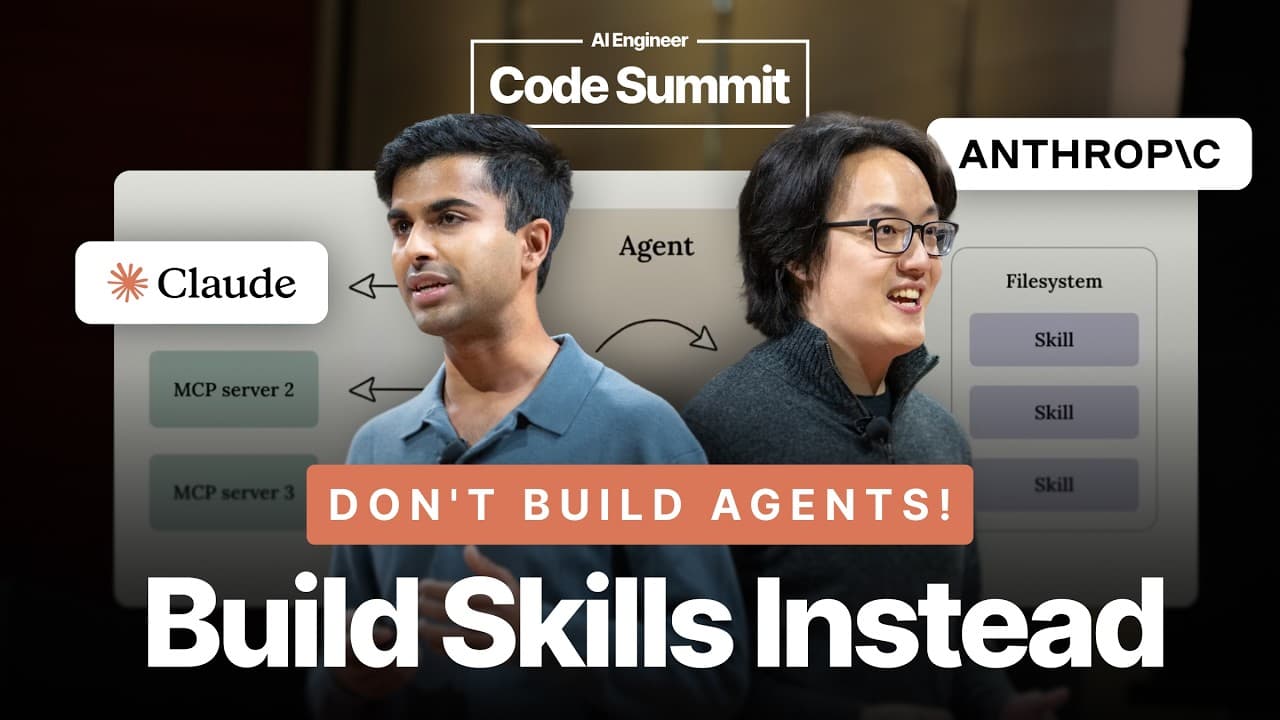
Why Build Agent Skills Instead of Separate Agents?, Barry Zhang & Mahesh Murag, Anthropic
TL;DR
Build skills instead of separate agents because a universal agent can already work across domains through code but still needs packaged domain expertise for consistent execution. Barry Zhang and Mahesh Murag define skills as organized folders containing instructions, procedural knowledge, and reusable scripts, with progressive disclosure protecting the context window. Their ecosystem grew to thousands of skills within five weeks, making the design worth exploring further.
Transcript
All right, good morning and thank you for having us again. Last time we were here, we're still figuring out what an agent even is. Today, many of us are using agents on a daily basis. But we still notice gaps. We still have slots, right? Agents have intelligence and capabilities, but not always expertise that we need for real work. I'm Barry. This ... Read More
Key Insights
- Skills are organized collections of files that package procedural knowledge for agents.
- Agents often lack domain expertise, which skills can provide effectively.
- Skills are simple, shareable, and can be versioned, making them accessible for both humans and agents.
- The skills ecosystem is rapidly growing, with thousands of skills being developed across various domains.
- Skills allow agents to perform complex tasks by orchestrating workflows with external data and connectivity.
- Non-technical people can create skills, making agents more accessible for everyday tasks.
- Skills can be progressively disclosed, protecting the context window while allowing for composability.
- The future of skills involves testing, evaluation, and better tooling to ensure quality and relevance.
Install to Summarize YouTube Videos and Get Transcripts
Explore YouTube Video Summarizer or Get YouTube Transcript Extractor
Questions & Answers
Q: Why build agent skills instead of separate agents?
The speakers found that the underlying agent can be more universal than expected because code provides an interface to the digital world. Skills then supply the domain expertise and procedural knowledge that the general-purpose agent lacks, avoiding separate agents for every use case and domain.
Q: What is an agent skill?
An agent skill is an organized collection of files that packages composable procedural knowledge for an agent. In practical terms, it is a folder that can contain core instructions, supporting files, and scripts used as tools.
Q: How can skills make agent work more consistent and efficient?
Skills can preserve scripts that an agent would otherwise recreate repeatedly. The speakers describe saving a Python script for styling slides so Claude could run the same tool later, improving consistency and efficiency.
Q: How do skills protect an agent's context window?
Skills use progressive disclosure so that only their metadata appears to the model at runtime. When a skill is needed, the agent reads its skill.md for the core instructions and a directory to the rest of the folder, leaving other material outside the context until required.
Q: Why are files used as the foundation for agent skills?
Files are a simple, established primitive that humans and agents can create and use with a computer. Skill folders can be versioned in Git, stored in Google Drive, zipped, and shared with a team.
Q: What kinds of agent skills are being created?
The speakers identify foundational skills, third-party skills made by ecosystem partners, and skills built within enterprises and teams. Examples include professional office-document creation, scientific research and EHR data analysis, browser automation with Browserbase's Stagehand, and research across Notion workspaces.
Q: How do skills complement tools and agent connectivity?
MCP provides agent connectivity, while skills can supply instructions and scripts that help an agent use connected capabilities effectively. Unlike a fixed traditional tool, code inside a skill is self-documenting, modifiable, and can remain in the file system until needed.
Q: How quickly has the agent-skills ecosystem grown?
The speakers say the ecosystem reached thousands of skills within five weeks of launch. They observed growth across foundational, partner-created, enterprise, and team-specific skills.
Summary & Key Takeaways
-
Skills are designed to provide agents with domain-specific expertise, allowing them to perform tasks with greater efficiency and accuracy. This new paradigm shifts the focus from building agents to equipping them with reusable skills that enhance their capabilities across various domains.
-
The skills ecosystem is growing rapidly, with foundational, third-party, and enterprise-specific skills being developed. These skills enable agents to perform tasks such as document creation, scientific research, and browser automation, making them more effective in different environments.
-
Skills are accessible to non-technical users, allowing for a broader range of people to contribute to the development of agent capabilities. This democratization of skill creation helps agents become more adaptable and useful in real-world applications, leading to continuous learning and improvement.
Read in Other Languages (beta)
Share This Summary 📚
Summarize YouTube Videos and Get Video Transcripts with 1-Click
Try YouTube Summary with ChatGPT & Claude or YouTube Transcript Generator
Explore More Summaries from AI Engineer 📚
Summarize YouTube Videos and Get Video Transcripts with 1-Click
Try YouTube Summary with ChatGPT & Claude or YouTube Transcript Generator