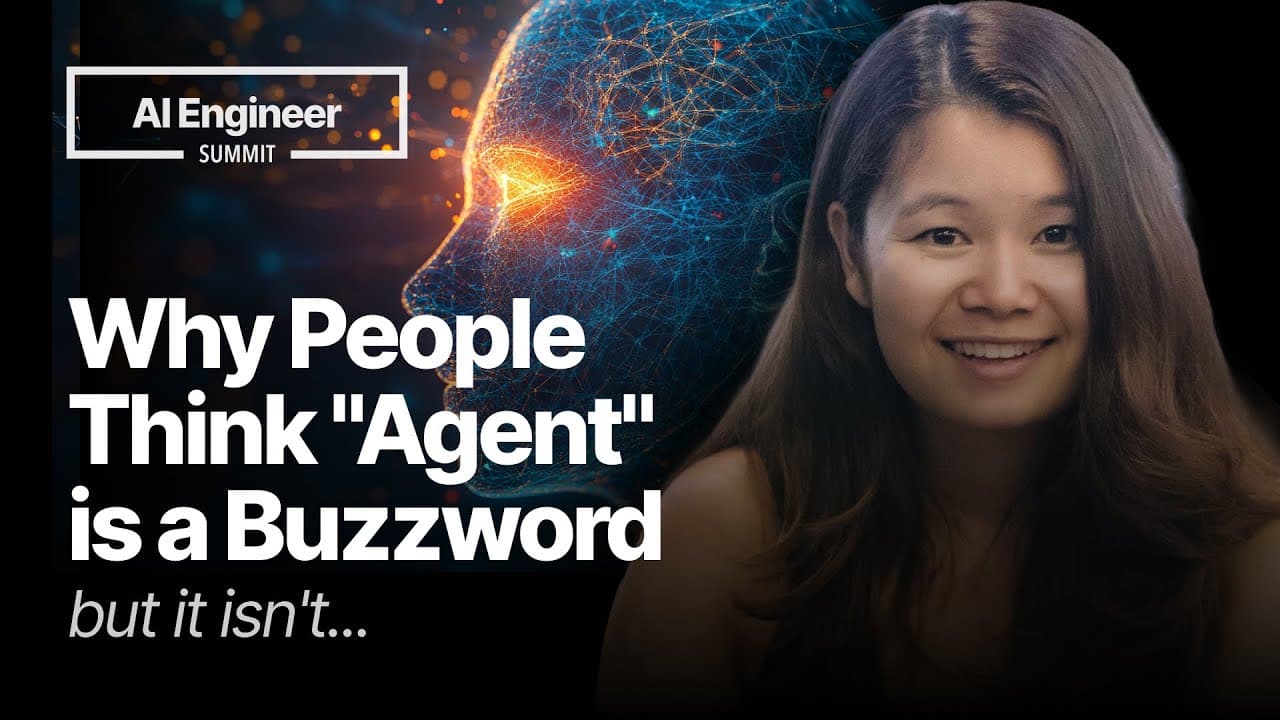
Why AI Agents Are More Than Just a Buzzword
TL;DR
AI agents are models that perceive an environment and act on it through tools such as web browsers, calculators, terminals, and file systems. Their practical value comes from addressing model limitations and fitting AI into existing workflows, but reliability declines quickly as tasks require more steps, making complexity management, stronger planning models, and task decomposition essential.
Transcript
hello my name is Chip I started an AI infrastructure setup a few years ago and after selling it last year I have been happily unemployed before that I work with Nvidia snug Ai and also taught a couple of courses at Stanford I have uh my uh for today I want to talk about the challenges in building agent or why people think agent is a b word and why ... Read More
Key Insights
- An agent is anything that can perceive its environment and act on that environment, according to the definition adopted in the talk. A chess board can be an environment, while legal chess moves are the actions available to the agent.
- An agent's environment determines which actions it can perform. A coding agent operating on a computer may navigate a repository, search files, view files, and edit content, while an agent placed inside a game remains limited to actions permitted by that game.
- Tool access expands an agent's effective environment. Giving a model web-browsing capability makes the internet part of its environment, while access to inboxes, calendars, terminals, file systems, or code editors connects the model to workflows where useful actions can occur.
- Actions can compensate for model limitations. Browsers and current-information APIs help answer questions beyond a model's cutoff date, while calculator access provides a practical alternative to training the model itself to become consistently strong at numerical computation.
- Specialized tools can extend the modalities available to a model. A text-based language model can use an image-captioning tool to convert an image into text, then use the resulting caption to construct a response about the image.
- Workflow integration is a central source of value for agents. When a model can act inside an inbox, calendar, or code editor, people can use its capabilities within their normal work instead of opening a separate browser interface for every interaction.
- Agent failure rates increase as tasks require more steps. With a 2% mistake probability at each step, the talk estimates that a ten-step task can produce a mistake about 18% of the time, illustrating how modest per-step errors accumulate.
- Task decomposition is one method for managing agent complexity. If an agent can reliably handle only about three steps while a task consistently requires five or six, the task can be divided into two smaller subtasks that better match the agent's capabilities.
Install to Summarize YouTube Videos and Get Transcripts
Explore YouTube Video Summarizer or Get YouTube Transcript Extractor
Questions & Answers
Q: What is an AI agent?
An AI agent is anything that can perceive an environment and act on that environment. The environment and available actions depend on the application. A chess agent perceives a chess board and acts through chess moves. A coding agent works within a computer environment and may navigate repositories, search files, view files, and edit content.
Q: Why are AI agents more than a buzzword?
AI agents are more than a buzzword because actions let models overcome limitations and participate directly in useful workflows. An agent can browse for recent information, use a calculator, process images through another model, or operate within inboxes, calendars, terminals, and code editors. These capabilities extend what a model can accomplish beyond generating isolated text responses.
Q: How do tools expand an AI agent's capabilities?
Tools give an agent new actions, and those actions can expand its effective environment. Web-browsing access makes the internet available to the agent. A calculator supports numerical work, while an image-captioning model lets a text model process visual input indirectly. Access to files, terminals, calendars, or inboxes similarly enables actions inside practical work environments.
Q: Why are multi-step agent tasks difficult?
Multi-step tasks are difficult because every additional step creates another opportunity for failure. Even when the probability of an error at an individual step is relatively small, errors accumulate across the entire workflow. The talk gives an example where a 2% mistake probability per step becomes about an 18% chance of a mistake across ten steps.
Q: How does task complexity affect agent reliability?
Agent reliability decreases rapidly as task complexity increases. The talk commonly measures complexity through the number of steps required to complete a task, although other use cases may define it differently. In the presented synthetic planning benchmark, most tested models could solve tasks requiring at most about five steps, while most failed after ten steps.
Q: How can a simple business query become an agent workflow?
A request for the number of people who bought products from a company last week can require several actions. The agent may first retrieve the company's product list, then obtain order counts for each product, sum those counts, and finally generate a response. This example shows how a seemingly simple query can become a four-step workflow.
Q: Do reasoning models handle complex agent tasks better?
The benchmark results presented in the talk show a substantial difference between newer reasoning models and the listed non-reasoning models. The curves for DeepSeek R1, Gemini 2.0 Flash Thinking, and o1 preview were pushed upward, indicating success on more complex tasks. The speaker expects planning capabilities to continue improving and unlock more practical applications.
Q: How can developers help agents complete complex tasks?
Developers can divide a complex task into smaller subtasks that match the agent's demonstrated capacity. If a workflow consistently requires five or six steps but the agent can reliably manage only about three, it can be split into two subtasks. This limits the amount of complexity presented at once and reduces exposure to accumulated step-level failures.
Summary & Key Takeaways
-
An agent is anything capable of perceiving an environment and acting on it. A chess agent operates through legal chess moves, while a coding agent works within a computer environment using actions such as repository navigation, file search, file viewing, and editing. Available actions determine what the agent can access and accomplish.
-
Actions extend model capabilities and help compensate for limitations. Web access supplies recent information beyond a model's cutoff date, calculators address weak arithmetic performance, and specialized tools let text models process images. Tool access can also embed models directly into inboxes, calendars, code editors, and other established workflows.
-
Agent reliability declines as task complexity and step count increase because errors accumulate across a workflow. The presented benchmark indicates that most tested models handled tasks requiring at most about five steps and generally failed after ten steps. Reasoning models performed better, while task decomposition was proposed as one way to control complexity.
Read in Other Languages (beta)
Share This Summary 📚
Summarize YouTube Videos and Get Video Transcripts with 1-Click
Try YouTube Summary with ChatGPT & Claude or YouTube Transcript Generator
Explore More Summaries from AI Engineer 📚



Summarize YouTube Videos and Get Video Transcripts with 1-Click
Try YouTube Summary with ChatGPT & Claude or YouTube Transcript Generator