How to Build Reliable AI Agent Skills for Work
TL;DR
Build reliable AI agent skills by targeting one small, repetitive task, supplying detailed process context, and improving the instructions through real use. Treat each skill like an intern or software product that requires observation and iteration, and divide long workflows into modular skills so context loss does not weaken performance.
Transcript
AI agents on Cloud Code, Co-work, and Code X are becoming more powerful by the day, but in order to actually automate work reliably, we need to get great at building agent skills. Skills are extremely powerful, but because they can be built with a one-line prompt and hundreds of them can be downloaded in one click, most people end up with dozens of... Read More
Key Insights
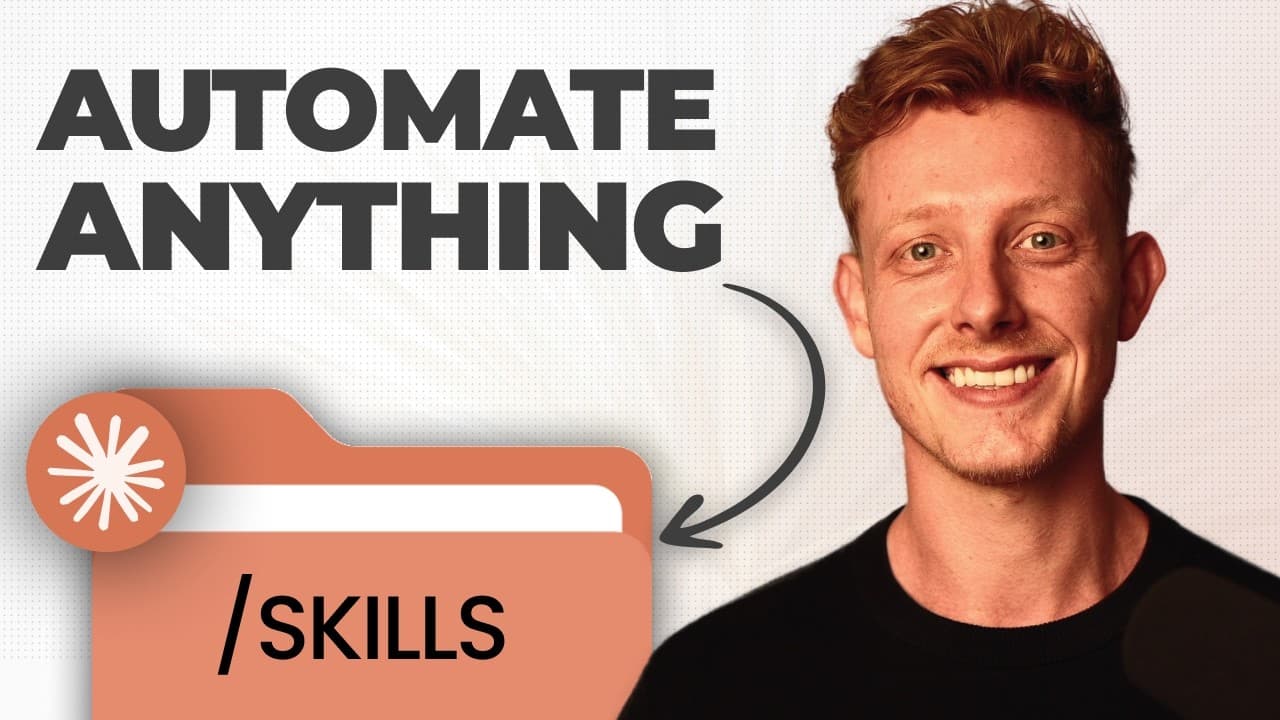
- AI agent skills are preset instructions that tell an agent how to complete a specific task. Their core is a skill.md text file, while optional reference files can supply examples, templates, contextual information, or guidance about the desired voice and personality.
- General skills are reusable helper tools that support many people and use cases, including fact checking, humanizing text, finding skills, and building skills. Because their application is broad, useful general skills can often be found online and downloaded instead of being developed for one organization.
- Work skills are customized instructions for recurring tasks and workflows within a particular business or professional role. Examples include LinkedIn writing, call preparation, email triage, YouTube research, sales work, marketing processes, and business operations that depend on organization-specific knowledge and practices.
- Work skills can be autonomous or human-assisted. An autonomous skill can execute through a scheduled task without ongoing involvement, while an assistant skill follows a defined process but still depends on a person to steer decisions and guide the model toward an acceptable result.
- A strong reason to build a skill is repeated work, repeated corrections, or repeatedly supplied context. Skills are also valuable when transferring a process because they can embed a person's knowledge and expertise in instructions that another person can use with an AI agent.
- Skill development is an iterative process comparable to onboarding an intern or building software. A first version should not be expected to work perfectly, because valuable performance emerges through actual use, observation, correction, and repeated optimization, which may require two iteration loops or five.
- Small modular skills are more reliable than a single skill covering an entire complex workflow. Long sequences can produce context rot, where the model remembers initial instructions less effectively, so research, ideation, title generation, packaging, outlining, writing, and image creation can be separated.
- Detailed process discovery is more effective than creating a skill from a one-line prompt. Planning with AI and answering extensive interview questions can establish a shared understanding of the intended process before construction, particularly when designing a new product, feature, software project, or workflow.
Install to Summarize YouTube Videos and Get Transcripts
Explore YouTube Video Summarizer or Get YouTube Transcript Extractor
Questions & Answers
Q: What is an AI agent skill and what does it contain?
An AI agent skill is a preset set of instructions that teaches an agent how to complete a specific task. It includes a skill.md text file that defines the steps the agent should follow. It can also contain reference files that improve execution, such as a voice and personality guide, successful examples, hook templates, or other task-specific context.
Q: When should you create an AI agent skill?
Create an AI agent skill when a task is repetitive, when you repeatedly give the agent the same corrections, or when you continually provide the same context to improve its output. A skill is also appropriate when you want to hand a process to someone else, because its instructions can capture and transfer your knowledge and expertise about that task.
Q: What is the difference between general skills and work skills?
General skills are broadly applicable helper tools that can support many tasks, people, and use cases. Examples include fact checking, humanizing text, finding skills, and building skills. Work skills are specific to a professional or business workflow, such as LinkedIn writing, email triage, call preparation, YouTube research, marketing, sales, or business operations, so they generally require customization.
Q: What is the difference between autonomous and assistant skills?
Autonomous work skills can run without a person participating during execution. The examples given are email triage and YouTube research skills that operate every morning at 8:00 a.m. through scheduled tasks. Assistant skills still follow a defined process, but a human remains involved and steers the model toward the right direction, as with the LinkedIn writer skill.
Q: Why should complex workflows be split into modular skills?
Complex workflows should be divided because an AI model can forget initial skill instructions as it completes more steps. This effect is described as context rot, where performance declines deeper into a conversation. Smaller skills let the agent reread focused instructions at each stage, improving reliability and efficiency while still allowing related skills to be used sequentially in the same chat.
Q: How do you choose the first task for an AI agent skill?
Start with the smallest part of a larger process that would still provide useful value by itself. In a content workflow involving research, LinkedIn posts, newsletters, and images, research alone may already be valuable. Build and stabilize that component first. Later stages can then be added, although separate skills are often preferable because each stage receives fresh, focused instructions.
Q: Why does one-shot prompting often produce weak skills?
One-shot prompting often produces weak skills because the AI does not receive enough context to understand the full process, its constraints, or the desired result. A one-line request encourages premature construction. Planning or a detailed process interview allows the agent to ask many questions and establish shared understanding before it writes the skill, reducing the need for endless correction afterward.
Q: How should an AI agent skill be tested and improved?
A skill should be used on real work, observed carefully, and refined whenever its behavior or output falls short. It should be treated like an intern being onboarded or software being developed, rather than a finished product created in one attempt. Depending on the task, reaching useful performance may require two iteration loops or five, with corrections incorporated into later versions.
Summary & Key Takeaways
-
AI agent skills are preset instructions that teach agents how to perform specific tasks. A skill contains a skill.md text file describing the process and may include reference materials such as personality guides, examples, or templates. Skills preserve working methods, reduce repeated explanations, and allow expertise to be shared with other people.
-
Useful work skills address repetitive business activities across areas such as marketing, sales, operations, and content production. Some can run autonomously through scheduled tasks, while assistant skills require human direction during execution. Both types benefit from clearly defined goals, sufficient context, realistic expectations, and ongoing refinement based on observed results.
-
Reliable skill development begins with the smallest part of a workflow that independently creates value. Complex processes should be divided into modular skills because instructions become easier to forget as a conversation grows. A detailed interview or planning process can capture domain knowledge before construction, while testing and optimization progressively improve practical performance.
Read in Other Languages (beta)
Share This Summary 📚
Summarize YouTube Videos and Get Video Transcripts with 1-Click
Try YouTube Summary with ChatGPT & Claude or YouTube Transcript Generator
Explore More Summaries from Ben AI 📚
Summarize YouTube Videos and Get Video Transcripts with 1-Click
Try YouTube Summary with ChatGPT & Claude or YouTube Transcript Generator