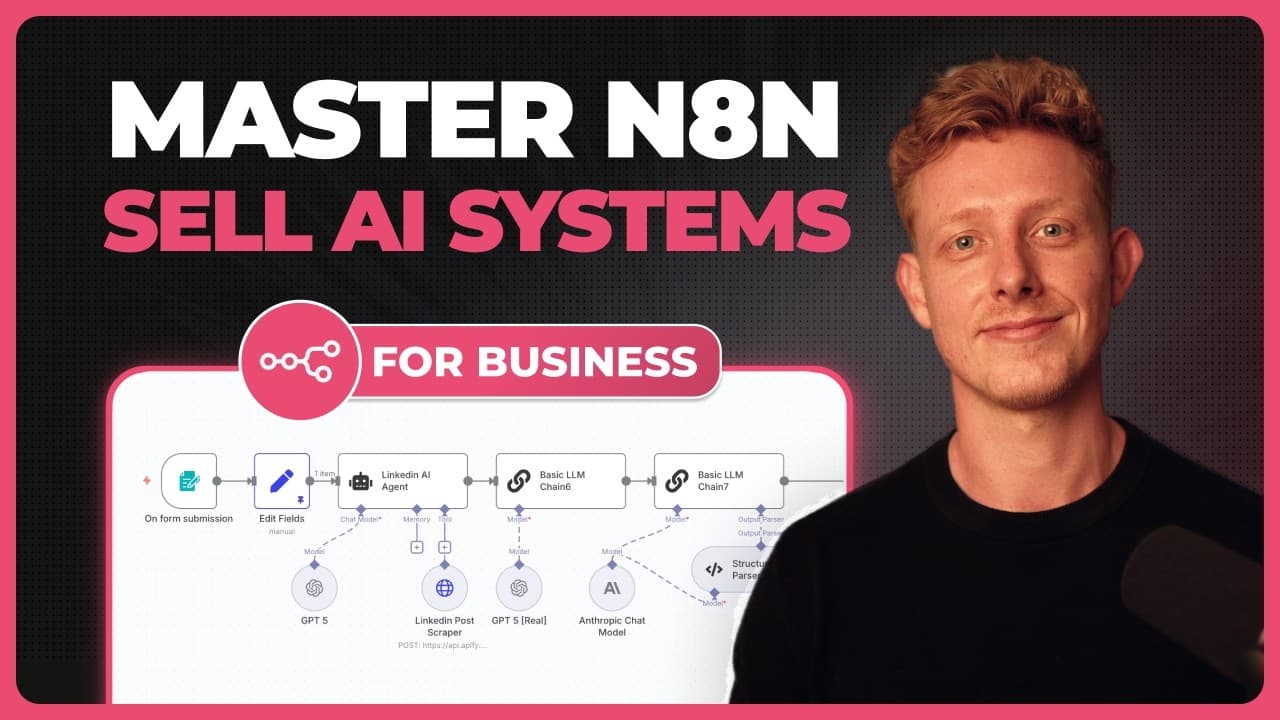
How to Build and Sell AI Automations with n8n
TL;DR
Combine n8n and AI automation skills with business domain expertise to create solutions that save time, reduce costs, or deliver measurable outcomes. Monetization options include custom automation agencies, AI-enabled service businesses, and packaged software products, while success depends on consistent practice, learning to debug failures, and designing systems around real business processes.
Transcript
So, in this video, I'll take you from zero experience in NAN and AI to being able to build and sell AI automations, AI agents, and even entire AI products. This is without a doubt one of the easiest and highest leveraged skills you can learn today to level up your career, build a business, or transform your existing business. I am Ben. I am not a c... Read More
Key Insights
- AI automation is most valuable when combined with domain expertise because that combination helps builders identify meaningful business problems and design relevant solutions. Nontechnical professionals can add automation capabilities to their existing knowledge, while technical people can develop domain knowledge or partner with experienced industry professionals.
- The beginner learning process is a cycle of difficulty, excitement, and renewed difficulty. Early technical concepts can feel overwhelming, first automations create enthusiasm, and production systems expose failures and edge cases. Persistence matters because recurring bugs become easier to recognize and resolve through experience.
- Production-ready automation is different from a successful demonstration because real business systems must handle errors, edge cases, and unreliable behavior. Debugging and error handling are therefore core parts of building, rather than signs that the builder lacks the ability to complete the system.
- Consistent practice is the recommended way to progress through difficult learning stages. The course suggests protecting one or two hours in a daily calendar for developing AI automation skills, especially for people who are balancing study with an existing job or business.
- An AI automation agency sells custom solutions that automate or enhance a company's existing processes. Its work can save time, reduce costs, and improve efficiency, but the model remains service-oriented and generally requires hiring more people as the volume of custom client work increases.
- An AI-enabled service business sells outcomes rather than AI technology. Examples of outcomes include leads, traffic, or recruited talent, while automation improves service delivery behind the scenes. This approach can support higher margins and allow a smaller team to manage greater revenue than a traditional service operation.
- An AI software business provides customers with a tool that delivers an outcome. It is especially relevant to people who understand a specific industry's pain points or have startup and software experience, although creating software is described as more difficult than offering a customized automation service.
- Packaged AI systems can be sold through more than one commercial structure. A business may charge customers for access through a subscription, or it may sell an entire system for a one-time price so that the purchasing business owns the intellectual property.
Install to Summarize YouTube Videos and Get Transcripts
Explore YouTube Video Summarizer or Get YouTube Transcript Extractor
Questions & Answers
Q: How can beginners start building AI automations with n8n?
Beginners can start by learning n8n's essential concepts through practical examples, including trigger nodes, action nodes, APIs, data types, JSON, data flow, and transformation nodes. They should then build simple automations before moving toward scraping, AI nodes, debugging, error handling, and production-ready systems. Reserving one or two hours each day can help maintain progress through the difficult early stages.
Q: Why should domain experts learn AI automation skills?
Domain experts already understand the processes, pain points, and desired outcomes within their profession or industry. Adding AI automation skills enables them to turn that knowledge into useful solutions for an employer, an existing business, or a new venture. The source identifies this combined skill set as particularly valuable because it connects technical capabilities with problems that businesses genuinely need to solve.
Q: What is the difference between a prototype and a production-ready automation?
A prototype or first automation may work under straightforward conditions and create excitement about what can be built. A production-ready automation must also cope with failing systems, recurring errors, and edge cases that appear in real business use. Reaching that level requires debugging and error-handling skills, plus the patience to recognize that technical failures are a normal part of building reliable systems.
Q: How can n8n and AI automation skills be monetized?
The course describes three primary monetization paths: an AI automation agency, an AI-enabled service business, and an AI software business. The agency creates custom automations for clients, the service business sells outcomes while automating delivery, and the software model sells a tool or packaged system. The appropriate path depends on domain expertise, business experience, desired scalability, and preferred delivery model.
Q: What does an AI automation agency sell to businesses?
An AI automation agency sells custom systems that automate or enhance processes already operating inside a business. The agency first understands those processes and then develops solutions intended to improve efficiency, save time, reduce costs, or transform how work is completed. Extensive prior domain expertise may be less necessary because clients bring their existing workflows and problems to the agency for analysis.
Q: How does an AI-enabled service business differ from an automation agency?
An AI-enabled service business sells a result, such as leads, traffic, or recruited talent, rather than selling the automation itself. AI and automation operate behind the scenes to improve delivery and outcomes. An automation agency, by contrast, develops custom systems for client processes. The service model can require fewer people to scale and can support higher margins because more delivery work is automated.
Q: What are the advantages and limits of the AI automation agency model?
The automation agency model is approachable for builders without extensive professional or industry expertise because client companies provide the processes that need improvement. Custom solutions can generate efficiency gains by saving time and reducing costs. Its main limitation is scalability: it remains a service agency, so growth over the long term generally requires hiring more people to deliver additional custom client projects.
Q: How can packaged AI software be sold to businesses?
Packaged AI software can be offered through access to a platform, potentially using a subscription, so customers use the tool themselves to produce an outcome. Another model is selling the entire software system to a business for a one-time price. Under the latter structure described in the source, the purchasing business owns the intellectual property rather than merely paying for continuing platform access.
Summary & Key Takeaways
-
The course presents n8n and AI automation as accessible skills for both technical and nontechnical professionals. It focuses on practical business applications, including automations, agents, and packaged products. The proposed learning path covers essential nodes, APIs, JSON, data flow, scraping, debugging, error handling, planning, and solution scoping.
-
Beginners should expect alternating periods of difficulty and excitement. Building an initial automation can produce many ideas, but production work introduces failures, edge cases, and recurring errors. The recommended response is consistent practice, such as reserving one or two hours each day, until debugging becomes a familiar part of development.
-
Three monetization models are described. Automation agencies build custom systems for businesses, AI-enabled service firms sell outcomes while automating delivery, and software businesses sell self-service or packaged tools. Each model has different requirements for domain expertise, staffing, scalability, pricing, and ownership of the finished system or intellectual property.
Read in Other Languages (beta)
Share This Summary 📚
Summarize YouTube Videos and Get Video Transcripts with 1-Click
Try YouTube Summary with ChatGPT & Claude or YouTube Transcript Generator
Explore More Summaries from Ben AI 📚
Summarize YouTube Videos and Get Video Transcripts with 1-Click
Try YouTube Summary with ChatGPT & Claude or YouTube Transcript Generator