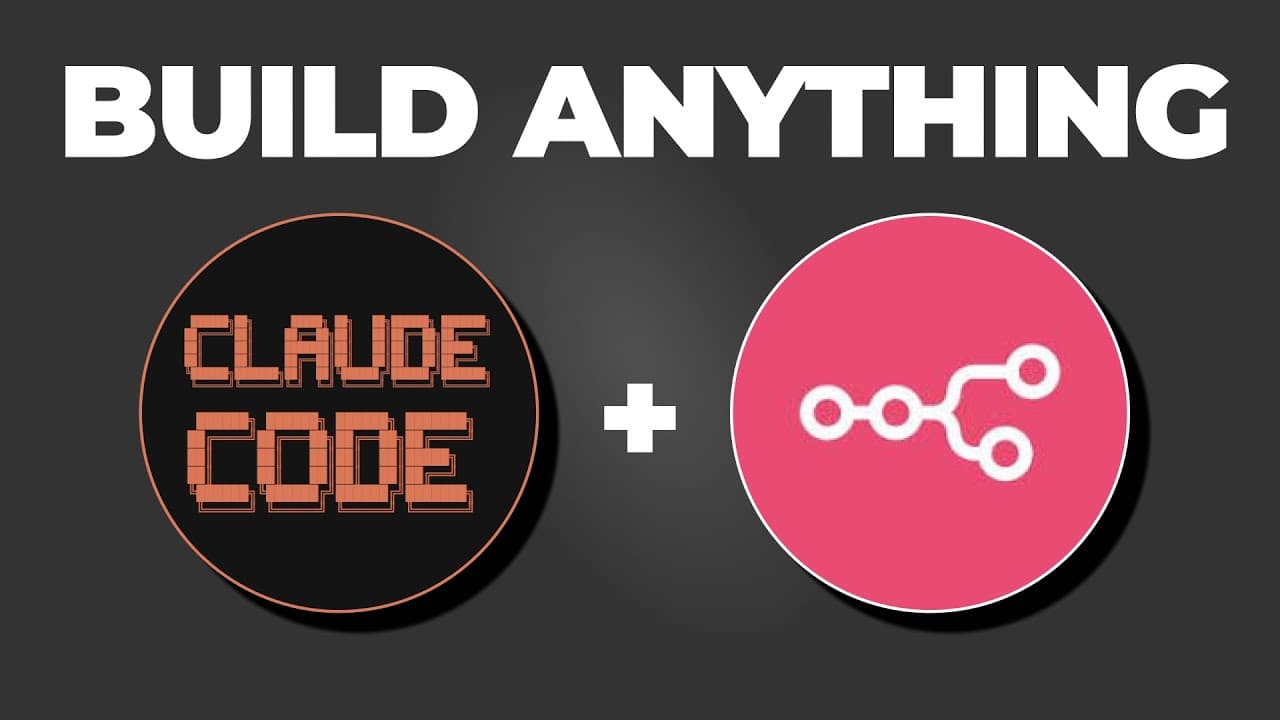
How to Build an AI SaaS with Claude Code and n8n
TL;DR
Build the product by defining its inputs and outputs, dividing the workflow into granular tasks, and keeping a human involved between AI-generated steps. Use one n8n webhook with identifiers to route requests, return results to a Claude Code-built interface, store application data with Supabase, test the complete workflow, and deploy it to a custom domain.
Transcript
So, in this video, I'm going to show you how to build an AI web app or AI SAS in minutes using Cloud Code and NAN without actually writing a single line of code. I've been testing tools like Lavable, Bolt, and Cursor over the last months. But in my experience, Cloud Code blows them all out of the water in terms of speed and front-end quality. And i... Read More
Key Insights
- AI product design is strongest when it starts with clearly defined inputs and outputs. The demonstrated system accepts a company URL, company name, and optional context, then aims to produce content for X, LinkedIn, and newsletters.
- A valuable AI product is designed around delivering a useful business outcome. Instead of treating isolated AI generation as the product, the workflow should package several connected tasks that move the user from initial information toward a usable final result.
- Partial autonomy is the recommended design for current AI applications because AI output remains unpredictable. Human review is inserted after context creation, strategic-angle generation, and idea generation so users can correct information and choose what the system should process next.
- The content workflow is divided into four granular tasks: business-context generation, strategic-angle generation, content-idea generation, and final content generation. Each stage produces a result for the interface before another automation is initiated.
- The n8n backend is organized around one webhook and a switch node. Requests include an identifier, and that identifier routes each call to the relevant workflow for context, strategy, ideas, or content generation.
- A Respond to Webhook node is required at the end of each demonstrated automation branch. It sends the generated data back to the application interface, where the user can review the output and decide whether to continue.
- A product requirements document gives Claude Code the information needed to begin building the application. The presenter uses a prompt template to create this document quickly, then supplies it to Claude Code to generate the initial web app.
- The demonstrated application is a prototype, not a finished production system. The presenter says its prompts would need substantial optimization, image generation and automatic publishing could be added, and a backend serving many customers would require a more scalable framework.
Install to Summarize YouTube Videos and Get Transcripts
Explore YouTube Video Summarizer or Get YouTube Transcript Extractor
Questions & Answers
Q: How do you plan an AI SaaS before building it?
Start with a clear product idea, then define the system’s inputs and outputs. For the demonstrated content application, the inputs include a company URL, company name, and optional user context. The desired outputs are posts for X and LinkedIn plus newsletters. Next, divide the end-to-end outcome into smaller tasks and identify where users should review, edit, or select results.
Q: Why should an AI workflow be divided into granular tasks?
Granular tasks make it possible to review each AI-generated result before the system proceeds. The demonstrated content process separates business-context generation, strategic-angle generation, idea generation, and final content creation. Each stage returns information to the interface, allowing the user to correct context or choose an option before triggering the next automation. This structure supports partial autonomy instead of uncontrolled end-to-end execution.
Q: Why is human review important in an AI SaaS workflow?
Human review is important because AI remains unpredictable, according to the presenter’s experience building an AI SEO product. Users can adjust the generated business context, select a strategic angle, choose an idea, and edit the finished content. These checkpoints keep people involved in consequential decisions while allowing automation to handle the generation work between each decision.
Q: How does one n8n webhook support multiple AI tasks?
The application sends requests to one n8n webhook and includes an identifier with each request. A switch node reads that identifier and routes the request to the correct branch, such as context generation, strategic-angle generation, idea generation, or content generation. This setup provides one connection point for the application while preserving separate, granular automation paths inside the backend workflow.
Q: How does n8n return generated data to the web app?
Each automation branch ends with a Respond to Webhook node. When the application calls the webhook, n8n routes the request to the correct workflow, processes the relevant task, and returns the output through that response node. The interface can then display the generated context, strategies, ideas, or content so the user can review the result and initiate the next action.
Q: What should a PRD contain for a Claude Code project?
A product requirements document should contain the information an engineer needs to begin building the product. In this workflow, the PRD translates the planned application, its inputs and outputs, its automation stages, and its required interface behavior into instructions for Claude Code. The presenter uses a prompt template to create the document quickly before generating the initial version of the web application.
Q: What does the demonstrated AI content SaaS generate?
The prototype manages content for multiple brands and begins with a website plus optional context. It can generate a target audience, brand tone, key offer, and strategic content angles for X, LinkedIn, and newsletters. Users can filter angles by platform, inspect objectives, create ideas from selected strategies, generate a post, edit that content, and review generated material from a dashboard.
Q: Is the demonstrated Claude Code and n8n app production-ready?
No. The presenter repeatedly describes the application and its automation as a prototype. He says the prompting would require substantial optimization to make the output good, and features such as image generation and automatic publishing could be added. He also warns that a full AI SaaS with many customers would require replacing the demonstrated n8n backend framework with something more scalable.
Summary & Key Takeaways
-
The process begins by defining what information enters the product and what outcome it should deliver. In the demonstrated content system, company information becomes content for X, LinkedIn, and newsletters. The full process is divided into context generation, strategic-angle generation, idea generation, and final content generation, with user decisions between stages.
-
The n8n backend uses one webhook, a switch node, and an identifier that routes each request to the appropriate automation. Every automation returns its output to the interface through a Respond to Webhook node. This structure lets the user inspect, adjust, or select generated results before triggering the next part of the workflow.
-
A product requirements document gives Claude Code the information needed to create the initial web application. The broader build sequence covers planning, backend automation, PRD creation, Claude Code setup, application construction, Supabase database integration, testing, debugging, and deployment. The demonstrated result is explicitly presented as a prototype rather than a production-ready SaaS product.
Read in Other Languages (beta)
Share This Summary 📚
Summarize YouTube Videos and Get Video Transcripts with 1-Click
Try YouTube Summary with ChatGPT & Claude or YouTube Transcript Generator
Explore More Summaries from Ben AI 📚


Summarize YouTube Videos and Get Video Transcripts with 1-Click
Try YouTube Summary with ChatGPT & Claude or YouTube Transcript Generator