How to Build a Profitable AI-First Service Agency
TL;DR
Build an AI-first service agency by selling business outcomes while using AI and automation behind the scenes to systemize delivery. This model can support more clients per account manager, faster results, higher margins, and lower prices than traditional service delivery, while opening both established agency markets and underserved small-business niches.
Transcript
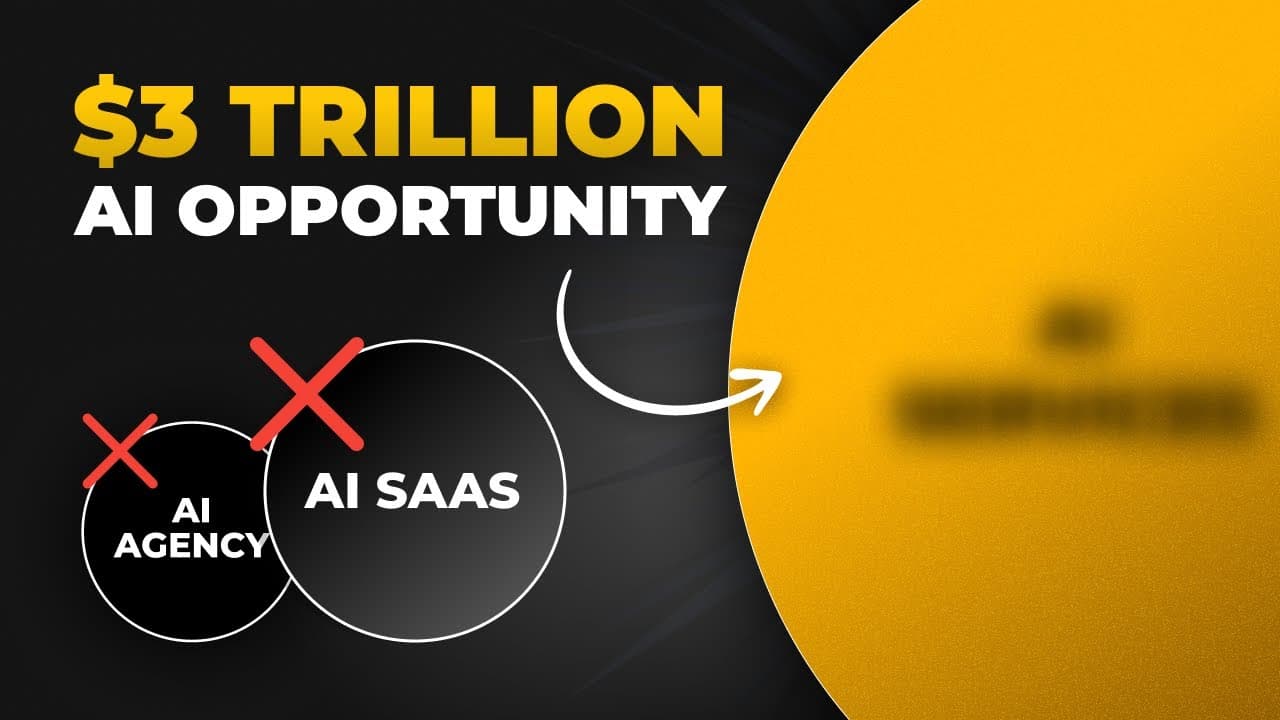
In 2025, the AI automation agency market is around 11 billion. The SAS market around 300 billion. But there's a $3 trillion market being disrupted by AI that nobody's talking about, the service industry. And while most attention in AI goes towards AI agencies or AI SAS, thousands of business owners are quietly attacking the biggest market of them a... Read More
Key Insights
- The service industry is presented as a $3 trillion market being disrupted by AI, compared with an AI automation agency market of around $11 billion and a SaaS market of around $300 billion in 2025. The argument is that services receive less attention despite their larger scale.
- AI-first service agencies are businesses that combine specialized service expertise with AI and automation in their internal operations. They use these technologies to systemize processes, automate portions of delivery, increase capacity, improve margins, and produce better or faster client outcomes.
- Traditional service agencies are constrained by hiring, training, and knowledge transfer. The transcript states that even strong agencies generally do not exceed 20–30% margins, while continued growth requires more staff and a steady effort to acquire enough clients to preserve profitability.
- The core offer is a business outcome rather than access to AI. ColdIQ sells lead-generation results, Rocket provides talent, Superside supports brand and marketing work, and the presenter’s company sells SEO results while using AI systems internally to perform the service.
- ColdIQ is described as an outbound email lead-generation agency that automates prospect research, lead research, and email personalization. The transcript reports approximately $6 million in annual recurring revenue during the previous year with a relatively small service team of roughly 30–35 employees.
- AI-assisted delivery can create a differentiated commercial offer through lower retainers, outcome-based pricing, faster execution, and improved results. Automating service work can also let each account manager support more clients, reducing the expert staffing overhead that limits conventional agencies.
- The red-ocean opportunity is to compete for existing, high-budget agency customers. An AI-first provider can challenge established firms by offering lower prices, faster delivery, enhanced outcomes, or pricing linked directly to results, while avoiding some traditional scaling constraints.
- The blue-ocean opportunity is to serve smaller businesses, specialized verticals, and specific regions that conventional agencies found too expensive or unattractive. Lower-cost automated or productized delivery can make previously uneconomical customers viable and reveal demand with little existing competition.
Install to Summarize YouTube Videos and Get Transcripts
Explore YouTube Video Summarizer or Get YouTube Transcript Extractor
Questions & Answers
Q: What is an AI-first service agency?
An AI-first service agency combines traditional expertise in an area such as marketing, recruiting, or SEO with AI and automation in its internal delivery process. It does not primarily sell AI technology to clients. It sells outcomes, then uses automated systems to standardize work, increase client capacity, accelerate delivery, improve results, and potentially operate at higher margins.
Q: How does an AI-first agency differ from an AI automation agency?
An AI-first service agency sells an established business outcome, such as qualified leads, new hires, brand awareness, or SEO results. AI is mainly part of the back-end delivery system and may not even appear prominently in its marketing. The defining distinction is that customers buy the completed service and its results, rather than buying AI implementation or consulting itself.
Q: Why can AI-first service agencies be more scalable?
AI-first service agencies can automate or systemize tasks that traditionally require additional employees, repeated training, and manual knowledge transfer. This allows an account manager to handle more clients and reduces dependence on hiring experts for every increase in workload. The resulting operational leverage can improve margins, speed up delivery, and reduce the staffing bottleneck associated with traditional agency growth.
Q: What services are suitable for an AI-first agency model?
The transcript identifies growth, talent, and operational services as the broad categories. Its main focus is digital marketing and talent services, including content, paid advertising, SEO, lead generation, recruiting, staffing, and headhunting. It also mentions legal services, accounting, bookkeeping, and outsourced customer support as operational categories where service delivery may be affected by AI and automation.
Q: Should an AI-first business sell software or managed services?
An AI-first business does not have to become a self-service software product. High-budget companies may prefer paying a provider for completed outcomes because they do not want another internal tool to operate. Managed services can therefore remain attractive. Productization is more suitable when a standardized tool can make a formerly expensive service accessible to smaller customers at a lower price.
Q: How can an AI-first agency compete with traditional agencies?
An AI-first agency can compete by automating substantial parts of service delivery and turning the resulting efficiency into a stronger client offer. The transcript identifies lower retainers, full outcome-based pricing, faster execution, and better results as possible advantages. These benefits can make the agency attractive to existing high-budget buyers while supporting more clients without proportionally expanding its expert team.
Q: What is the blue-ocean opportunity for AI-first services?
The blue-ocean opportunity is to target customers that traditional agencies could not serve economically. Smaller businesses, specialized verticals, and specific geographic markets may need marketing, talent, or operational support but find conventional agency fees too expensive. Automation and productization can lower delivery costs enough to serve these customers, opening markets described as having untapped demand and little competition.
Q: What examples illustrate the AI-first service model?
ColdIQ uses AI and automation for outbound prospecting, lead research, and email personalization. Rocket pairs recruiters with proprietary AI to source and deliver candidates faster. Superside applies AI within a broad range of creative and marketing services. The presenter’s company uses an internal AI SEO system to deliver SEO outcomes directly to clients while supporting more accounts per manager.
Summary & Key Takeaways
-
AI-first service agencies combine traditional domain expertise with AI and automation. Instead of selling AI itself, they sell valuable outcomes such as leads, hires, brand awareness, or SEO results. Automating research, production, and other delivery processes can reduce staffing constraints, support more clients, improve margins, and accelerate results.
-
The model can compete for existing high-budget agency clients through lower retainers, faster delivery, improved outcomes, or outcome-based pricing. It can also serve smaller businesses that traditional agencies could not profitably target. Specialized industries, geographic markets, and other underserved niches may offer demand with less direct competition.
-
Businesses can remain service providers or move toward self-service products. ColdIQ, Rocket, Superside, and the presenter’s SEO operation illustrate AI-assisted service delivery, while Hoppy Copy, POPAI, and Opus Clip illustrate productization. The appropriate format depends on whether customers prefer managed outcomes or software they operate themselves.
Read in Other Languages (beta)
Share This Summary 📚
Summarize YouTube Videos and Get Video Transcripts with 1-Click
Try YouTube Summary with ChatGPT & Claude or YouTube Transcript Generator
Explore More Summaries from Ben AI 📚

Summarize YouTube Videos and Get Video Transcripts with 1-Click
Try YouTube Summary with ChatGPT & Claude or YouTube Transcript Generator