How Integrals Inverse Derivatives Explained

TL;DR
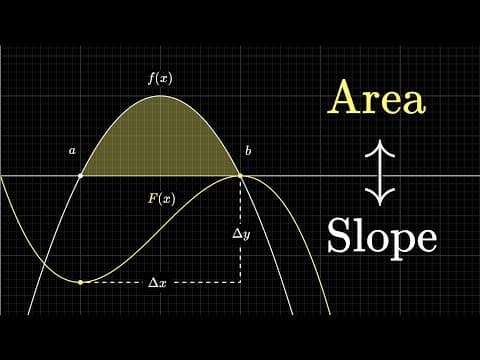
The integral accumulates velocity over time to give distance, acting as the inverse of the derivative. By interpreting distance traveled as the area under the velocity graph, we see how taking the derivative of this area recovers velocity. This builds intuition for why integrals solve area and accumulation problems in science and math.
Transcript
This guy, Grothendieck, is somewhat of a mathematical idol to me, and I just love this quote, don't you? Too often in math, we dive into showing that a certain fact is true with a long series of formulas before stepping back and making sure it feels reasonable, and preferably obvious, at least at an intuitive level. In this video, I want to talk ab... Read More
Key Insights
- The distance traveled over a time interval equals the area under the velocity curve over that interval.
- Integrals are defined as the limiting sum of tiny area elements, not a fixed finite sum.
- Treating velocity as piecewise constant on small intervals approximates motion and leads to the integral concept.
- Refining the time step dt makes the rectangle approximation more accurate and approaches the exact area.
- The area under a velocity curve between 0 and T forms a distance function s(t).
- The derivative of the distance function s(t) is the velocity function v(t).
- The fundamental idea is that the integral accumulates contributions over time to give a total.
- Antiderivatives undo derivatives, turning rates back into accumulated quantities like distance.
Install to Summarize YouTube Videos and Get Transcripts
Explore YouTube Video Summarizer or Get YouTube Transcript Extractor
Questions & Answers
Q: What is the core idea behind the integral in this video
The core idea is that the integral computes the accumulation of small contributions, here the distance traveled, by summing tiny area pieces under the velocity curve. As we refine the time steps dt toward zero, these tiny rectangles add up to the exact area, which represents total distance, linking accumulation to area under a graph.
Q: How is distance related to the velocity graph in the explanation
Distance is shown as the area beneath the velocity graph over a given time interval. When velocity changes, the accumulated distance is the sum of small rectangular areas, each with height equal to velocity at a chosen time and width dt. This area corresponds to the total distance traveled.
Q: Why does the video discuss approximating velocity with rectangles
Rectangles provide a simple way to approximate motion when velocity is not constant. By choosing the height of each rectangle as the velocity at the interval start, we create a clear, computable area. As dt shrinks, these approximations converge to the true area under the curve, yielding the exact distance.
Q: What happens when we differentiate the area function s(t)
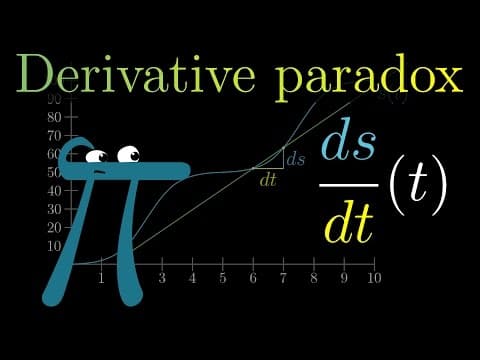
Differentiating the area function s(t) with respect to time yields the velocity v(t). This is because the incremental change in area corresponds to a small time increment dt times the velocity, so ds/dt equals v(t). This demonstrates that the derivative of the accumulated area recovers the original rate of change.
Q: What is the fundamental theorem of calculus as presented here
The fundamental idea is that the derivative of the area under a curve equals the original function, and the integral accumulates that area to produce a distance. This establishes a deep connection: derivatives and integrals are inverse operations, with the area under a velocity curve giving distance and its derivative giving velocity.
Q: Why is area under a curve described as a general tool
Area under a graph serves as a unifying language for many problems because it translates a dynamic, changing quantity into a static measure that can be added up. This perspective helps solve a wide range of problems by converting rates into accumulated quantities through integration.
Q: How does the video justify using smaller dt values
Smaller dt values reduce the error of the rectangle approximation, increasing the number of rectangles to fill the same time span. This refinement makes the sum converge to the exact area under the curve, which corresponds to the true distance traveled, illustrating the limit concept essential to defining integrals.
Q: What intuition does the velocity to distance relation provide about integrals
The intuition is that integration aggregates countless tiny contributions over time, turning a rate into a total. By summing velocity over time, we accumulate distance; by differentiating this accumulated distance, we recover velocity. This reciprocal relationship is the essence of why integrals and derivatives are interconnected.
Summary & Key Takeaways
-
The video connects velocity, distance, and area to illustrate why integrals are inverse to derivatives, using a car example and area interpretation. The idea is developed by approximating motion with small rectangles and refining to a precise area under the velocity curve. The fundamental theorem links accumulation and rate of change.
-
Distance as area under velocity leads to an antiderivative, showing how d/dt of the area yields velocity. The approach motivates broader integral problems and sets up the fundamental theorem of calculus in a general sense.
-
The video emphasizes intuition behind area under a curve, its relation to accumulation, and how a derivative of the area function recovers the original graph. It prepares the reader for extending these ideas to multiple contexts in calculus.
Read in Other Languages (beta)
Share This Summary 📚
Summarize YouTube Videos and Get Video Transcripts with 1-Click
Try YouTube Summary with ChatGPT & Claude or YouTube Transcript Generator
Explore More Summaries from 3Blue1Brown 📚
Summarize YouTube Videos and Get Video Transcripts with 1-Click
Try YouTube Summary with ChatGPT & Claude or YouTube Transcript Generator