How to understand divergence and curl in vector fields?
TL;DR
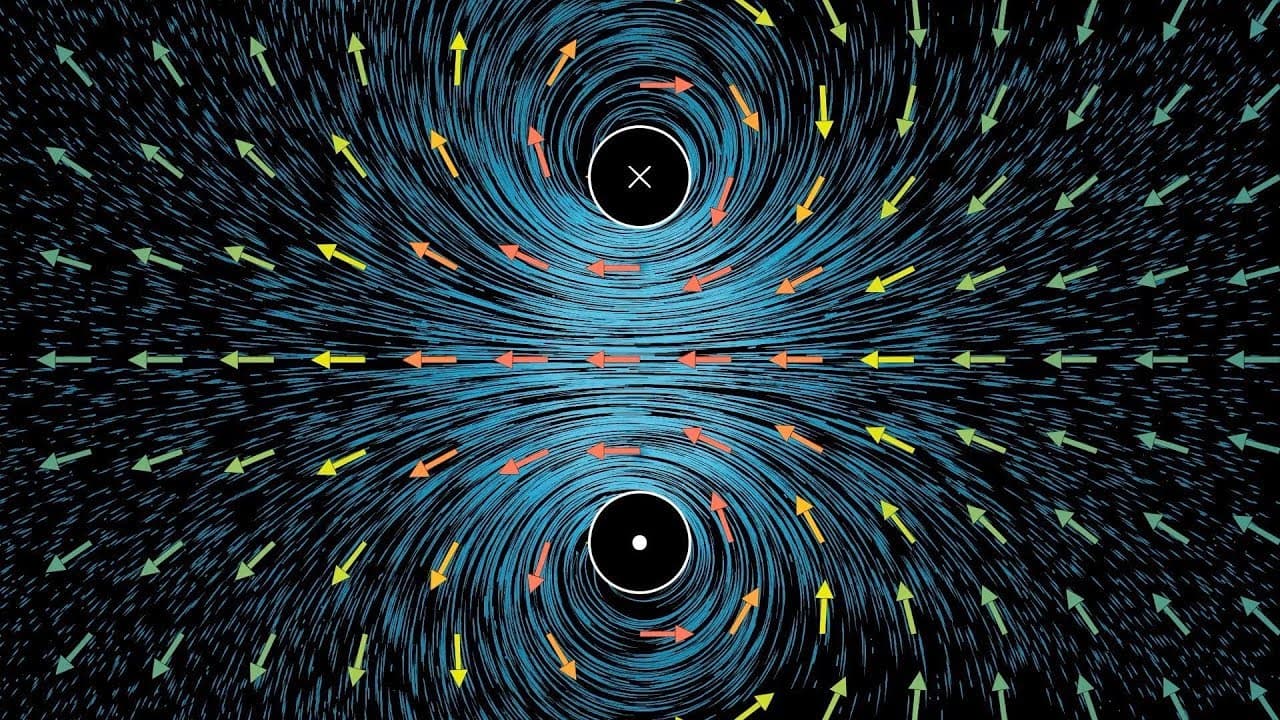
Divergence measures how much a small region acts as a source or sink for a vector field, while curl captures local rotation around a point. The video frames these ideas through fluid flow intuition and ties them to Maxwell’s equations, showing how divergence and curl explain physical phenomena such as charge distribution and magnetic fields, and how they relate to three dimensional effects.
Transcript
Today, you and I are going to get into divergence and curl. To make sure we're all on the same page, let's begin by talking about vector fields. Essentially a vector field is what you get if you associate each point in space with a vector, some magnitude and direction. Maybe those vectors represent the velocities of particles of fluid at each point... Read More
Key Insights
- Divergence measures the tendency of a field to originate from or converge to a point, functioning as a local source or sink in the surrounding region.
- Curl represents the rotational tendency of a field around a point, indicating how the field circulates in the nearby neighborhood.
- Incompressible fluid flow has zero divergence everywhere, meaning no net outflow or inflow at any point.
- Curl is conceptually a three dimensional idea, but a two dimensional version can be used to assign a scalar rotational value to each point.
- Maxwell's equations relate divergence and curl between electric and magnetic fields, linking how one field changes to the behavior of the other.
- Non physical interpretations, like visualizing electric fields as fluids, can provide intuition for otherwise abstract vector identities.
- The field of differential equations benefits from phase space visualization where vectors show how system states evolve over time.
- Practical practice with computing divergence and curl helps reveal the structure of the underlying physical or abstract systems.
Install to Summarize YouTube Videos and Get Transcripts
Explore YouTube Video Summarizer or Get YouTube Transcript Extractor
Questions & Answers
Q: What is divergence in simple terms for a 2D vector field?
Divergence in a 2D vector field is a single number at each point that tells you whether a small neighborhood tends to add more fluid leaving the point or more fluid entering it. A positive value means the region acts like a source, a negative value means it acts like a sink, and zero indicates incompressible flow in that neighborhood.
Q: How does curl relate to rotation in a fluid flow around a point?
Curl measures how much the fluid tends to rotate around a point. If a twig dropped into the fluid would tend to spin around the point, there is nonzero curl. Positive curl corresponds to counterclockwise rotation and negative curl corresponds to clockwise rotation, even though directions of surrounding vectors may vary.
Q: Why are these concepts important in Maxwell's equations?
Divergence and curl are central in Maxwell's equations because they describe how electric and magnetic fields change in space. The divergence relates to charge density in Gauss's law, while the curl relates to how changing magnetic fields produce electric fields and vice versa, enabling the description of electromagnetic waves and field dynamics.
Q: What intuition helps when thinking about divergence for real fluids?
For real fluids, divergence can be understood as the net rate at which fluid content increases or decreases in a small region. If the flow is incompressible, the density of fluid remains constant locally, leading to a divergence of zero everywhere, which constrains the possible vector fields that describe the flow.
Q: How does the two dimensional curl differ from the full three dimensional concept?
In two dimensions, curl reduces to a single scalar value at each point, representing the rotation tendency of the field about that point, rather than a full vector in 3D. The essential idea remains the same: it captures local swirling behavior, but the representation is simplified to a scalar in the plane.
Q: Can you use a phase space view to relate divergence and curl to dynamic systems?
Yes, in phase space each point represents a state of the system and a vector shows how those states change. Divergence and curl give information about growth or rotation of nearby trajectories in that space, helping to identify attracting or repelling behavior and possible cyclic dynamics in the evolution of the system.
Q: What is the practical takeaway about computing divergence and curl?
Practice with the computations reveals how fields behave locally and globally. The divergence is the dot product of a gradient-like operator with the field, while the curl is a cross product that encodes rotation. Mastery helps interpret physical fields, differential equations, and the way quantities interact in space.
Q: Why is the illustration of fields as fluid helpful for understanding?
Imagining a vector field as a fluid flow makes the abstract operators tangible. Divergence corresponds to sources and sinks in the flow, while curl corresponds to local rotation. This metaphor makes it easier to visualize how fields interact and how the same mathematical objects appear in different physical contexts.
Summary & Key Takeaways
-
Divergence quantifies net outflow from a point in a vector field, acting like a local source or sink.
-
Curl describes local rotation or swirling of the field around a point, indicating rotational behavior.
-
Maxwell’s equations use divergence and curl to describe how electric and magnetic fields interact and propagate as waves.
Read in Other Languages (beta)
Share This Summary 📚
Summarize YouTube Videos and Get Video Transcripts with 1-Click
Try YouTube Summary with ChatGPT & Claude or YouTube Transcript Generator
Explore More Summaries from 3Blue1Brown 📚
Summarize YouTube Videos and Get Video Transcripts with 1-Click
Try YouTube Summary with ChatGPT & Claude or YouTube Transcript Generator