What Is a Fourier Series and How Does It Work?
TL;DR
A Fourier series is a way to represent a function as the sum of simple sine waves. By adjusting the size and angle of rotating vectors, it can approximate any shape or function. This mathematical tool is crucial for solving differential equations and understanding complex systems in physics and engineering.
Transcript
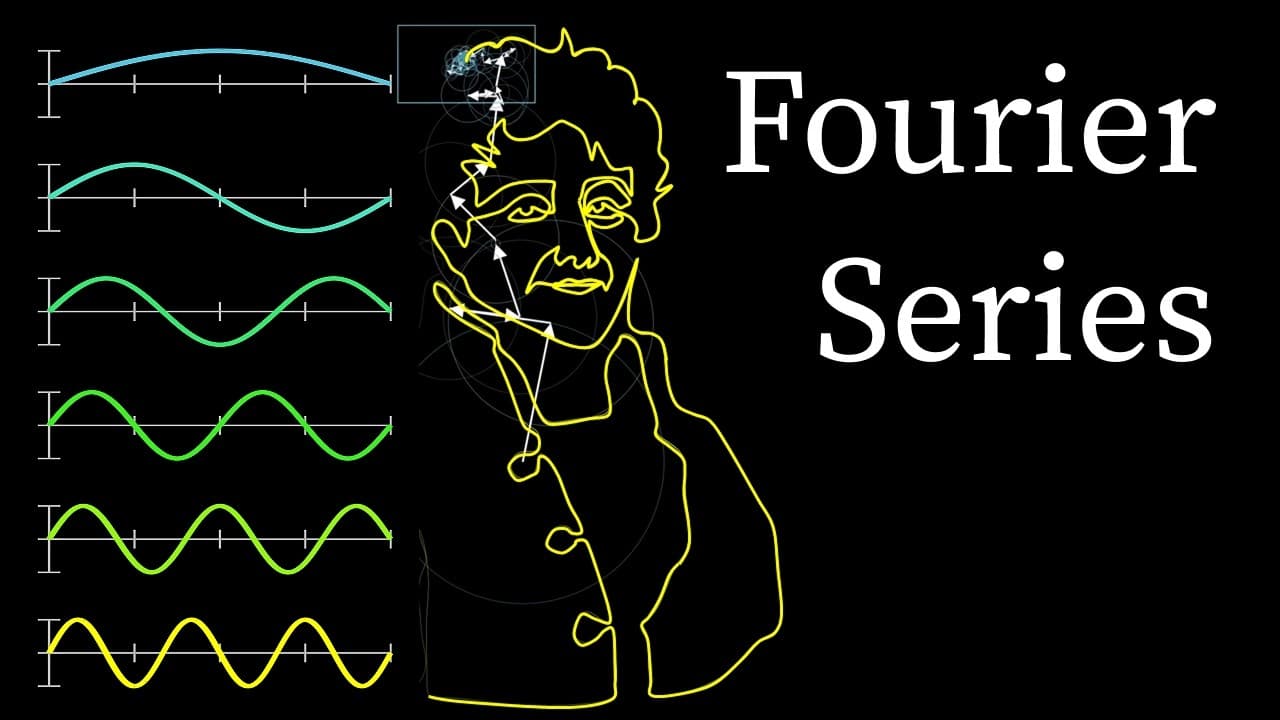
Here, we look at the math behind an animation like this one, what's known as a complex Fourier series. Each little vector is rotating at some constant integer frequency, and when you add them together, tip to tail, the final tip draws out some shape over time. By tweaking the initial size and angle of each vector, we can make it draw pretty much... Read More
Key Insights
- A Fourier series breaks down complex functions into sums of sine waves.
- The complex Fourier series uses rotating vectors to approximate shapes.
- Fourier series are crucial for solving linear differential equations.
- The heat equation led to the development of Fourier series.
- Infinite sums of sine waves can approximate discontinuous functions.
- Fourier series can describe complex natural phenomena mathematically.
- Complex exponentials simplify computations in Fourier series.
- The coefficients in a Fourier series determine the shape being drawn.
Install to Summarize YouTube Videos and Get Transcripts
Explore YouTube Video Summarizer or Get YouTube Transcript Extractor
Questions & Answers
Q: What is a Fourier series used for?
A Fourier series is used to express complex functions as sums of simpler sine waves. This mathematical tool is essential for analyzing periodic phenomena, solving differential equations, and modeling various natural and engineered systems. It allows for the decomposition of functions into fundamental frequencies, aiding in understanding and controlling complex behaviors.
Q: How does a Fourier series represent a function?
A Fourier series represents a function by decomposing it into a sum of sine and cosine waves, each with specific frequencies and amplitudes. By adjusting the coefficients of these waves, the series can approximate the original function closely, capturing its periodic nature. This method is particularly useful for functions that exhibit repeating patterns.
Q: Why are Fourier series important in mathematics?
Fourier series are important in mathematics because they provide a powerful framework for analyzing and solving problems involving periodic functions. They are crucial in fields such as signal processing, heat transfer, and acoustics, where understanding the frequency components of a signal or function is essential. Fourier series simplify complex problems by breaking them down into manageable parts.
Q: What role do rotating vectors play in Fourier series?
In Fourier series, rotating vectors are used to visualize and compute the components of a function. Each vector represents a sine wave with a specific frequency, and their combination approximates the original function. By adjusting the length and angle of these vectors, the series can accurately represent complex shapes and patterns, making it easier to analyze and understand periodic phenomena.
Q: How did Fourier series originate?
Fourier series originated from Joseph Fourier's work on the heat equation in the early 19th century. He discovered that complex temperature distributions could be expressed as sums of simple sine waves, leading to a general method for solving linear differential equations. This breakthrough laid the foundation for modern signal processing and mathematical analysis of periodic functions.
Q: What is the significance of complex numbers in Fourier series?
Complex numbers are significant in Fourier series because they simplify the representation and computation of rotating vectors. By using complex exponentials, the series can efficiently handle both the magnitude and phase of each component wave, making calculations cleaner and more intuitive. This approach also extends the applicability of Fourier series to functions with complex outputs, broadening their usefulness in mathematical analysis.
Q: Can Fourier series approximate discontinuous functions?
Yes, Fourier series can approximate discontinuous functions by using infinite sums of sine waves. Although finite sums cannot capture discontinuities perfectly, the series approaches the function's shape as more terms are added. This ability to approximate discontinuous behaviors makes Fourier series valuable for modeling real-world phenomena, such as sudden changes in temperature or signal jumps.
Q: How are Fourier series applied in engineering?
In engineering, Fourier series are applied to analyze and design systems that involve periodic signals, such as electrical circuits, communication systems, and mechanical vibrations. By breaking down complex signals into their frequency components, engineers can optimize system performance, filter noise, and predict system behavior under various conditions. Fourier series provide a foundational tool for understanding and controlling dynamic systems.
Summary & Key Takeaways
-
Fourier series allow functions to be expressed as sums of sine waves, crucial for analyzing periodic phenomena. By adjusting the coefficients of these waves, complex shapes and functions can be approximated, making it a powerful tool in mathematics and physics.
-
The video explains how Fourier series originated from solving the heat equation, highlighting their far-reaching applications in various fields. It shows how complex rotating vectors can simplify the representation of functions, enhancing understanding of periodic systems.
-
Viewers learn about the mathematical foundation of Fourier series, including the use of complex numbers and exponentials. This approach provides a clear understanding of how functions can be decomposed into simpler components, aiding in solving differential equations.
Read in Other Languages (beta)
Share This Summary 📚
Summarize YouTube Videos and Get Video Transcripts with 1-Click
Try YouTube Summary with ChatGPT & Claude or YouTube Transcript Generator
Explore More Summaries from 3Blue1Brown 📚
Summarize YouTube Videos and Get Video Transcripts with 1-Click
Try YouTube Summary with ChatGPT & Claude or YouTube Transcript Generator