How to assess AI code leaks in supply chains?
TL;DR
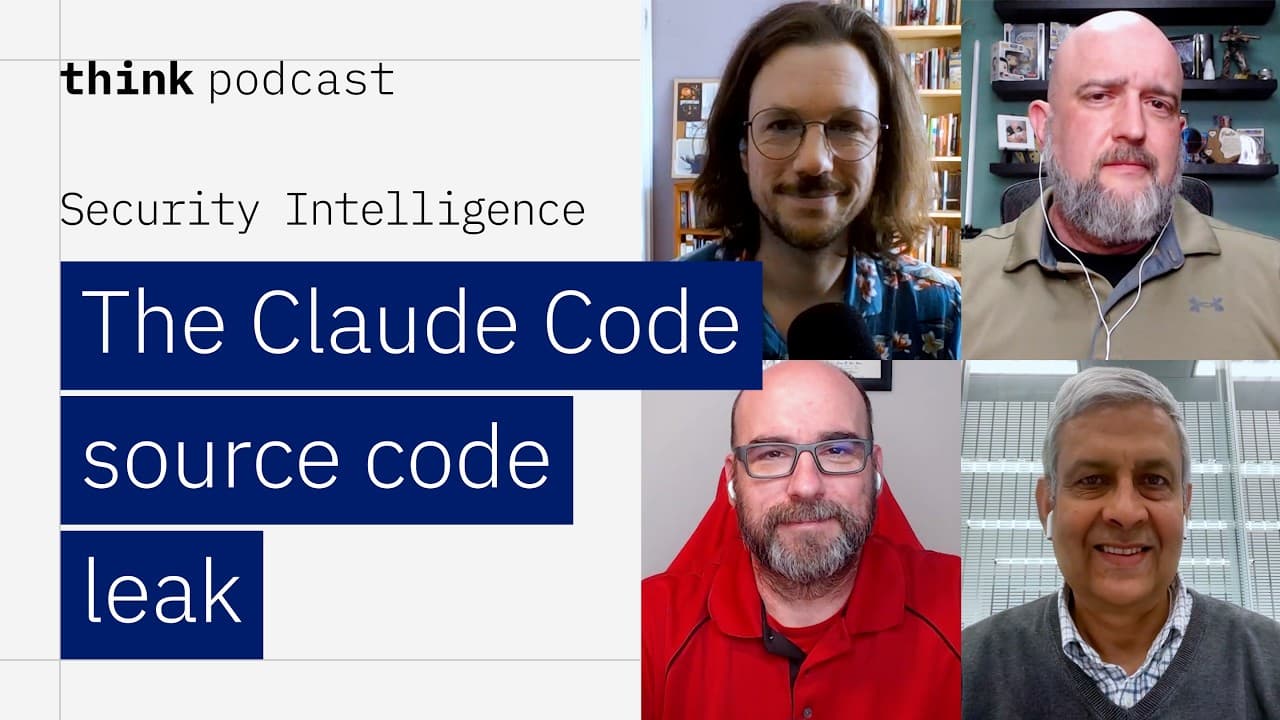
The Claude Code leak highlights supply chain risks in AI tools and how attackers exploit lookalike packages and npm trust chains. Defenders should focus on supply chain hygiene, risk from open source ecosystems, and cautious rollout of AI tools in CI CD pipelines. Mitigation requires careful testing and monitoring rather than rushing patches.
Transcript
I think Claude Anthropic is going to be just fine. And any tool that you think you're going to use for something good, someone else is going to use it for something bad. All that and more on Security Intelligence. Hello and welcome to Security Intelligence, IBM's weekly cybersecurity podcast, where our expert panelists turn the biggest industry new... Read More
Key Insights
- AI tool leaks can undermine supply chains by exposing internal code and workflows.
- The trusted supply chain is increasingly attacked through npm lookalike and typosquatting attacks.
- Open source ecosystems require careful dependency and version management to prevent exploitation.
- Code leaks enable attackers to study guardrails and potentially weaponize tools.
- There is a distinction between immediate malware spread and long term malicious reuse of leaked code.
- Defenders should inspect artifacts, hashes, and provenance, but recognize there are limits to hashing based checks.
- Proactive lab testing and staged upgrades help reduce risk when adopting AI tools.
- Organizational security should account for non events and close-call databases to strengthen AI adoption guidelines.
- More videos from this channel:
- More from this channel: IBM Technology
Install to Summarize YouTube Videos and Get Transcripts
Explore YouTube Video Summarizer or Get YouTube Transcript Extractor
Questions & Answers
Q: How can organizations assess the risk of AI tool leaks in their supply chains?
Organizations should start by mapping their AI tool dependencies across the CI CD pipeline and third party libraries. They need to monitor for lookalike packages and typosquatting attempts in npm and similar ecosystems. Regularly verify provenance, review guardrails and policy controls in AI tooling, and implement staged upgrades to test compatibility and security before full deployment. This approach helps identify potential exposure from leaked code and reduces the chance of weaponized reuse of code. Continuous monitoring and incident response planning are essential to adapt to evolving threats in AI supply chains.
Q: What is the significance of the Claude Code leak for defenders in cybersecurity?
The Claude Code leak is significant because it demonstrates how leakage of AI tool internals can accelerate threat modeling and exploitation. Defenders must understand that trust chains in the supply chain can be subverted, not just vulnerabilities in software. It underscores the need to scrutinize API keys, embedded logic patterns, and the integrity of all components moving through npm, CI CD pipelines, and deployment environments. By recognizing these risks, defenders can implement better governance, monitoring, and rapid containment strategies for compromised AI assets.
Q: What immediate threats arise from leaked AI tool source code?
Immediate threats include attackers weaponizing the leaked code to create trojanized repositories, bypassing guardrails, and generating tailored malware for specific environments. Access to internals can reveal forthcoming features and offline modes, enabling adversaries to tailor exploits and gain a foothold in production pipelines. Organizations should respond with rapid validation of dependencies, enhanced change control, and suspending risky upgrades until assessments confirm safety and integrity of new tool versions.
Q: How does this leak relate to broader supply chain security concerns?
The leak illustrates a broader problem where trust chains and vendor ecosystems can be subverted, creating risk across multiple layers from package registries to CI CD tooling. It highlights dependency confusion, typosquatting, and lookalike packages as ongoing threats. The incident reinforces that supply chain security is not a single vulnerability but an ecosystem issue requiring continuous diligence, verification, and collaboration with vendors to secure toolchains end to end.
Q: What long term threat does the Claude Code incident pose to AI adoption in enterprises?
In the long term, leaked code can enable malicious actors to study and replicate dangerous patterns, weaken guardrails, and craft targeted attacks against AI driven workflows. This means enterprises must implement robust governance, secure software supply chains, and ongoing risk assessment for AI adoption. It also emphasizes training teams to recognize suspicious artifacts and to maintain a security mindset as AI tooling evolves.
Q: What defensive measures are recommended to mitigate supply chain risks exposed by this leak?
Defenders should implement supply chain hygiene, monitor for lookalike packages, and verify the provenance of dependencies. They must test patches in controlled labs before deployment, apply cautious versioning strategies, and adopt N minus one safe version practices where feasible. Establishing close collaboration with vendors, enforcing credential rotation, and maintaining a playbook for cyber threats related to AI agents will help reduce exposure to such leaks.
Q: Why is it important to study non events and close calls in cybersecurity?
Studying non events and close calls helps organizations identify latent risks and strengthen controls before a breach occurs. It provides insight into how threats could have materialized, enabling proactive mitigation strategies. By analyzing near misses, teams can refine detection, response, and governance frameworks to better manage evolving AI driven ecosystems and the vulnerabilities that come with them.
Q: What does the discussion imply about the future of AI supply chain security?
The discussion implies that AI supply chain security will require ongoing vigilance, collaboration with vendors, and improved visibility into dependencies and trust chains. As AI tools evolve, organizations must anticipate new threat surfaces such as guardrail circumvention and feature disclosures, and adapt their security practices to protect production environments while enabling responsible AI adoption. This proactive stance will be essential for resilient AI implementations.
Summary & Key Takeaways
-
The Claude Code leak reveals a supply chain risk that goes beyond a single product and affects AI driven code tools across environments. It emphasizes the need for visibility into dependencies, proper vetting of packages, and continuous monitoring of trust chains from npm to production. The discussion also covers potential mitigations and organizational responses.
-
The episode links the Claude incident to broader breaches like Team PCP and Shiny Hunters, examining credential rotation and uneven security surface in modern supply chains. It urges defenders to anticipate not only active attacks but also near misses and to consider how mature AI adoption interacts with security practices.
-
The conversation recasts threat intelligence to include non events where no breach occurred, inviting organizations to learn from near misses and design security strategies that address evolving AI agent ecosystems and supply chain dynamics.
Read in Other Languages (beta)
Share This Summary 📚
Summarize YouTube Videos and Get Video Transcripts with 1-Click
Try YouTube Summary with ChatGPT & Claude or YouTube Transcript Generator
Explore More Summaries from IBM Technology 📚


Summarize YouTube Videos and Get Video Transcripts with 1-Click
Try YouTube Summary with ChatGPT & Claude or YouTube Transcript Generator