What Are the Real Limits of AI and Will It Surpass Humans?
TL;DR
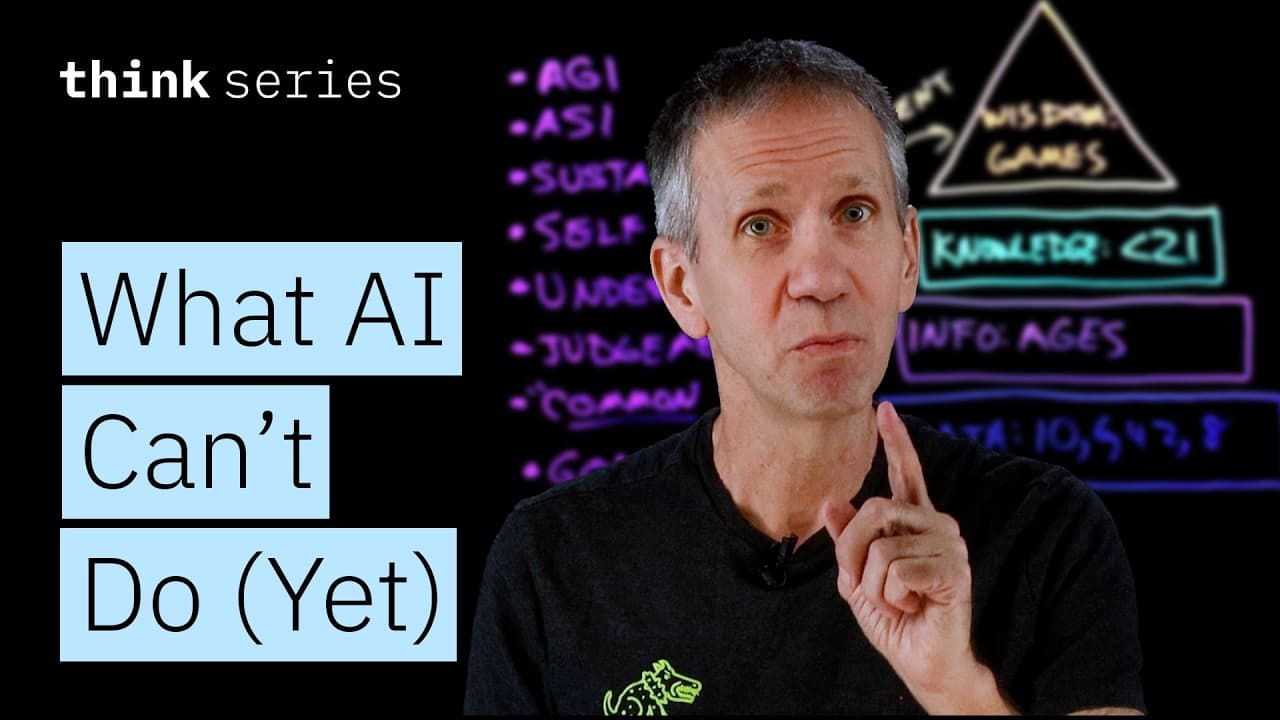
AI has already surpassed many once-thought limits such as reasoning, natural language understanding, and creativity, as shown by milestones like chess programs and modern chatbots. Yet challenges like hallucinations persist, though mitigations like retrieval augmentation and model chaining are reducing them. The overall message is to use AI as a complementary tool with humans where each excels, not to fear an imminent total takeover.
Transcript
Artificial intelligence is everywhere right now. In your phone, in your car, even writing emails for you. You may be wondering if there are actually any limits to what AI can do. I've heard many people over the last few decades confidently assert AI can do certain things, but it's never going to be able to do, and then you fill in the blank. Gu... Read More
Key Insights
- AI has progressed beyond early limits in reasoning and problem solving, evidenced by milestones such as Deep Blue and advanced chatbots.
- Natural language processing has improved to handle nuance, humor, and user intent with increasingly accurate interpretation.
- Creativity in AI includes generating art and music, showing that novel outputs can arise from machine processes.
- Real time perception, such as in self driving cars, demonstrates AI can navigate and decide in dynamic environments.
- Emotional intelligence in AI is simulated, allowing systems to respond to moods and expressions in conversation.
- Hallucinations remain a fault line for generative AI, but techniques like retrieval augmented generation reduce the risk.
- Mixtures of experts and model chaining help combine strengths of multiple AI systems for better accuracy.
- The future of AI is framed as a collaboration where humans leverage AI strengths while addressing its remaining limits.
- More videos from this channel:
- More from this channel: IBM Technology
Install to Summarize YouTube Videos and Get Transcripts
Explore YouTube Video Summarizer or Get YouTube Transcript Extractor
Questions & Answers
Q: What is the difference between data, information, knowledge, and wisdom in AI context?
Data are raw facts, information is data with context, knowledge is interpreted information, and wisdom is applying knowledge to make decisions or guide actions. This progression shows how AI systems can transform raw inputs into useful guidance, gradually adding context, interpretation, and practical utility. Understanding this hierarchy helps explain why AI can turn simple inputs into meaningful outputs. It also highlights where AI still depends on human insight for value judgments.
Q: Which AI milestones demonstrate that reasoning and problem solving are achievable by machines?
Milestones include the chess playing program Deep Blue defeating a world champion and modern systems capable of complex natural language processing and problem solving. These examples illustrate that advanced reasoning and strategic planning have become possible beyond simple computation, challenging earlier beliefs about AI limits. They show that AI can handle structured decision making and context-rich tasks that require inference and planning.
Q: How has natural language processing evolved in AI according to the video?
NLP has evolved from simple conversational programs to systems that understand idioms, humor, and nuanced intent. Early bots asked generic questions, while today's AI can grasp figurative speech and handle puns, enabling more natural and relevant interactions. This evolution is key to making AI feel more understanding and capable in everyday communication.
Q: What role does creativity play in AI as described in the video?
Creativity in AI is about generating new art and music by recombining existing ideas in novel ways. This mirrors human creativity, which is also influenced by past experiences and influences. The video argues that AI can produce original outputs, and these outputs are a form of creativity, even if they build on prior patterns learned during training.
Q: What is real time perception in AI, and why is it important?
Real time perception refers to AI systems, such as self driving cars and robots, perceiving their environment and making timely decisions. This capability is crucial for navigating dynamic environments, anticipating others' actions, and maintaining safety. It demonstrates AI's practical applicability in real-world tasks that require fast, accurate interpretation of sensory data.
Q: What are hallucinations in generative AI and how can they be mitigated?
Hallucinations are when a generative AI confidently asserts false or unsupported facts. Mitigation strategies include retrieval augmented generation, where external information is provided to guide responses, and mixture of experts that uses specialized models for different domains. Chaining models and other techniques reduce errors, improving reliability while acknowledging the problem still exists.
Q: How does the video describe the EQ aspect of AI and its limits?
The video notes that artificial emotional intelligence is simulated, with systems able to sense moods and tailor responses, but this remains a simulation rather than genuine emotion. The distinction matters for evaluating how AI understands human experience. The current state supports more responsive interactions, while true emotional understanding remains a broader, unresolved area.
Q: What is the recommended mindset about AI and humans for the future, according to the video?
The recommended mindset is to avoid betting against AI while recognizing its limits, and to view AI as a tool that complements human strengths. Humans excel in context, values, and ethical judgment, while AI handles data processing, pattern recognition, and complex computation. By leveraging both, we can tackle problems more effectively and responsibly. This collaborative approach guides future development and adoption.
Summary & Key Takeaways
-
AI limits are being redefined as systems show reasoning, language, and perception in real time, reshaping expectations and applications.
-
The video explains how data becomes information, knowledge, and wisdom, and why AI progress hinges on interpreting, not just storing data.
-
The talk concludes with a cooperative view where humans and AI each contribute strengths to solve complex problems.
Read in Other Languages (beta)
Share This Summary 📚
Summarize YouTube Videos and Get Video Transcripts with 1-Click
Try YouTube Summary with ChatGPT & Claude or YouTube Transcript Generator
Explore More Summaries from IBM Technology 📚






Summarize YouTube Videos and Get Video Transcripts with 1-Click
Try YouTube Summary with ChatGPT & Claude or YouTube Transcript Generator