How to Build an OpenRAG RAG System for AI Workflows
TL;DR
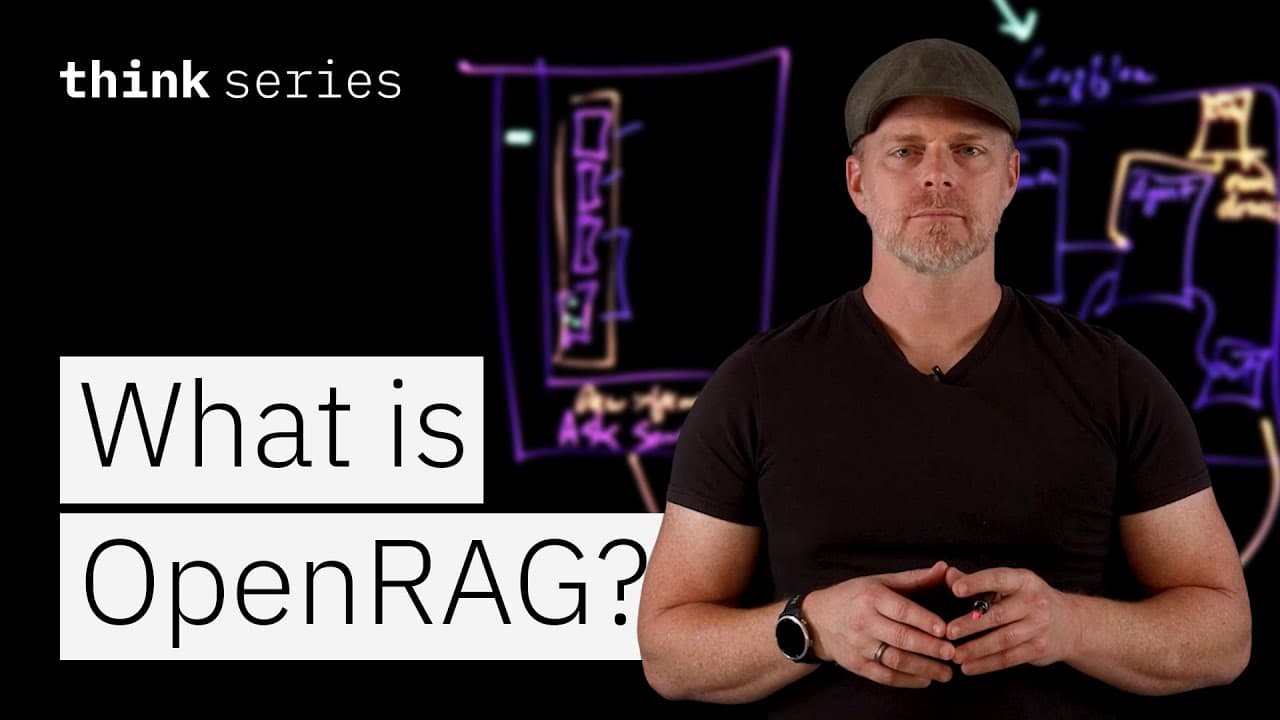
OpenRAG is an open-source platform that bundles Docling for data ingestion, OpenSearch for fast retrieval, and Langflow for orchestration to create an agentic RAG system. It supports ingesting external data sources, customizing flows, and swapping model providers, enabling rapid deployment and flexible AI workflows without starting from scratch.
Transcript
So now that gen AI models have had some time to grow and mature a bit— Wheeee!— and context windows have become very large, there is talk that we no longer need RAG. But even if context windows were infinite, RAG is still extremely relevant for cost performance and accuracy of responses when dealing with agentic and gen AI systems. First off, RAG m... Read More
Key Insights
- OpenRAG is an open-source platform that unifies data ingestion, fast search, and orchestration for agentic RAG systems.
- Docling handles intelligent document ingestion so data is optimized for LLMs and agents, reducing junk data.
- OpenSearch stores processed documents as vector representations and enables fast retrieval.
- Langflow provides the wiring and execution engine to connect models, tools, and data sources.
- External data sources can be added as tools in Langflow to expand the agent’s knowledge base.
- The OpenRAG workflow supports changing model providers and data processing steps without rebuilding from scratch.
- OpenRAG allows you to stand up a RAG platform in minutes while still offering depth for advanced customization.
- The solution emphasizes configurability and immediate data access to boost accuracy and efficiency in AI tasks.
- More videos from this channel:
- More from this channel: IBM Technology
Install to Summarize YouTube Videos and Get Transcripts
Explore YouTube Video Summarizer or Get YouTube Transcript Extractor
Questions & Answers
Q: How to start using OpenRAG for a new project
To start with OpenRAG, install the three core platforms Docling, OpenSearch, and Langflow, which together provide end-to-end ingestion, storage, and orchestration for a RAG system. Begin by ingesting your data into Docling, then index it in OpenSearch as vectors. Use Langflow to connect the tools and define a simple agent workflow, test queries, and iterate as needed.
Q: What is the role of Docling in OpenRAG
Docling is responsible for intelligent document ingestion. It analyzes inputs like PDFs and other formats, extracts structure such as text, tables, and images, and converts them into a form that is optimized for LLM processing. This reduces noise and improves the quality of downstream responses from the RAG system.
Q: Why is OpenSearch used in OpenRAG
OpenSearch stores processed knowledge as vector representations and is optimized for fast search retrieval. It acts as the backbone for quickly locating relevant information within a large corpus, which is crucial for generating accurate and timely responses in agentic workflows.
Q: How does Langflow contribute to OpenRAG
Langflow provides the orchestration layer and workflow wiring that connects data sources, models, and tools. It enables users to configure, customize, and extend agent flows through a UI or API, making it possible to incorporate external data sources and switch model providers easily.
Q: Can external data sources be added to OpenRAG
Yes, external data sources can be brought in as additional tools within Langflow. This lets the agent access new data sources on the fly, augmenting the base corpus stored in OpenSearch and enabling richer, more up-to-date responses without re-ingesting everything.
Q: How do you modify data processing in OpenRAG
Data processing can be modified by adjusting the Langflow workflow settings. You can change how data is ingested, transformed, and routed to OpenSearch, and these changes reflect immediately in the running OpenRAG setup, allowing rapid experimentation and refinement.
Q: Is OpenRAG suitable for quick deployment
OpenRAG is designed to stand up a RAG platform in minutes, offering a ready-to-use configuration while remaining highly customizable. This makes it suitable for rapid deployment of AI workflows, with the option to deepen integration and tailor components as needs grow.
Q: What is the benefit of an open-source OpenRAG stack
The open-source nature of OpenRAG enables transparency, extensibility, and community-driven improvements. It allows developers to inspect, modify, and extend the ingestion, search, and orchestration components, aligning the platform with specific security, compliance, or domain requirements.
Summary & Key Takeaways
-
OpenRAG provides a ready-to-run RAG stack by integrating Docling, OpenSearch, and Langflow for ingestion, search, and orchestration. It emphasizes easy setup, immediate knowledge ingestion, and the ability to query and filter a corpus effectively.
-
The system is designed to be flexible, allowing external data sources and changes to data processing workflows to be incorporated quickly. It also highlights the ease of switching model providers within the Langflow framework.
-
OpenRAG is fully open source and aims to simplify building agentic AI applications, offering a guided path from installation to building custom AI workflows that leverage a knowledge base.
Read in Other Languages (beta)
Share This Summary 📚
Summarize YouTube Videos and Get Video Transcripts with 1-Click
Try YouTube Summary with ChatGPT & Claude or YouTube Transcript Generator
Explore More Summaries from IBM Technology 📚

Summarize YouTube Videos and Get Video Transcripts with 1-Click
Try YouTube Summary with ChatGPT & Claude or YouTube Transcript Generator