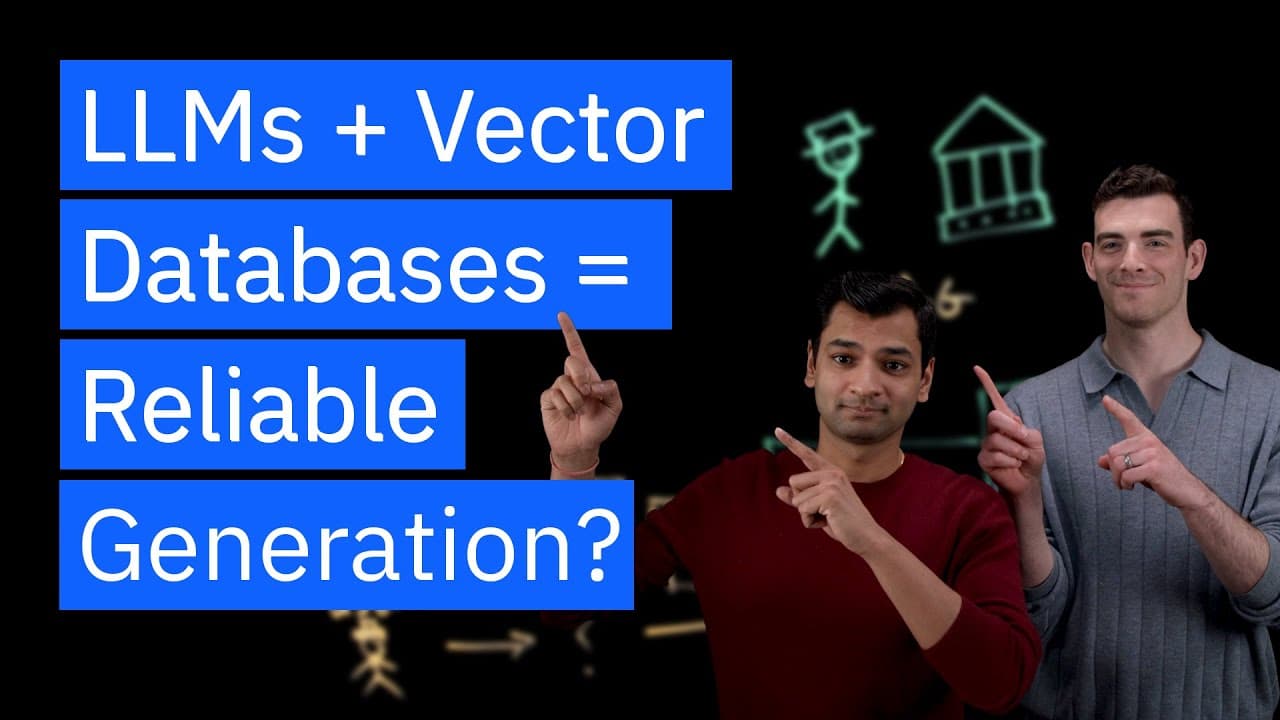
How does Retrieval Augmented Generation (RAG) work in AI?
TL;DR
RAG combines a user query with data fetched from a vector database. The system queries sources, obtains embeddings, and feeds them back into the LLM to produce up to date, source grounded answers. Governance and data quality are crucial to avoid inaccuracies and bias in outputs.
Transcript
So imagine you're a journalist and you want to write an article on a specific topic. Now you have a pretty good general idea about this topic, but you'd like to do some more research. So you go to your local library. Now, this library has thousands of books on multiple different topics. But how do you know, as a journalist, which books are relevant... Read More
Key Insights
- RAG uses a vector database to store both structured and unstructured data.
- The data retrieval step returns embeddings that are incorporated into the prompt for the LLM.
- Embeddings should be updated as new data arrives to keep answers current.
- Quality data input is critical to avoid garbage in and garbage out in RAG outputs.
- Model transparency is important to assess training data and potential biases.
- Governance and data management are essential in enterprise RAG deployments.
- The librarian journalist analogy maps well to the RAG workflow for information gathering.
- Both data sources and models must be trustworthy to protect brand and accuracy in answers.
- More videos from this channel:
- More from this channel: IBM Technology
Install to Summarize YouTube Videos and Get Transcripts
Explore YouTube Video Summarizer or Get YouTube Transcript Extractor
Questions & Answers
Q: How does RAG differ from a standard language model approach?
RAG differs by actively retrieving external data via a vector database and embedding process before generating an answer. This means the model is grounded in current source material rather than relying solely on its training data. The result is more accurate, up to date, and source referenced responses.
Q: What role does a vector database play in RAG?
A vector database stores both structured and unstructured data and converts it into embeddings. These embeddings are used in prompts to the LLM to provide relevant, data driven context for the answer. This enables real time or near real time access to pertinent information.
Q: Why is data governance critical in RAG implementations?
Governance ensures data is clean, accurate, and properly managed before it reaches the LLM. Poor data quality leads to incorrect or biased outputs, so establishing data standards, provenance, and control is essential for reliable enterprise use.
Q: What ensures the LLM remains trustworthy in a RAG system?
Trust comes from using transparent models, knowing training data origins, and avoiding black box approaches. By choosing models with clear training details and by validating data sources, organizations reduce risk of inaccuracies and bias in generated answers.
Q: How are new data updates handled in RAG?
As new data becomes available, embeddings are updated in the vector database. When the same question is asked again, the LLM can access the refreshed data to produce a more accurate and current answer.
Q: What is the advantage of combining a journalist and librarian analogy for RAG?
The analogy helps explain that the journalist asks questions and the librarian provides the sources. Together they yield well grounded responses. In RAG, the LLM synthesizes from trusted sources retrieved by the vector database to answer effectively.
Q: What risks should enterprises mitigate when deploying RAG for customer facing apps?
Enterprises should mitigate hallucinations and bias by ensuring data quality, governance, and model transparency. It is crucial to use trusted sources, monitor outputs, and maintain control over data provenance to protect brand integrity.
Q: How do embeddings contribute to RAG accuracy?
Embeddings capture semantic meaning and enable the model to retrieve the most relevant data related to a query. By feeding these embeddings back into prompts, the LLM can generate responses that align with retrieved, contextually appropriate information.
Summary & Key Takeaways
-
RAG uses a journalist and librarian analogy to describe how data is retrieved and integrated with an LLM to answer questions. The process relies on vector databases, embeddings, and prompts to ensure relevant data is included in the final answer. Data governance and transparent models are emphasized to reduce risk.
-
The described workflow separates data retrieval from generation, allowing the LLM to focus on synthesis while data sources provide up to date information. Keeping embeddings current is important when new data becomes available, improving subsequent answers.
-
The dialogue highlights concerns about hallucinations and bias and recommends clean, governed data and transparent training origins for models to maintain trust and reliability in enterprise applications.
Read in Other Languages (beta)
Share This Summary 📚
Summarize YouTube Videos and Get Video Transcripts with 1-Click
Try YouTube Summary with ChatGPT & Claude or YouTube Transcript Generator
Explore More Summaries from IBM Technology 📚


Summarize YouTube Videos and Get Video Transcripts with 1-Click
Try YouTube Summary with ChatGPT & Claude or YouTube Transcript Generator