How to choose between LangChain and LangGraph for LLM apps
TL;DR
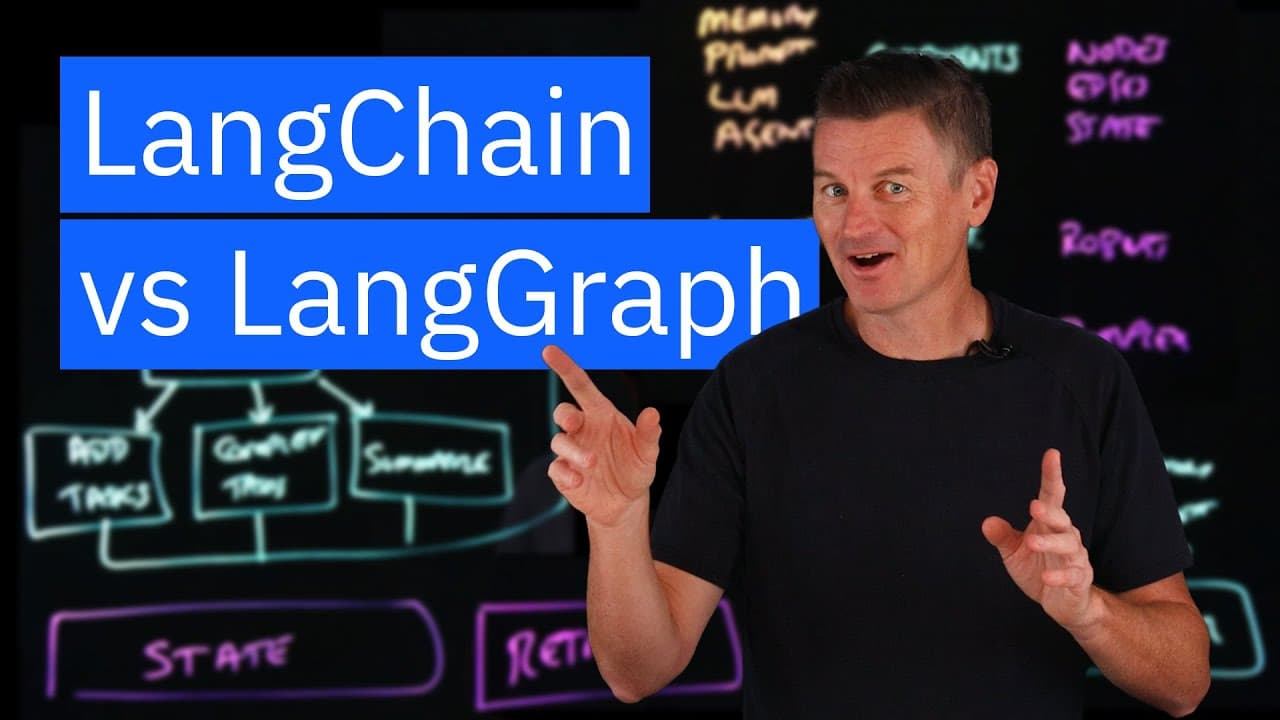
LangChain focuses on chaining LLM operations in a linear or Dag structure, while LangGraph centers on stateful multi agent workflows with a graph of nodes and edges. For simple sequential tasks, LangChain is a natural fit; for complex, context heavy, interactive systems, LangGraph provides robust state management and flexible routing.
Transcript
LangChain and LangGraph are both open source frameworks designed to help developers build applications with large language models. So what are the differences and why use one over the other? Well, I think a good place to start. Is to define what these two things are, and let's begin with LangChain. Now, we've done a dedicated video on LangChain, an... Read More
Key Insights
- LangChain orchestrates LLM tasks through a chain based architecture that emphasizes forward progression, ideal for stepwise data processing.
- LangGraph uses a graph based architecture with nodes and edges to support stateful, non linear workflows and looping between states.
- LangChain offers memory and prompt components to retain context within a single run, but persistent cross run state is limited.
- LangGraph treats state as a core component accessible by all nodes, enabling robust context aware behavior across interactions.
- LangChain is best for sequential tasks like retrieve, summarize, and answer where steps are known ahead of time.
- LangGraph supports complex use cases requiring ongoing interaction and adaptation across a graph of actions.
- Primary distinction is LangChain focuses on chaining operations, LangGraph on graph driven multi agent workflows.
- Use case guidance: choose LangChain for structured pipelines and LangGraph for dynamic, long running conversations.
- More videos from this channel:
- More from this channel: IBM Technology
Install to Summarize YouTube Videos and Get Transcripts
Explore YouTube Video Summarizer or Get YouTube Transcript Extractor
Questions & Answers
Q: How to decide if LangChain or LangGraph fits a new LLM app?
LangChain is typically the first choice when you have a clear, linear workflow that moves data from retrieval to summarization to answer. It excels at defining a predictable sequence and can incorporate memory to carry context through a single interaction. If your project requires simple stepwise orchestration, LangChain is usually sufficient and straightforward.
Q: What makes LangGraph better for stateful tasks?
LangGraph is designed around a graph structure where each action is a node and transitions are edges. This allows looping and revisiting states, making it suitable for interactive systems that depend on evolving conditions and user input. State management is robust because all nodes can access and modify the shared state.
Q: Can LangChain support long term memory across sessions?
LangChain provides memory components to retain information during interactions, which helps maintain context within a session. However, persistent state across multiple runs is not built in as a core feature, so you may need external storage or custom implementations to retain long term context beyond a single conversation.
Q: What is a practical example where LangGraph outperforms LangChain?
A practical example is a task management assistant that must add tasks, complete tasks, and summarize the current task list over many interactions. LangGraph’s graph approach lets the system route to different actions based on user input while maintaining a shared task state across sessions, providing more natural, contextual interactions.
Q: How does the architecture differ in handling tasks and transitions?
LangChain uses a directed acyclic graph style chain that enforces a sequential order, guiding tasks forward in a defined path. LangGraph uses a graph with possible loops, enabling non linear navigation between states. This difference affects how you design flows: linear sequences vs dynamic, stateful routing.
Q: Are LangChain components like memory and prompts still useful in LangGraph?
Yes, LangGraph also employs LLM components within nodes and edges, and can leverage prompts and state to guide outputs. The key distinction is that in LangGraph, these components operate within a robust stateful graph, allowing context to persist and influence routing across many interactions.
Q: Which framework supports repeatable, predictable pipelines best?
LangChain is generally better for repeatable, predictable pipelines where steps follow a defined order, such as a retrieval, summarization, and answering workflow. Its chain concept provides clarity and predictability, making it easier to implement and maintain when the process is linear and well defined.
Q: What should a developer consider when choosing between them?
A developer should consider the required complexity of interactions, the need for persistent state, and whether the workflow is linear or nonlinear. If the app needs long term context and flexible routing with changing conditions, LangGraph is advantageous. If the app is a straightforward sequence, LangChain offers simplicity and clarity.
Summary & Key Takeaways
-
LangChain builds LLM powered applications by executing a sequence of functions in a chain, typically data retrieval, summarization, and answering. This makes it well suited for linear workflows where steps follow a defined order. LangChain also supports memory and prompt components to manage context and LLM calls.
-
LangGraph is a specialized library for stateful multi agent systems, representing tasks as nodes and transitions as edges. It enables looping and dynamic routing, maintaining context across extended interactions and across multiple actions.
-
LangGraph excels in complex, evolving scenarios where user input drives different paths and persistent state is essential, such as a task management assistant that can add, complete, and summarize tasks while maintaining context over time.
Read in Other Languages (beta)
Share This Summary 📚
Summarize YouTube Videos and Get Video Transcripts with 1-Click
Try YouTube Summary with ChatGPT & Claude or YouTube Transcript Generator
Explore More Summaries from IBM Technology 📚


Summarize YouTube Videos and Get Video Transcripts with 1-Click
Try YouTube Summary with ChatGPT & Claude or YouTube Transcript Generator