What Are Differential Equations and Why They Matter
TL;DR
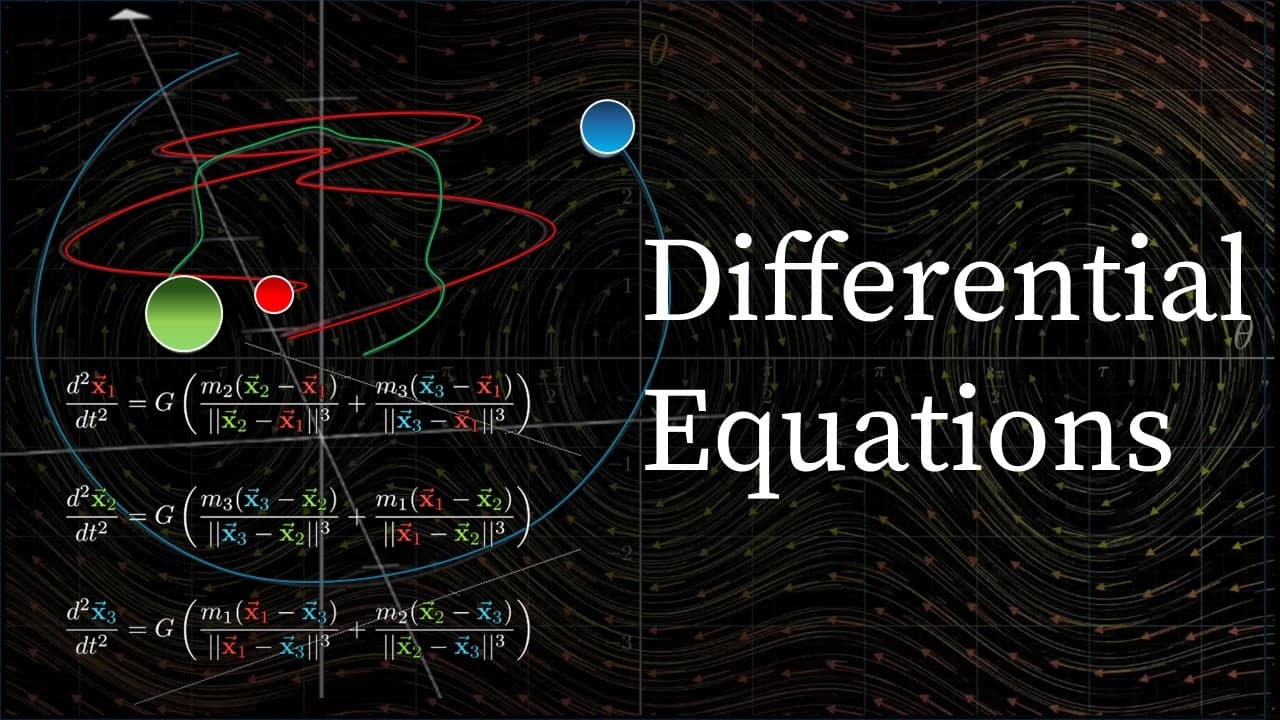
Differential equations describe how changing quantities evolve over time or other inputs, and they form the core language for modeling physical systems. They include ordinary equations with a finite number of changing values and sometimes depend on the current state, forcing, and constraints. Understanding comes from linking rate of change to the function itself and studying simple and complex examples alike.
Transcript
Taking a quote from Stephen Strogatz, since Newton, mankind has come to realize that the laws of physics are always expressed in the language of differential equations. Of course, this language is spoken well beyond the boundaries of physics as well, and being able to speak it and read it adds a new color to how you view the world around you. In th... Read More
Key Insights
- Differential equations express how a quantity changes, not just its current amount.
- An ordinary differential equation involves a finite set of changing values, usually with time as the independent variable.
- Second order differential equations appear frequently in physics, linking position, velocity, and acceleration.
- Solutions may be hard or impossible to write in closed form, yet the equations still guide understanding and computation.
- Pendulum dynamics show that simple linear models can fail for large amplitudes, highlighting nonlinear effects.
- Phase space and related concepts help visualize how systems evolve over time without needing exact solutions.
- For many problems, defining a new function as the solution is useful, but practical computation relies on analysis of the equations themselves.
- The lecture emphasizes learning to build intuition and numerical methods instead of chasing exact formulas.
Install to Summarize YouTube Videos and Get Transcripts
Explore YouTube Video Summarizer or Get YouTube Transcript Extractor
Questions & Answers
Q: A real search query question about the video (e.g. 'How to...', 'What is...', 'Why does...'). Question 1
How do differential equations differ from algebraic equations and why are they central to modeling physical change. The key difference is that differential equations describe how a quantity changes with respect to another variable, typically time, by relating derivatives to the state of the system. This enables modeling of motion, growth, decay and other dynamic processes in a compact and transferable way.
Q: Question 2
What is an ordinary differential equation and how does it differ from a partial differential equation. An ordinary differential equation involves functions of a single input, usually time, and their derivatives, describing finite changing values. A partial differential equation involves multiple inputs, such as space and time, describing how a function changes across a continuum and is discussed as a topic for future exploration.
Q: Question 3
Why is gravity used in the pendulum example and what does it illustrate about differential equations. Gravity provides a constant downward acceleration that leads to a second derivative of position, illustrating how the rate of change of velocity (acceleration) depends on position, and how adding damping or nonlinear terms changes the behavior, showing the limits of simple approximations.
Q: Question 4
What does the term phase space help you understand about differential equations. Phase space is a way to visualize the evolution of a system by plotting variables that describe its state, such as position and velocity, rather than just their numeric values. It helps interpret trajectories and stability without requiring exact solutions.
Q: Question 5
How does the pendulum example demonstrate nonlinear effects and why do exact analytic solutions become unwieldy. For larger angles the sine nonlinearity becomes important, causing the period to deviate from simple formulas and making the solution highly intricate, which motivates qualitative analysis and numerical methods.
Q: Question 6
What role do initial conditions play in solving differential equations. Initial conditions select the specific solution among many that share the same differential equation by fixing the starting state, such as initial velocity and position, which determine the trajectory in time and space.
Q: Question 7
Why would one study differential equations even without an exact closed form solution. Because the equations dictate how systems behave, enabling computations, simulations, and qualitative understanding, which are essential for predicting outcomes, controlling processes, and developing intuition about complex dynamics.
Q: Question 8
What is the practical takeaway from the tour of differential equations in physics and beyond. The practical takeaway is that many phenomena are governed by how things change, not just by their current values, and mastering the language of differential equations provides tools for modeling, analyzing, and computing in a wide range of disciplines.
Summary & Key Takeaways
-
Differential equations describe change and how quantities evolve, offering a framework for modeling dynamics.
-
A pendulum example shows how acceleration depends on position and velocity, revealing the complexity of real systems beyond simple sine waves.
-
The study of differential equations emphasizes understanding and computation over explicit closed forms, using qualitative reasoning and simulations to gain insight.
Read in Other Languages (beta)
Share This Summary 📚
Summarize YouTube Videos and Get Video Transcripts with 1-Click
Try YouTube Summary with ChatGPT & Claude or YouTube Transcript Generator
Explore More Summaries from 3Blue1Brown 📚

Summarize YouTube Videos and Get Video Transcripts with 1-Click
Try YouTube Summary with ChatGPT & Claude or YouTube Transcript Generator