How to Scale a Coaching Biz Fast in 2026?
TL;DR
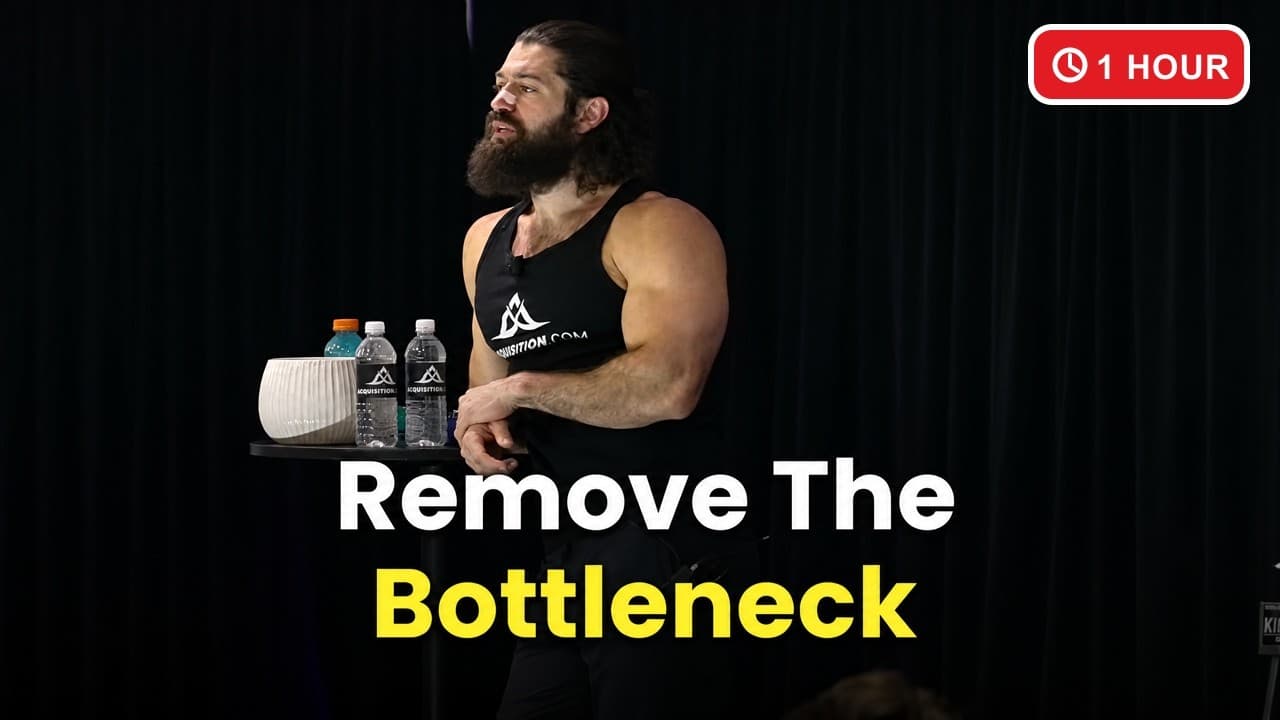
The core move is shifting from numerous single day tours to scalable 5-day camps with higher margins. Price strategy matters, and free content supports discovery while paid programs fuel growth. Focusing on unit economics and cash flow enables faster expansion and market leadership.
Transcript
Hey, Alex. Thank you. Uh, my name is AJ. I own a Did you hear it? >> The what? >> Did you hear my question from before or do I have to restate the whole thing? >> Uh, restate it. Sure. >> 1.2 million. >> Yes. 1.2 million in 2024. >> I heard the money. >> 2025. [laughter] >> 25 we doubled it to 2.2. Um, this year we're projected to do four. >> Reall... Read More
Key Insights
- The speaker scaled from 70 to 140 single-day tour dates in 2024, finding the bottom 20 were net negative and the next 20 were under $1,000 in profit.
- Five-day camps produced well over six-figure net results per event in 2024, guiding the shift toward more camps and fewer single-day events.
- The pricing discussion reveals a belief that raising prices is feasible if the value justifies it and the sales motion is optimized for conversion.
- Free content has broad reach, but monetizing a portion of the audience is necessary for scalable growth and impact.
- Unit economics is the central lens for decision making, focusing on cost to acquire and life-time value of customers.
- Competition copying a broken model can be beneficial, as it validates the market while pushing the original operator to optimize further.
- The speaker emphasizes returning to customer-centric strategies to avoid detrimental price wars or profit erosion.
- A successful scaling plan requires data collection and a sales motion that can be tested and iterated rapidly.
- More videos from this channel:
- More from this channel: MoreMozi
Install to Summarize YouTube Videos and Get Transcripts
Explore YouTube Video Summarizer or Get YouTube Transcript Extractor
Questions & Answers
Q: How can you scale a coaching business quickly in 2026?
To scale quickly, focus on high-margin, scalable offerings like 5-day camps instead of expanding many one-day events. Evaluate unit economics to ensure each event contributes meaningfully to profit, and invest in a sales process that converts interested prospects into paid participants. This approach reduces operational drag and accelerates revenue growth.
Q: Why did the shift from single-day tours to 5-day camps work?
The shift worked because the 5-day camps delivered significantly higher net profit per event, while single-day tours dragged on operations and mostly produced little margin. By consolidating to fewer but richer events, the business could scale more efficiently, allocate resources better, and achieve higher annual revenue targets.
Q: What price strategy is discussed for camps versus day passes?
The discussion highlights that the one-day pass was priced at $300 while the 5-day camp was $1,200. The suggestion is to experiment with pricing, increase where willing to pay, and rely on a robust sales motion to close higher ticket values. Pricing should align with perceived value and capacity to deliver.
Q: What role does free content play in monetization strategy?
Free content serves as a discovery engine that reach a vast audience; however, monetization focuses on converting a portion of that audience into paid programs. The model relies on scale through free materials while using paid offerings to fund growth and expand impact.
Q: How important are unit economics in decision making?
Unit economics are critical because they define the profitability and feasibility of each event format. The decision to keep or drop certain event types hinges on margins, return on capital, and the effort required. This quantitative lens ensures sustainable growth rather than momentum alone.
Q: What should a competitor copying a model mean for the business?
If a competitor copies a broken model, it validates the market and clarifies what not to do, enabling the original operator to refine the strategy. It is better if competitors imitate ineffective methods, because it spurs focus on higher-margin, scalable offerings and strengthens defensibility.
Q: How should pricing power be managed according to the talk?
Pricing power should be exercised by continuously testing willingness to pay and raising prices where value and demand justify it. Build a robust sales motion to support higher price points, and ensure programs deliver outcomes that customers perceive as worth the cost, maintaining strong conversion and customer satisfaction.
Q: What is the long-term goal discussed for 2027 in the interview?
The long-term goal discussed is to become a million dollar per month company by 2027. This would involve monetizing scalable events, optimizing pricing, and continuing to dominate the market with high-margin, high-value camps while maintaining a strong free content presence to sustain growth.
Summary & Key Takeaways
-
A shift from many single-day events to fewer five-day camps improves profitability and scalability, based on the speaker's 2024-2025 experience and projections for 2026.
-
Pricing and sales motion are critical; higher value offerings and careful monetization of free content can unlock greater revenue, while preserving access for those who cannot afford it.
-
Unit economics drives decisions; comparing micro and macro event formats shows that larger, higher-margin programs can accelerate growth without sacrificing long-term impact.
Read in Other Languages (beta)
Share This Summary 📚
Summarize YouTube Videos and Get Video Transcripts with 1-Click
Try YouTube Summary with ChatGPT & Claude or YouTube Transcript Generator
Explore More Summaries from MoreMozi 📚


Summarize YouTube Videos and Get Video Transcripts with 1-Click
Try YouTube Summary with ChatGPT & Claude or YouTube Transcript Generator