How to Reduce Anxiety While Running a Business
TL;DR
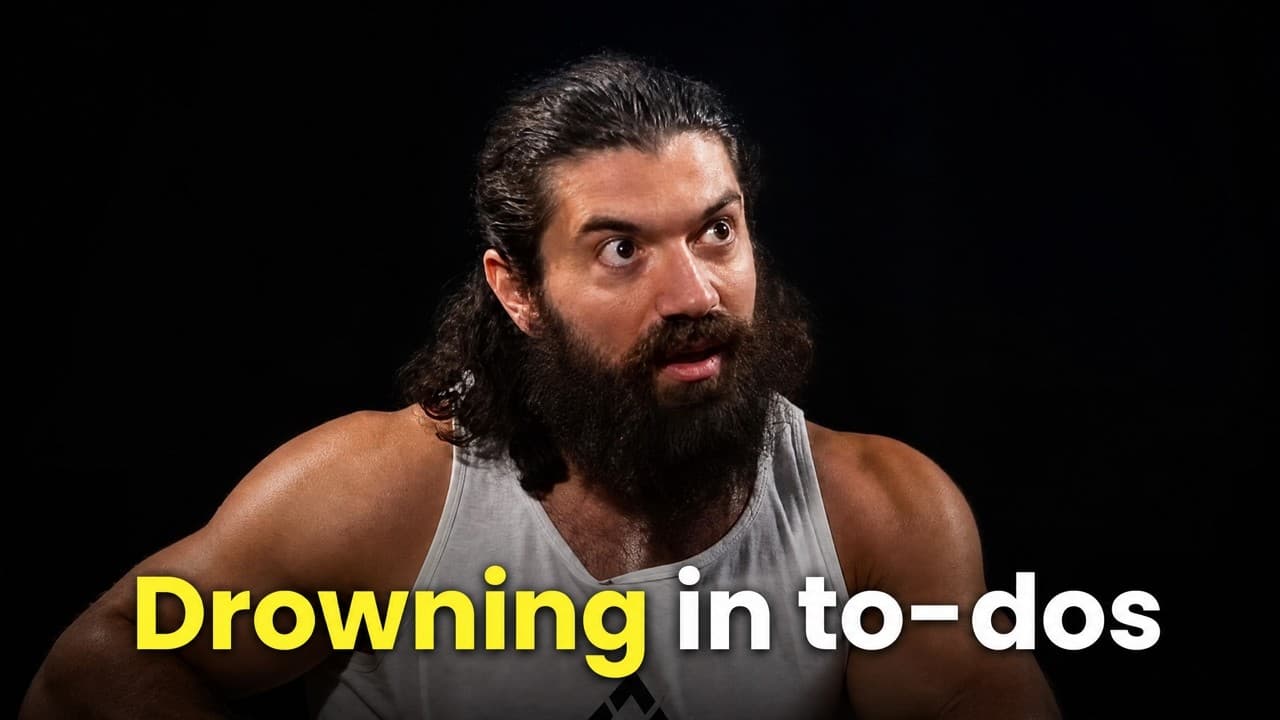
Reduce business anxiety by subtracting competing priorities and focusing on the promise already made to customers. Deliver the committed product, delegate repetitive support work, then assess the remaining cash and choose the next move. For advertising, set a learning budget you can afford to lose and use controlled experiments to improve your skills.
Transcript
you delivered on it well. Okay. So, so big picture I want you to erase the other games from your mind for a moment. I want you to make an offer to the existing audience for the two more games that are coming down the line so you can generate some cash. I want you to not think about anything that's not now those two other games. With this extra cash... Read More
Key Insights
- Anxiety is created by pursuing many actions without clear priorities. When every operational concern and future opportunity competes for attention, the founder becomes distracted and uncertain about what to do next, even when the business has a relatively simple immediate obligation.
- The immediate priority is fulfilling the promise already made to customers. Completing delivery allows the founder to honor existing commitments, collect useful customer feedback, and determine how much cash remains before investing further attention or money in additional products.
- Business anxiety can be reduced through subtraction. Removing projects and decisions that are not essential now creates clarity, protects attention, and prevents long-term concerns from interfering with the short-term work required to make that long-term future possible.
- Customer support is a practical first delegation target because it consumed much of the founder’s time while contributing less value than core product and growth work. A contractor or virtual assistant can answer routine emails and reduce the founder’s operational burden.
- Operational complexity can be partly self-created. The founder described numerous concerns despite having no employees and already using fulfillment partners that manage shipping and freight, suggesting that unclear priorities made the business feel more complicated than its essential workflow required.
- Advertising is the largest capability gap identified in the discussion. Relying on the same successful creative without systematic testing leaves the founder staring at performance rather than building the knowledge needed to produce more effective advertisements.
- An advertising learning budget makes experimentation emotionally and financially manageable. The founder should choose an amount that can be lost completely, treat it as tuition, and use it to test variations instead of expecting every advertising expense to generate an immediate return.
- The recommended advertising allocation favors disciplined exploration. Put 70% of the learning budget into ideas almost identical to the existing winner, 20% into adjacent ideas, and 10% into unconventional experiments that may reveal entirely new directions.
- More videos from this channel:
- More from this channel: MoreMozi
Install to Summarize YouTube Videos and Get Transcripts
Explore YouTube Video Summarizer or Get YouTube Transcript Extractor
Questions & Answers
Q: How can a business owner reduce anxiety from too many priorities?
A business owner can reduce anxiety by subtracting projects and choosing one immediate objective. In this case, the priority is delivering the games already promised to customers. Customer support can be delegated, unrelated future products can be ignored temporarily, and operational concerns can be narrowed to what directly affects delivery. Clear priorities replace the uncertainty created by juggling many simultaneous actions.
Q: What should a founder prioritize after selling a product that is not yet delivered?
The founder should prioritize completing the promise made to customers. Product delivery comes before expanding attention to unrelated games, long-term plans, or added operational systems. Once delivery is complete, the founder can review the cash remaining, examine customer feedback, and decide how to adjust or fund later products. This sequence protects the existing commitment and produces better information for future decisions.
Q: Why does thinking about long-term business plans increase short-term anxiety?
Long-term planning increases short-term anxiety when it competes with an urgent, clearly defined obligation. The founder was worrying about later products and broader operations while still preparing to deliver the original purchase. That divided attention created uncertainty and distraction. The advice is to complete the current promise first because failing to execute the short term can prevent the desired long-term outcome from becoming possible.
Q: What task should a solo founder delegate first?
A solo founder should first consider delegating repetitive work that consumes substantial time while producing relatively little value from the founder’s personal involvement. Here, customer support was identified as the lowest-hanging fruit because answering emails had been intense. A contractor or virtual assistant can handle routine messages, allowing the founder to focus on product delivery, customer feedback, and advertising capability.
Q: How should a founder learn to run better advertisements?
A founder should combine focused education with repeated experiments. The advice is to join a community specifically related to Facebook ads, study systems for producing advertisements and content, and test ideas at enough scale to generate useful answers. Rather than watching one successful creative continue to perform, the founder should actively build skill by creating variations, measuring outcomes, and learning from unsuccessful attempts.
Q: What is an advertising learning budget?
An advertising learning budget is an amount of money the founder is willing to lose completely while developing advertising skill. The transcript suggests choosing a monthly amount that does not create excessive concern and treating it as the cost of experimentation. This removes the expectation that every test must succeed and gives the founder room to try variations, adjacent concepts, and unconventional creative ideas.
Q: How should an advertising test budget be allocated?
The suggested allocation puts 70% of the budget into tests that are almost identical to the current winning advertisement, 20% into ideas adjacent to that winner, and 10% into unconventional concepts. This structure balances exploitation and exploration. Most spending builds on evidence that already exists, while smaller portions investigate nearby opportunities and ideas that could produce an unexpected new direction.
Q: Why can adding too many projects hurt a growing business?
Adding too many projects spreads the founder’s time and attention too thin, making it difficult to execute any single responsibility well. The discussion argues that businesses can fail from taking on too much rather than having too few opportunities. Excess projects create complexity, weaken focus, and increase anxiety. Temporarily ignoring additional products helps the founder fulfill current promises and preserve the business foundation.
Summary & Key Takeaways
-
The entrepreneur’s anxiety comes from juggling product delivery, customer support, advertising, fulfillment, logistics, and future plans without a clear priority. The recommended response is subtraction: ignore unrelated projects, reduce operational complexity, and make fulfilling the existing customer promise the central objective until delivery is complete.
-
Customer support is identified as low-value work that consumed substantial time, making it suitable for delegation to a contractor or virtual assistant. The business itself is described as simpler than the owner perceives because fulfillment partners handle shipping and freight, leaving fewer essential responsibilities for the founder to manage directly.
-
Advertising is presented as the largest missing growth lever and a skill the founder needs to develop through learning and experimentation. The tactical recommendation is to establish a disposable learning budget, test mostly close variations of the proven creative, try some adjacent concepts, and reserve a smaller portion for unconventional ideas.
Read in Other Languages (beta)
Share This Summary 📚
Summarize YouTube Videos and Get Video Transcripts with 1-Click
Try YouTube Summary with ChatGPT & Claude or YouTube Transcript Generator
Explore More Summaries from MoreMozi 📚

Summarize YouTube Videos and Get Video Transcripts with 1-Click
Try YouTube Summary with ChatGPT & Claude or YouTube Transcript Generator