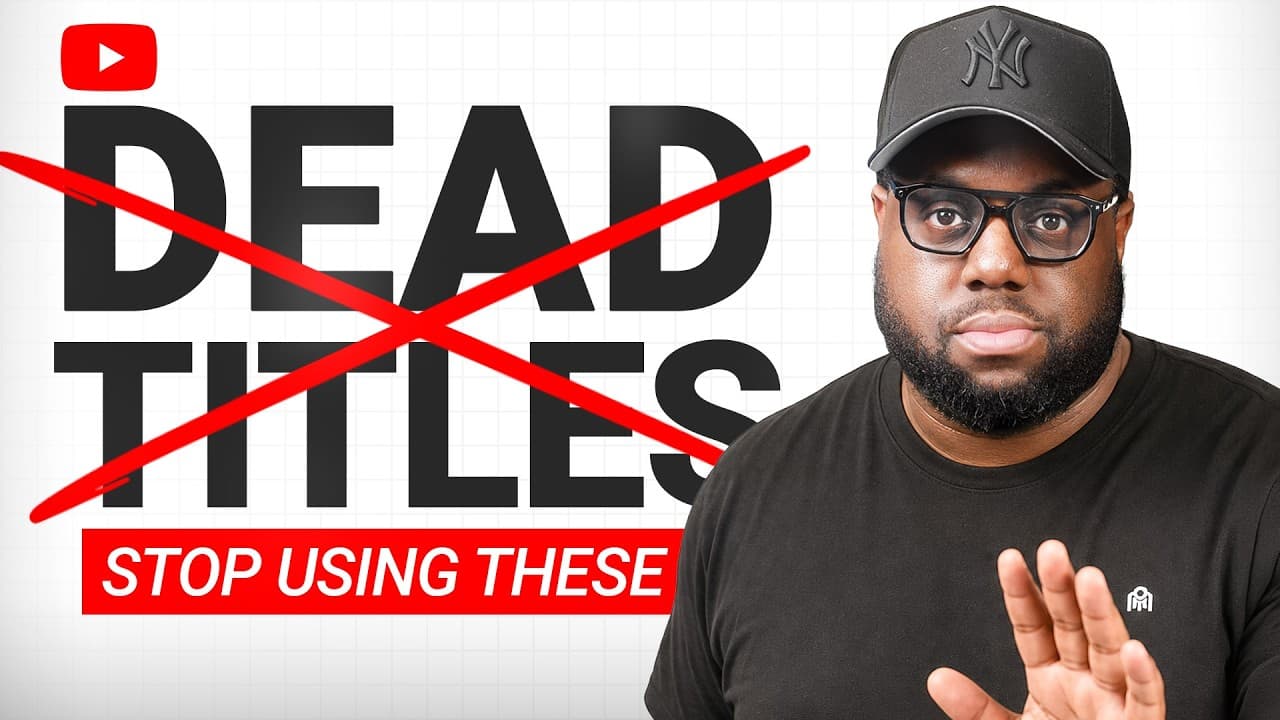
How to Write YouTube Titles That Get More Views
TL;DR
Stack three or four compatible title frames around a viable topic to create one compelling idea. The strongest patterns in the analysis included witness, transformation, access, warning, credibility, insider, forbidden, story, superlative, and duration frames, while question endings and confession titles underperformed. These structures amplify good ideas, but cannot rescue weak topics.
Transcript
I analyzed over 4 million videos uploaded in 2026 to find you the viral title formats that are working. I'm also going to show you ones that are not working, the ones that you can just and stick around to the end of this video cuz I'm going to show you how you can do this yourself on your own channel, in your own niche. [music] So, I'm ready, you r... Read More
Key Insights
- Question-ending titles are underperforming in the analyzed 2026 data, producing a 0.82 lift, roughly 18 percent below videos without them. "I was wrong" confession titles performed at less than half the average lift, while plain how-to titles were nearly average at 1.07.
- The witness frame positions content as footage of an event someone captured, with "caught on camera" titles generating more than four times average views. Creators can adapt the principle by presenting a glitch caught during a stream or a secret recipe finally recorded.
- The transformation frame shows a clear starting condition and destination, producing more than three times lift. A worthless, broken, or abandoned object becoming something valuable lets viewers mentally anticipate the change before clicking, making the title function like a compressed story.
- The access frame promises entry into a hidden or unfamiliar world, and titles using "inside X" produced about 2.5 times lift across varied niches. Its versatility comes from suggesting that viewers will see places, processes, relationships, or controversies they ordinarily cannot access.
- The warning frame creates personal relevance by implying that viewers may be making a costly mistake. Titles built around "stop," "never," or "avoid" generated almost twice the average lift and were presented as stronger than positive instructions because they emphasize potential loss.
- The credibility frame uses relevant age or tenure as an immediate reason to trust the creator. Titles such as lessons learned after 35 years or experiences at age 62 produced more than twice the lift by signaling accumulated experience and battle-tested knowledge.
- The insider and forbidden frames create curiosity through exclusivity or restriction. Claims that nobody knows or discusses something produced more than 2.5 times lift, while words such as "banned," "forbidden," "abandoned," "forgotten," or "illegal" generated more than twice the lift.
- Frame stacking is the defining pattern among the largest outliers, with some titles combining three or four structures. The goal is not to list disconnected triggers, but to fuse duration, transformation, warning, access, credibility, or other frames into one understandable and irresistible premise.
- More videos from this channel:
- More from this channel: vidIQ
Install to Summarize YouTube Videos and Get Transcripts
Explore YouTube Video Summarizer or Get YouTube Transcript Extractor
Questions & Answers
Q: Which YouTube title formats are underperforming in 2026?
Question-ending formats such as "why" and "should you" titles produced a 0.82 lift in the analyzed data, about 18 percent below videos without them. "I was wrong" confession titles achieved less than half the average lift. Plain how-to titles reached 1.07, essentially average, while "everything you need to know" and "everything you know is wrong" styles were described as overused and burned out.
Q: What is the witness frame for YouTube titles?
The witness frame presents content as an event or discovery that someone happened to capture. Titles containing "caught on camera" generated more than four times the average views in the analysis. The transferable principle is broader than that exact phrase. A gaming creator could describe an extraordinary glitch caught during a stream, while a cooking creator could frame a family recipe as something finally permitted to be recorded.
Q: Why do transformation titles attract more views?
Transformation titles identify both an initial state and a meaningful destination, such as turning something old, broken, worthless, or abandoned into something valuable. This pattern produced more than three times lift in the analyzed videos. It works because the title immediately establishes narrative movement, allowing viewers to imagine the process and anticipate the final result before they click.
Q: How does the access frame work in a YouTube title?
The access frame commonly uses a structure such as "inside X" to promise entry into a place, process, community, or controversy that viewers do not normally see. It produced about 2.5 times lift and was identified as the most versatile pattern across the dataset. The format worked in unrelated subjects, including history, mining, essential resources, and celebrity scandal, because each offers privileged access to a hidden world.
Q: How can warning titles create viewer interest?
Warning titles begin with language such as "stop," "never," or "avoid" and imply that viewers may currently be doing something incorrectly. The pattern generated almost twice the average lift. Examples included changing how eggs are fried, avoiding land with certain features, and avoiding particular tire brands. The framing creates immediate self-relevance by focusing attention on a possible mistake or loss.
Q: How can age or experience strengthen a YouTube title?
Relevant age and tenure can serve as credibility shortcuts because they show why the creator's experience deserves attention. Titles mentioning a first month at age 62, a method refined after 35 years, or life at age 73 produced more than twice the lift. The age suggests accumulated wisdom, while the duration suggests that the advice has been developed and tested through sustained experience.
Q: What is title frame stacking on YouTube?
Title frame stacking combines several compatible structures into one clear premise. The example "99-year-old abandoned cruise ship transformed into a luxury ocean mansion" uses duration, forbidden, transformation, and superlative frames. That video exceeded 12 million views on a channel with 81,000 subscribers and reached 1,045 times the channel's average view count. The largest outliers commonly stacked three or four frames.
Q: How can creators research winning title formulas in their niche?
Creators can open vidIQ, go to the AI Coach, and ask, "What are the title formulas winning in my niche right now?" According to the transcript, the tool returns formulas, breakout multipliers, and the channel sizes associated with successful examples. It also tiers the patterns to indicate which titles may fit the creator's size, allowing the research to be completed in less than five minutes.
Summary & Key Takeaways
-
An analysis of about 4 million videos uploaded in 2026 found that several familiar title formats now underperform. Question-ending titles generated a 0.82 lift, confession titles using the "I was wrong" format achieved less than half the average lift, and plain how-to titles produced a near-average 1.07 lift.
-
The strongest individual frames promise witnessed events, visible transformations, privileged access, warnings, credibility, insider knowledge, forbidden material, surprising stories, extremes, or bounded durations. Their effectiveness comes from creating curiosity, self-relevance, narrative movement, perceived authority, scarcity, or a clearly defined payoff before viewers click.
-
The largest outliers combined multiple compatible frames into a single coherent idea. One title about a 99-year-old abandoned cruise ship becoming a luxury ocean mansion stacked duration, forbidden, transformation, and superlative frames, helping a channel with 81,000 subscribers reach more than 12 million views and 1,045 times its average.
-
Creators should treat title frameworks as amplifiers rather than fixes for weak topics. They can research patterns within their own niches by asking the vidIQ AI Coach which title formulas are currently winning, then reviewing the reported breakout multipliers, successful channel sizes, and tiered suggestions to identify structures appropriate for their channels.
Read in Other Languages (beta)
Share This Summary 📚
Summarize YouTube Videos and Get Video Transcripts with 1-Click
Try YouTube Summary with ChatGPT & Claude or YouTube Transcript Generator
Explore More Summaries from vidIQ 📚
Summarize YouTube Videos and Get Video Transcripts with 1-Click
Try YouTube Summary with ChatGPT & Claude or YouTube Transcript Generator