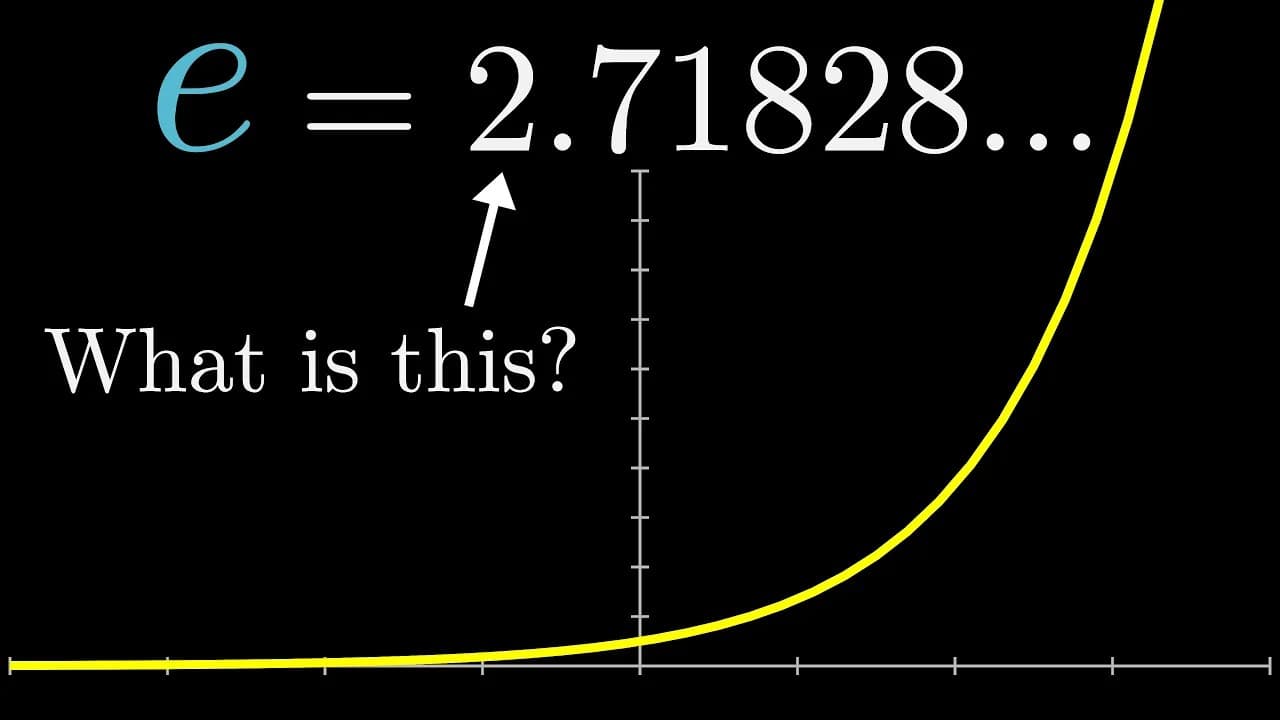
What is e and why exponentials are proportional to their derivatives
TL;DR
The derivative of a^t is proportional to a^t with a constant that depends on the base. For base e this constant equals 1, so e^t equals its own derivative. Other bases satisfy derivative = ln(base) times a^t, linking e, natural logs, and the chain rule.
Transcript
I've introduced a few derivative formulas, but a really important one that I left out was exponentials. So here I want to talk about the derivatives of functions like 2 to the x, 7 to the x, and also to show why e to the x is arguably the most important of the exponentials. First of all, to get an intuition, let's just focus on the function 2 to th... Read More
Key Insights
- A^t derivative is proportional to A^t with a constant depending on A.
- The special base e yields a derivative equal to the function itself.
- For base 2 the derivative constant is ln 2, approximately 0.6931.
- The derivative of a^t can be derived by rewriting a^t as e^{t ln a} and applying the chain rule.
- Writing exponentials as e^{ct} makes the rate constant c explicit.
- Natural logs give the rate constants for all bases via ln(base).
- Exponentials model many natural phenomena where growth is proportional to size.
- The concept of e is tied to the property that e^t is its own derivative, uniquely.
- Using e simplifies calculus when dealing with derivatives of exponential functions.
Install to Summarize YouTube Videos and Get Transcripts
Explore YouTube Video Summarizer or Get YouTube Transcript Extractor
Questions & Answers
Q: A real search query question about the video (e.g., 'How to...','What is...','Why does...'). Question 1
The derivative of a^t equals the base raised to the t times the natural log of the base, so d/dt a^t = (ln a) a^t. This follows from rewriting a^t as e^{t ln a} and applying the chain rule, which introduces the constant ln a as the rate factor multiplying the original function. This holds for any positive base a.
Q: Question 2
When a = e, ln e equals 1, so d/dt e^t = e^t. This is the defining property of the base e: its exponential function is proportional to itself with a unit constant of proportionality. It also matches the geometric interpretation that the slope of the e^t graph at any point equals its value at that point.
Q: Question 3
Why can we write a^t as e^{t ln a}? This is because exponent rules allow moving the exponent into a product, turning the base a into e raised to a logarithm, which is useful for differentiation. This equivalence enables the chain rule to be applied cleanly, revealing the derivative as (ln a) a^t.
Q: Question 4
What is the significance of the constant ln a in the derivative? It is the rate constant that scales the original exponential. It quantifies how quickly the function grows per unit time relative to its current size. Larger bases give larger ln a, hence faster growth rates in the derivative.
Q: Question 5
How does the chain rule come into play for e^{ct}? When you differentiate e^{ct}, the outer exponential differentiates to itself and is multiplied by the derivative of ct, which is c. Thus, d/dt e^{ct} = c e^{ct}. This shows how the rate constant c translates directly into the derivative.
Q: Question 6
What is the practical interpretation of e in real world models? In models where growth is proportional to current size, the natural exponential with base e provides a convenient frame where the rate constant is directly interpretable as the continuous growth rate. This arises because e is the unique base making the function equal to its own derivative.
Q: Question 7
How do natural logs relate to different bases in practice? The natural log ln a is the constant that converts a base a exponential to an e-based form. Since a^t = e^{t ln a}, the derivative becomes (ln a) a^t, connecting the base to the growth rate via the natural logarithm.
Q: Question 8
Why is e considered special among exponentials? Because e^t is its own derivative, the slope of the tangent equals the function value at every point. This unique property makes e the natural base for continuous growth and decay models, simplifying calculus and interpretation across many applications.
Summary & Key Takeaways
-
Exponential functions are linked to their rates of change through a constant of proportionality, which depends on the base of the exponent. The special base e makes the function equal to its own derivative, a unique property that underpins many calculus applications. Writing exponentials as e^{ct} clarifies this relationship.
-
The constant of proportionality for a^t is the natural logarithm of the base, because a^t = e^{t ln a} and the derivative of e^{kt} is k e^{kt}. This ties the base, natural logs, and the chain rule together in a single framework.
-
In real-world terms, many phenomena grow or decay at rates proportional to their current size, which naturally leads to exponential models. Using e in these models provides a clean interpretation of the rate constant as the natural log of the base.
Read in Other Languages (beta)
Share This Summary 📚
Summarize YouTube Videos and Get Video Transcripts with 1-Click
Try YouTube Summary with ChatGPT & Claude or YouTube Transcript Generator
Explore More Summaries from 3Blue1Brown 📚



Summarize YouTube Videos and Get Video Transcripts with 1-Click
Try YouTube Summary with ChatGPT & Claude or YouTube Transcript Generator