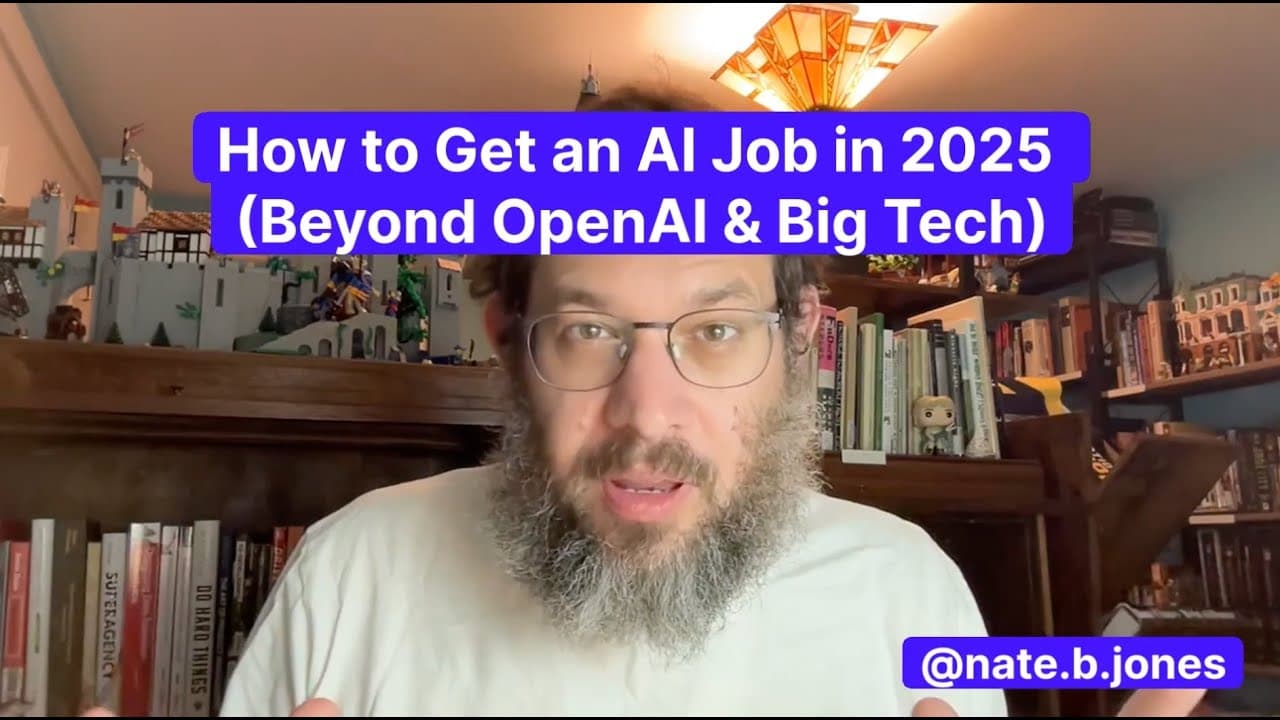
How to land an AI startup job in 2025 targeting Series A startups
TL;DR
The best path is to target Series A AI startups where equity upside remains and your time is the main risk. Focus on a problem space you are passionate about, develop a spear fishing style application strategy for a single company, and rely less on generic cold applications while building authentic interest.
Transcript
All right, settle in. We're going to have a talk about how to get a job in the age of AI. It's one of the biggest questions I get asked. I want to pack this video with absolutely everything I know. And I'm going to start with the startup targeting site. That's actually something most people don't talk about. Almost all of the job advice I see is wh... Read More
Key Insights
- AI job strategy shifts away from chasing big tech to targeting early stage startups where equity upside remains realistic.
- The speaker warns that chasing high valuation firms reduces upside and increases risk, making startups at Series A often a better balance of risk and reward.
- There is a clear preference for targeting companies at or near Series A because they still offer multiple expansion and growth potential for equity.
- Passive resume hacks like keyword stuffing are less effective in the AI job market, and a bespoke targeting approach yields better results.
- Passion for the problem space is a differentiator that enables credible long term engagement and problem solving within startups.
- A spear fishing strategy, where you intensely target one company with a tailored package, can succeed for non traditional candidates.
- Time is the key investment for job seekers; unlike VCs who invest money, job seekers invest time which is finite and irretrievable.
- Investors falling into late rounds signal limited upside for employees, so choose firms with balanced risk and reward and avoid follow me capital.
- More videos from this channel:
- More from this channel: AI News & Strategy Daily | Nate B Jones
Install to Summarize YouTube Videos and Get Transcripts
Explore YouTube Video Summarizer or Get YouTube Transcript Extractor
Questions & Answers
Q: How should I describe the ideal target stage for AI job hunting in 2025?
The ideal target stage is around Series A. At this point a startup has proven some business model and there is still growth left to realize. Targeting Series A allows you to participate in meaningful equity upside while avoiding the extreme risk of seed stage startups or the capped upside in late rounds of larger companies. Your strategy should align with that stage’s dynamics, emphasizing impact, learning, and scalable contributions.
Q: What is the main risk-reward consideration when choosing AI employers according to the video?
The main consideration is that big AI companies and OpenAI level giants already have heavy investment and their equity upside is largely baked in, reducing the potential wealth you can gain. Startups at the Series A level offer a better balance where you can still gain meaningful equity appreciation, while the risk remains manageable if you pick a company with a credible plan and solid problem space.
Q: Why is passion for a problem space emphasized as a hiring driver?
Passion for a problem space signals sustained engagement and the ability to solve problems with technical leverage over time. The speaker notes that without authentic interest in the problem area, it is difficult to stand out in a crowded market. Passion drives persistent learning, creative problem solving, and the willingness to invest the time needed to contribute meaningfully in a startup environment.
Q: What is spearfishing in the context of applying for AI startups?
Spear fishing refers to a highly targeted, deeply prepared application strategy for one company. It involves researching the company, aligning your background to its needs, and presenting a tailored value proposition, sometimes supported by a presentation or video. This approach can be effective for non traditional candidates who may not fit a standard job title but have relevant problem space expertise.
Q: According to the video, how long can the cold application approach take to pay off?
Cold applications can still work, but they are rarer and less efficient in the current AI job market. It can take months or even a year and a half of persistent effort to land a role through broad cold applications. The message is to diversify your approach and not rely solely on mass applications, especially in a market where targeting and storytelling carry more weight.
Q: What does the speaker say about equity vs cash offers in AI startups?
Equity in a breakout startup can have life changing potential, whereas high cash offers may provide immediate comfort but often come with limited upside. The speaker urges weighing offers by the long term value of equity and the problem space you can contribute to, rather than prioritizing salary alone. This perspective emphasizes wealth creation through meaningful ownership.
Q: How does the video suggest candidates should evaluate their fit for a role?
Candidates should seek a 95 percent or better fit for the role, focusing on positions that align strongly with their capabilities and passion. The approach emphasizes targeting fewer, better matches rather than applying to many roles with marginal fit. This improves the odds of a meaningful, long term contribution and helps the candidate stand out through demonstrated alignment.
Q: What is the recommended approach if you are an unconventional candidate with a non traditional background?
For unconventional candidates, a targeted strategy is essential. Identify one company, define your learning goals, and build a comprehensive, highly tailored package that highlights how your background maps to the startup’s problem space. The effort should include showing credible passion and delivering a compelling narrative that resonates with the company’s mission and needs.
Summary & Key Takeaways
-
Starting with targeted searching, pick undervalued AI startups aligned with your values and problem space before polishing resumes. This focus reduces reliance on mass applications and increases your chances of standing out. The video argues that passion and targeted effort matter more than broad resume tactics.
-
The sweet spot is around the Series A stage where growth and equity upside still exist, compared to seed or late rounds. The speaker advises evaluating risk and reward, avoiding overly cash rich offers that limit upside, and prioritizing roles with meaningful impact.
-
A spear fishing approach can help a candidate who does not fit a traditional title, by deeply researching a company, crafting a tailored narrative, and presenting a clear value proposition that aligns with the startup’s needs and problem space.
Read in Other Languages (beta)
Share This Summary 📚
Summarize YouTube Videos and Get Video Transcripts with 1-Click
Try YouTube Summary with ChatGPT & Claude or YouTube Transcript Generator
Explore More Summaries from AI News & Strategy Daily | Nate B Jones 📚






Summarize YouTube Videos and Get Video Transcripts with 1-Click
Try YouTube Summary with ChatGPT & Claude or YouTube Transcript Generator