What Is Context Engineering for LLM Agents and Prompts?
TL;DR
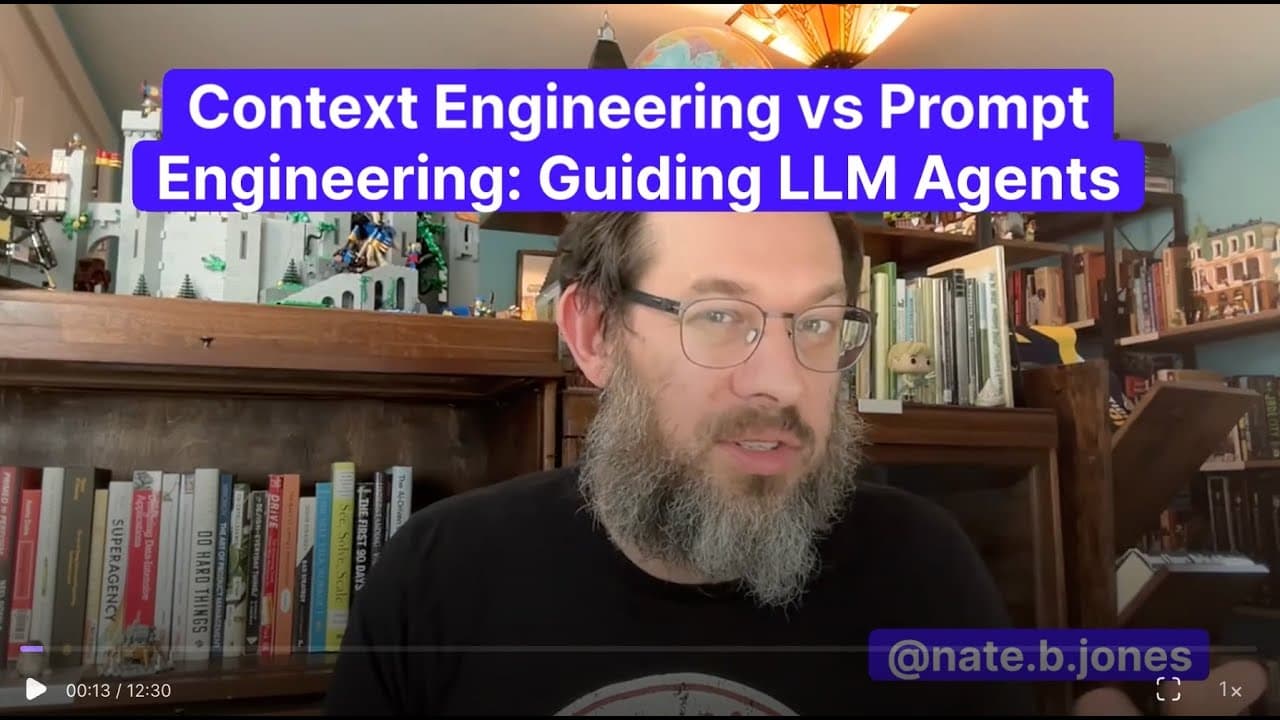
Context engineering expands beyond prompts by shaping both deterministic and probabilistic context. It argues that token savings are only part of the story and emphasizes discovering effective interaction through semantic highways, monitoring source quality, and securing the open web and internal data surfaces. It also calls for rigorous evaluation and strict versioning of prompts and environments.
Transcript
I'd like to suggest that we aren't talking clearly enough about context engineering and that we're getting it wrong in some important ways. If you don't know what context engineering is, it's kind of the successor to the idea of prompt engineering or prompting. Context engineering basically says prompts are great, but large language models look at ... Read More
Key Insights
- Deterministic context is the small, controllable prompt and knowledge base that precedes an agent’s operation but is only a fraction of total context.
- Probabilistic context comprises a vast, dynamic set of sources the agent may consult, which dominates the final output when web access is used.
- Token optimization remains useful, yet the core goal is higher accuracy and congruence in answers, not merely lower token usage.
- Discovery windows should be designed so prompts steer which domains the agent searches, without fully constraining its findings.
- Source quality must be monitored and revised over time; citations can exist without fully reliable provenance.
- Security considerations are essential as probabilistic context opens avenues for prompt injection and data poisoning across external and internal sources.
- Evaluation should evolve from traditional precision and recall to measuring overall decision accuracy and source relevance within large context windows.
- Version everything and apply software-like control to prompts and environments to maintain reproducibility and trust.
- More videos from this channel:
- More from this channel: AI News & Strategy Daily | Nate B Jones
Install to Summarize YouTube Videos and Get Transcripts
Explore YouTube Video Summarizer or Get YouTube Transcript Extractor
Questions & Answers
Q: How does deterministic context differ from probabilistic context in LLM agents?
Deterministic context includes the fixed pieces you control directly, such as system instructions, prompts, and internal documents. Probabilistic context is the broader set of sources the agent may consult when web access or tools are available, including external sites and internal data, which can significantly influence the final answer. This distinction matters because probabilistic context often dominates the model’s output, making control more complex.
Q: Why should we care about discovery in context engineering?
Discovery refers to how quickly and reliably a desired response can be obtained when probabilistic context is in play. Designing for discovery means creating prompts and environments that guide the agent to high-quality results despite a large and uncertain search space. It helps maintain usefulness and stability even as the agent explores broader data sources.
Q: What role do sources play in the quality of probabilistic context?
Sources determine the factual grounding of the agent’s output. Monitoring and auditing sources is essential because even when the results seem correct, the provenance may be weak or unreliable. By evaluating source quality and relevance, you improve trust and reduce the risk of propagating misinformation from dubious sources.
Q: What security risks come with probabilistic context and web access?
Open web access and distributed data sources increase the risk of injection attacks and prompt manipulation. As agents search across many sources and internal data stores, attackers may attempt to influence results or inject harmful prompts. Proactive defenses, monitoring, and constrained source selection are necessary to mitigate these risks.
Q: How should evaluation evolve for probabilistic context enabled agents?
Evaluation should go beyond precision and recall on fixed inputs. It should measure overall decision accuracy and how well source relevance supports results. This requires testing with evolving sources, auditing provenance, and possibly using evaluation harnesses that reflect dynamic, probabilistic contexts rather than static datasets.
Q: Why is versioning important for prompts in context engineering?
Versioning ensures reproducibility and accountability as prompts, sources, and environments change. In a probabilistic context setting, small prompt edits can shift the agent’s behavior across many sources. Systematic version control allows teams to track changes, compare outcomes, and rollback when necessary to maintain trust and quality.
Q: What is the practical takeaway about token optimization in this context?
Token optimization is legitimate for cost control, but it is not the primary goal in probabilistic context environments. The practical aim is to guide the agent toward more accurate and congruent answers by shaping the context window rather than merely minimizing token usage. This often involves steering searches and enforcing source constraints.
Q: How should practitioners approach shaping probabilistic context for agents?
Practitioners should design environments that steer search domains, constrain reliable sources, and monitor how sources influence outcomes. This includes setting expectations for discovery, auditing source quality over time, and considering security and evaluation as integral parts of the context engineering process rather than afterthoughts. The goal is higher decision accuracy across broad data surfaces.
Summary & Key Takeaways
-
Context engineering shifts focus from small, controllable prompts to the larger probabilistic context an agent can access when web or tool access is enabled.
-
It highlights the need to monitor and audit information sources used by agents to ensure reliability and relevance over time, not just after a single output is produced.
-
It urges strong attention to security, evaluation methods, and version control as core practices when building probabilistic context aware agents that operate across web and internal data sources.
Read in Other Languages (beta)
Share This Summary 📚
Summarize YouTube Videos and Get Video Transcripts with 1-Click
Try YouTube Summary with ChatGPT & Claude or YouTube Transcript Generator
Explore More Summaries from AI News & Strategy Daily | Nate B Jones 📚






Summarize YouTube Videos and Get Video Transcripts with 1-Click
Try YouTube Summary with ChatGPT & Claude or YouTube Transcript Generator