How AI Compresses Time: Impacts and Challenges
TL;DR
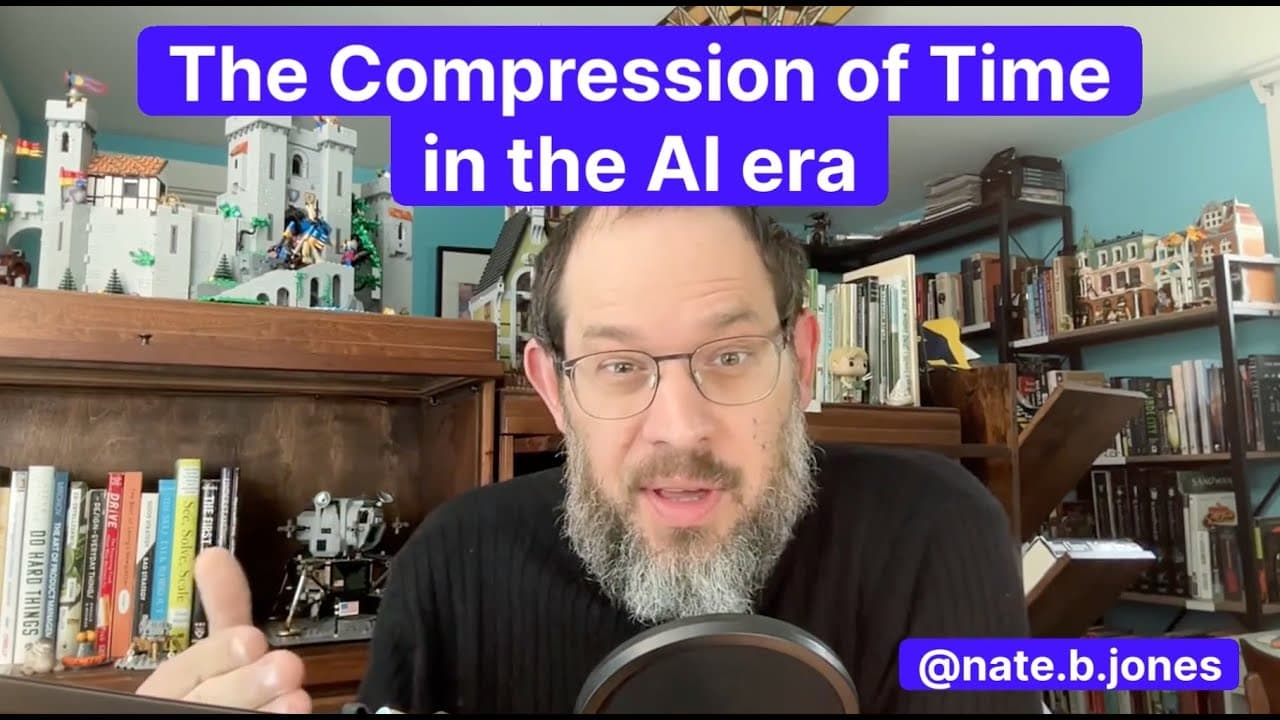
AI is transforming how work is accomplished by compressing tasks into shorter timeframes through advanced computing. While AI can achieve more in less time, it struggles with maintaining intent over long periods. Human oversight remains crucial as AI scales intelligence faster than its ability to sustain focus, highlighting a need for strategic task management.
Transcript
I want to talk today about one of the most subtle aspects but pervasive aspects of this AI revolution. AI compresses time. And we are living through it, right? We are living through this moment where we feel like we're always trying to catch up. DM after DM, email after email I get is, "Nate, tell me how I can keep up with this. The news drops on T... Read More
Key Insights
- AI compresses work into shorter timeframes by utilizing advanced computing capabilities.
- Humans are currently better at maintaining long-term intent compared to AI agents.
- AI's intelligence is rapidly increasing, but its ability to sustain focus over time is lagging.
- The 'Physical Turing Test' challenges AI to achieve human-like physical tasks, a goal still far off.
- NVIDIA's simulation technology can compress extensive training periods into hours, showcasing compute power.
- AI tools like Devin work best with well-defined tasks but struggle with open-ended projects.
- AI's ability to handle complex tasks is improving, but human guidance is essential for strategic alignment.
- The disparity between AI's growing intelligence and its temporal coherence poses challenges for effective task delegation.
Install to Summarize YouTube Videos and Get Transcripts
Explore YouTube Video Summarizer or Get YouTube Transcript Extractor
Questions & Answers
Q: How does AI compress time in work processes?
AI compresses time in work processes by leveraging advanced computing capabilities to perform tasks more efficiently and quickly. This allows AI to achieve more in a given timeframe compared to traditional methods. However, the challenge remains in maintaining long-term intent and focus, which currently requires human oversight and strategic task management.
Q: What is the 'Physical Turing Test' and its significance?
The 'Physical Turing Test' is a benchmark proposed by Jim Fan to assess AI's ability to perform human-like physical tasks, such as cleaning a household autonomously. It highlights the gap between AI's conversational prowess and its embodied competence. Passing this test would signify a significant advancement in AI's physical capabilities, which is still a distant goal.
Q: Why is human oversight important in AI task management?
Human oversight is crucial in AI task management because, despite AI's growing intelligence, it struggles with sustaining intent over long periods. Humans are better at maintaining long-term strategic goals, providing guidance, and ensuring tasks are framed correctly for AI to execute effectively. This oversight helps bridge the gap between AI's capabilities and the demands of complex, open-ended projects.
Q: How does NVIDIA's simulation technology impact AI training?
NVIDIA's simulation technology significantly impacts AI training by allowing extensive training periods to be compressed into hours. This is achieved through parallel processing and advanced computing, demonstrating the potential of compute power to accelerate AI development. It showcases how AI can transform work processes, but also highlights the ongoing challenge of aligning AI's rapid intelligence growth with its ability to maintain focus.
Q: What challenges do AI agents face in maintaining intent over time?
AI agents face challenges in maintaining intent over time due to their current limitations in sustaining long-term focus and strategic alignment. While AI can perform tasks quickly and efficiently, it struggles with tasks requiring prolonged attention and continuity. This necessitates human intervention to provide oversight, ensure strategic alignment, and manage task delegation effectively.
Q: What role does human guidance play in AI task execution?
Human guidance plays a critical role in AI task execution by providing strategic oversight, framing tasks appropriately, and ensuring alignment with long-term goals. While AI can execute tasks efficiently, it requires human intervention to manage complex, open-ended projects and to address challenges related to maintaining intent and focus over extended periods.
Q: How do AI tools like Devin handle task delegation?
AI tools like Devin handle task delegation by excelling in well-defined, scoped tasks but struggling with open-ended projects. These tools require clear task definitions and human oversight to ensure strategic alignment and effective execution. Human guidance is essential to frame tasks appropriately and manage the limitations of AI's current capabilities in sustaining long-term intent.
Q: What is the significance of AI's intelligence scaling faster than its temporal coherence?
The significance of AI's intelligence scaling faster than its temporal coherence lies in the challenges it poses for effective task delegation and management. While AI's intelligence is rapidly increasing, its ability to maintain focus over time is lagging. This disparity necessitates human oversight to ensure tasks are aligned with strategic goals and to manage the limitations of AI's current capabilities in sustaining long-term intent.
Summary & Key Takeaways
-
AI compresses work into shorter timeframes by utilizing advanced computing capabilities, allowing it to achieve more in less time. However, AI struggles with maintaining intent over long periods, making human oversight crucial. The rapid increase in AI intelligence outpaces its ability to sustain focus, necessitating strategic task management.
-
NVIDIA's simulation technology demonstrates the potential of compute power by compressing extensive training periods into hours. This showcases how AI can transform work processes, but the disparity between AI's intelligence growth and temporal coherence remains a challenge for effective task delegation.
-
AI tools like Devin excel in handling well-defined tasks but falter with open-ended projects. While AI's ability to handle complex tasks is improving, human guidance is essential for strategic alignment, highlighting the need for careful task framing and supervision in creative and technical domains.
Read in Other Languages (beta)
Share This Summary 📚
Summarize YouTube Videos and Get Video Transcripts with 1-Click
Try YouTube Summary with ChatGPT & Claude or YouTube Transcript Generator
Explore More Summaries from AI News & Strategy Daily | Nate B Jones 📚






Summarize YouTube Videos and Get Video Transcripts with 1-Click
Try YouTube Summary with ChatGPT & Claude or YouTube Transcript Generator