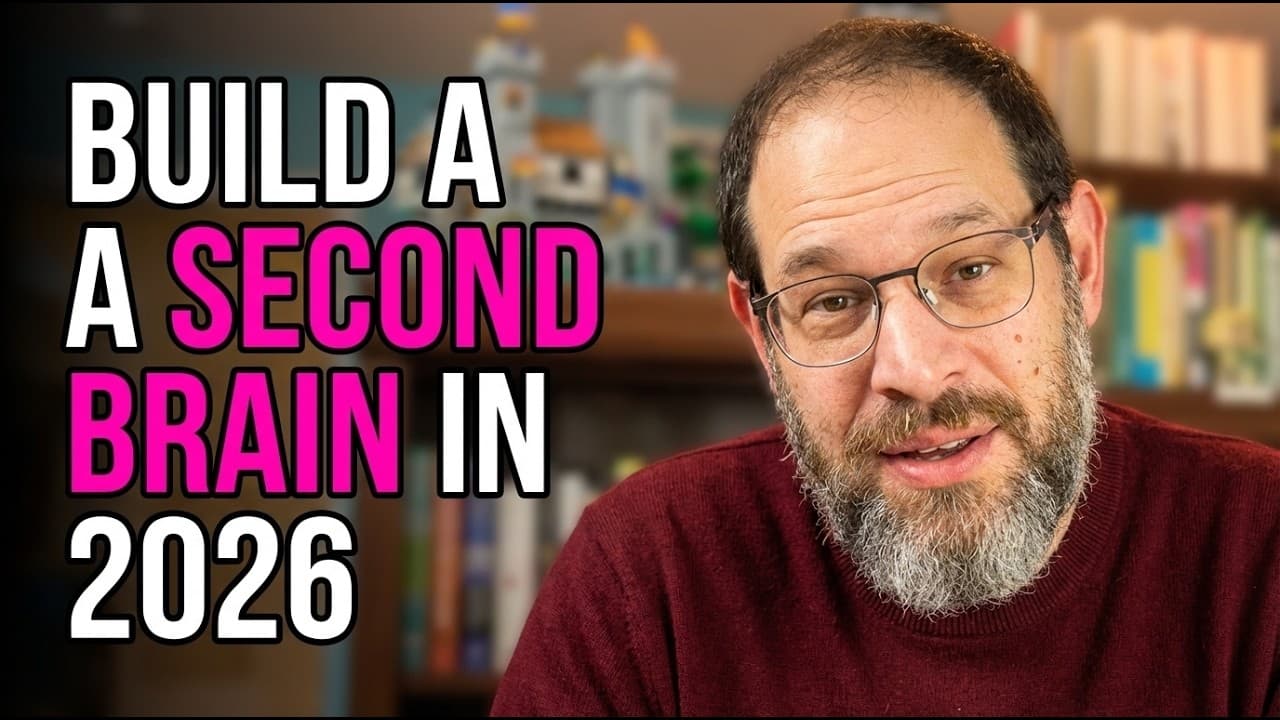
How to Build a Second Brain with AI in 2026
TL;DR
In 2026, leveraging AI to build a second brain is accessible to non-engineers. Traditional storage systems are passive, requiring users to remember and organize. AI-driven systems actively classify, route, and surface information, reducing cognitive load and enhancing productivity. This shift enables users to focus on thinking rather than remembering, utilizing tools like Slack, Notion, Zapier, and AI models for seamless integration.
Transcript
For 500,000 years, we've had essentially the same cognitive architecture. And today, I want to talk about a leap that we can make, all of us, even non-engineers, can make in 2026 that will help us to build a second brain with AI in a way that's never been possible before. But first, let me set the stage. Why does this matter? Look, a second brain d... Read More
Key Insights
- Human cognitive architecture has remained largely unchanged for 500,000 years.
- Traditional productivity systems are workarounds for the brain's limitations in memory and retrieval.
- AI loops actively classify, route, and surface information without user intervention.
- 2026 marks the first time non-engineers can build a second brain using AI without writing code.
- A second brain reduces cognitive load by closing open loops and providing daily nudges.
- The system uses Slack for capture, Notion for storage, Zapier for automation, and AI for intelligence.
- Key principles include reducing human tasks to one behavior and separating memory from compute.
- Trust mechanisms, such as confidence scores and audit trails, are essential for system reliability.
Install to Summarize YouTube Videos and Get Transcripts
Explore YouTube Video Summarizer or Get YouTube Transcript Extractor
Questions & Answers
Q: How can AI help in building a second brain?
AI assists in building a second brain by actively classifying, routing, and surfacing information without user intervention. Traditional systems require users to remember and organize data, while AI-driven systems automate these tasks, allowing users to focus on thinking rather than remembering. This approach reduces cognitive load and enhances productivity by closing open loops and providing timely nudges.
Q: What tools are needed to create a second brain in 2026?
To create a second brain in 2026, you need tools like Slack for capturing thoughts, Notion for storing data, Zapier for automating processes, and AI models like Claude or ChatGPT for providing intelligence. These tools integrate seamlessly to manage information, reduce cognitive load, and enhance productivity, making the system accessible to non-engineers without requiring coding skills.
Q: Why do traditional storage systems fail?
Traditional storage systems fail because they are passive, requiring users to remember and organize information. They rely on the user's ability to recall where data is stored and how it is organized, which can lead to cognitive overload and system abandonment. In contrast, AI-driven systems actively manage information, reducing the need for user intervention and enhancing system reliability.
Q: What are the key principles for building a second brain?
Key principles for building a second brain include reducing human tasks to one reliable behavior, separating memory from compute, implementing trust mechanisms, and ensuring system reliability. These principles help create a scalable, maintainable system that reduces cognitive load, enhances productivity, and allows users to focus on meaningful work rather than organizing and remembering information.
Q: How does AI-driven system reduce cognitive load?
AI-driven systems reduce cognitive load by automating the classification, routing, and surfacing of information. This automation means users no longer need to remember or organize data manually, freeing up mental resources for more critical thinking tasks. The system provides daily nudges and closes open loops, further reducing the cognitive burden and enhancing productivity.
Q: What role does Zapier play in the second brain system?
Zapier plays a crucial role in the second brain system by automating processes and connecting different tools. It acts as the automation layer, wiring together Slack for capturing thoughts, Notion for storing data, and AI models for providing intelligence. Zapier ensures seamless integration and workflow automation, reducing the need for manual intervention and enhancing system efficiency.
Q: How do trust mechanisms enhance system reliability?
Trust mechanisms enhance system reliability by providing transparency and accountability. Features like confidence scores, audit trails, and easy error correction build user confidence in the system. These mechanisms ensure that users can trust the system to manage information accurately, reducing errors and increasing the likelihood of continued use and engagement.
Q: Why is 2026 significant for building a second brain?
2026 is significant for building a second brain because it marks the first time non-engineers can create such systems without writing code. Advances in AI and automation tools make it possible to build systems that actively manage information, reducing cognitive load and enhancing productivity. This accessibility allows more people to leverage AI-driven systems to support their cognitive processes and focus on meaningful work.
Summary & Key Takeaways
-
In 2026, building a second brain with AI is achievable without engineering skills. Traditional systems fail due to their passive nature, requiring users to organize and remember information. AI-driven systems actively classify, route, and surface data, allowing users to focus on thinking rather than remembering. This shift is facilitated by tools like Slack, Notion, Zapier, and AI models, which integrate seamlessly to enhance productivity and reduce cognitive load.
-
The video outlines the limitations of human cognitive architecture and how traditional productivity systems serve as workarounds for these limitations. AI loops offer a transformative solution by actively managing information, reducing the need for user intervention. The speaker explains the principles and tools needed to build a second brain, emphasizing the importance of automation, trust mechanisms, and maintaining system reliability.
-
Key principles for building a second brain include reducing human tasks to a single behavior, separating memory from compute, and implementing trust mechanisms. The system captures thoughts via Slack, stores them in Notion, automates processes with Zapier, and uses AI for intelligence. This approach allows users to close open loops, receive daily nudges, and focus on meaningful work, ultimately enhancing productivity and reducing cognitive load.
Read in Other Languages (beta)
Share This Summary 📚
Summarize YouTube Videos and Get Video Transcripts with 1-Click
Try YouTube Summary with ChatGPT & Claude or YouTube Transcript Generator
Explore More Summaries from AI News & Strategy Daily | Nate B Jones 📚




Summarize YouTube Videos and Get Video Transcripts with 1-Click
Try YouTube Summary with ChatGPT & Claude or YouTube Transcript Generator