How to turn prompts into a personal AI tutor
TL;DR
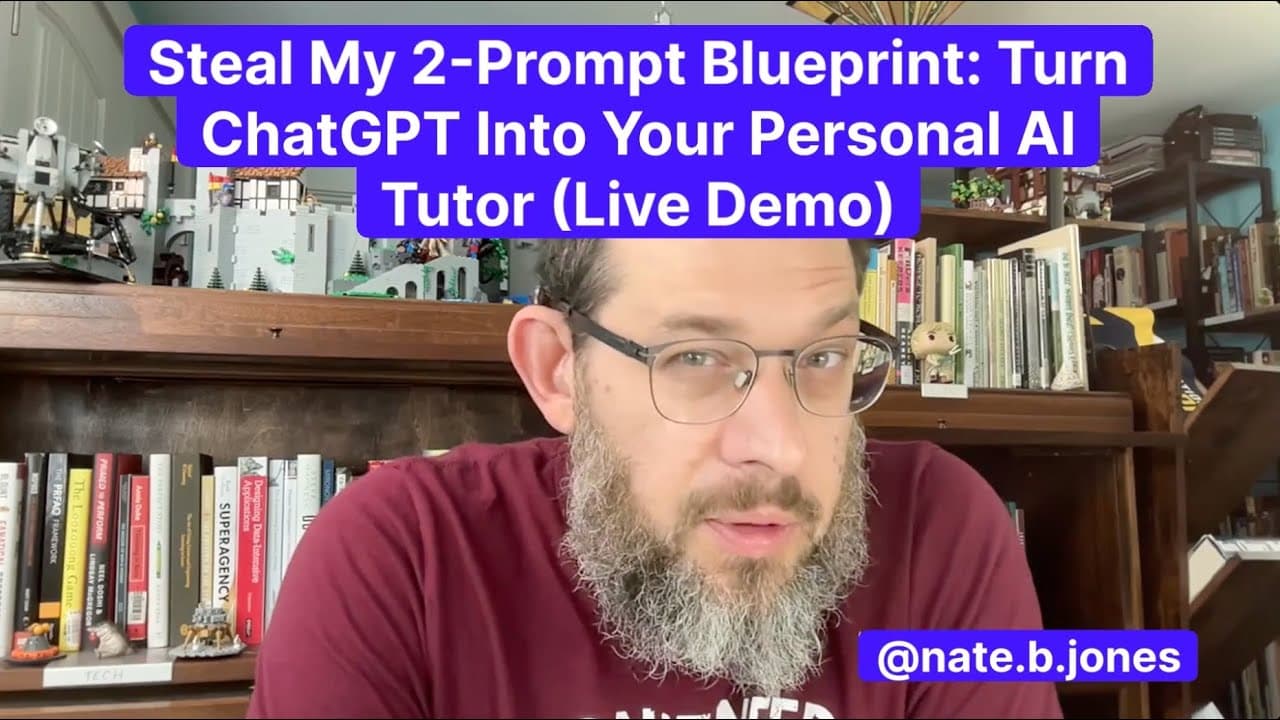
The video shows two prompts that function as dual goals to train an AI tutor. It explains a four-part prompt structure (purpose, instructions, reference, output) and contrasts hard-mode with easy-mode setups. Practical tips include logging prompts, using AI to critique prompts, and tailoring prompts to drive progressive learning and self-improvement.
Transcript
You know, the details of how we prompt profoundly influence AI. And most people know that, but they don't know how to shape those details so they matter. And I find that whenever I do prompt content, people get really excited. But there's been a gap. There's something that's been missing. And it's been me talking you through multiple versions of th... Read More
Key Insights
- Prompts are designed as systems of learning, not single-shot commands.
- A role statement guides the conversation into a productive semantic space rather than dictating facts.
- Hard-mode prompts demand exhaustive user input and strict follow-through.
- Easy-mode prompts lower friction with pre-filled defaults and single-question progressions.
- Small changes in constraints can dramatically alter the learner experience.
- Prompt blueprint structure (purpose, instructions, reference, output) drives model behavior.
- Notion-style prompt logging turns AI into a self-improvement partner.
- Meta-prompting and AI self-review accelerate mastery by iterative critique.
- More videos from this channel:
- More from this channel: AI News & Strategy Daily | Nate B Jones
Install to Summarize YouTube Videos and Get Transcripts
Explore YouTube Video Summarizer or Get YouTube Transcript Extractor
Questions & Answers
Q: How can I turn a prompt into a long-term teaching system for AI?
Turning a prompt into a long-term teaching system starts with a clear goal and a robust structure. Define the role, purpose, instructions, references, and the expected output. Use a progressive learning path that diagnoses the learner and then delivers increasingly harder material. Add memory of confirmed answers and constraints to maintain consistency across sessions. This approach creates a repeatable framework that guides the model to act as a personal tutor rather than a one-off responder.
Q: What is the difference between hard-mode and easy-mode prompting in the video?
Hard-mode prompting requires the user to answer a full set of questions before proceeding and often includes strict gating to ensure completeness. It is designed for deep, exhaustive setup and is harder for beginners. Easy-mode prompting pre-fills defaults and limits the scope to single questions or micro-lessons, making onboarding smoother. The choice depends on the learner’s familiarity with prompts and their willingness to invest upfront time for deeper customization.
Q: Why is the prompt role important if it doesn’t improve factual recall?
The role is important because it places the model in the right semantic space for the conversation. This helps dialogue flow toward the intended goals and makes it easier to guide the interaction, ask targeted questions, and structure learning steps. The role acts as a cognitive primer that shapes how the model processes instructions and follows the learning pipeline, rather than trying to enhance memory of facts.
Q: How does the four-part prompt structure affect the AI tutor's performance?
The four parts—purpose, instructions, reference, and output—establish a clear scaffold for the AI. Purpose states the overarching goal; instructions define behavior; references supply context; and output specifies the format. This separation reduces ambiguity, improves consistency, and makes it easier to customize the tutor for different subjects or skill levels. It also facilitates repeatable experimentation with prompt variants.
Q: What practical steps can I take to start using AI as a tutor today?
Begin by outlining a simple two-prompt setup: one to diagnose the learner and another to deliver progressive lessons. Use memory to carry forward confirmed answers and set constraints to prevent drift. Log prompts in a tool like Notion, and have an AI assistant critique them to refine the blueprint. Start with easy-mode to onboard quickly, then transition to hard-mode as familiarity grows.
Q: How does logging prompts with AI help improve learning outcomes?
Logging prompts creates a personal knowledge base that tracks what works and what doesn’t, enabling iterative improvement. It allows you to review how the AI responded to different prompts and to test variations systematically. This practice turns prompt design into a data-driven activity, helping you optimize for clarity, engagement, and learning velocity over time.
Q: What roles do memory and reference play in maintaining a tutor-like experience?
Memory helps the AI retain confirmed learner responses, avoiding repeated questions and preserving context across sessions. References provide the necessary background and constraints to avoid stray outputs. Together, they create a coherent, consistent tutoring experience, enabling the model to recall past goals and align future lessons with the learner’s progress without redundant prompts.
Q: What are meta-prompting techniques and why are they valuable?
Meta-prompting involves training the AI to critique its own prompts, propose improvements, and adjust the learning pathway. By enabling self-review, the model becomes a proactive partner in learning, offering insights about pacing, coverage, and difficulty. This approach accelerates mastery by enabling rapid experimentation and refinement of the instructional strategy.
Summary & Key Takeaways
-
This overview explains a two-prompt approach that teaches AI how to learn and how to teach itself. It emphasizes a structured prompt blueprint with sections and workflow rules aimed at turning an assistant into a personal tutor. The presenter demonstrates how small prompt adjustments yield different learning outcomes and easier onboarding.
-
The video evangelizes prompt architecture as performance, showing that role framing primes semantic space and that memory and references keep interactions coherent. It also contrasts hard-mode exhaustive prompts with easy-mode starter prompts to accommodate different learner levels.
-
It concludes with practical advice on tooling, such as Notion for prompt logging, and highlights meta-prompting techniques to critique prompts, build custom lesson plans, and form a sustainable practice around AI-assisted learning.
Read in Other Languages (beta)
Share This Summary 📚
Summarize YouTube Videos and Get Video Transcripts with 1-Click
Try YouTube Summary with ChatGPT & Claude or YouTube Transcript Generator
Explore More Summaries from AI News & Strategy Daily | Nate B Jones 📚






Summarize YouTube Videos and Get Video Transcripts with 1-Click
Try YouTube Summary with ChatGPT & Claude or YouTube Transcript Generator