How to navigate AI driven career transitions at work
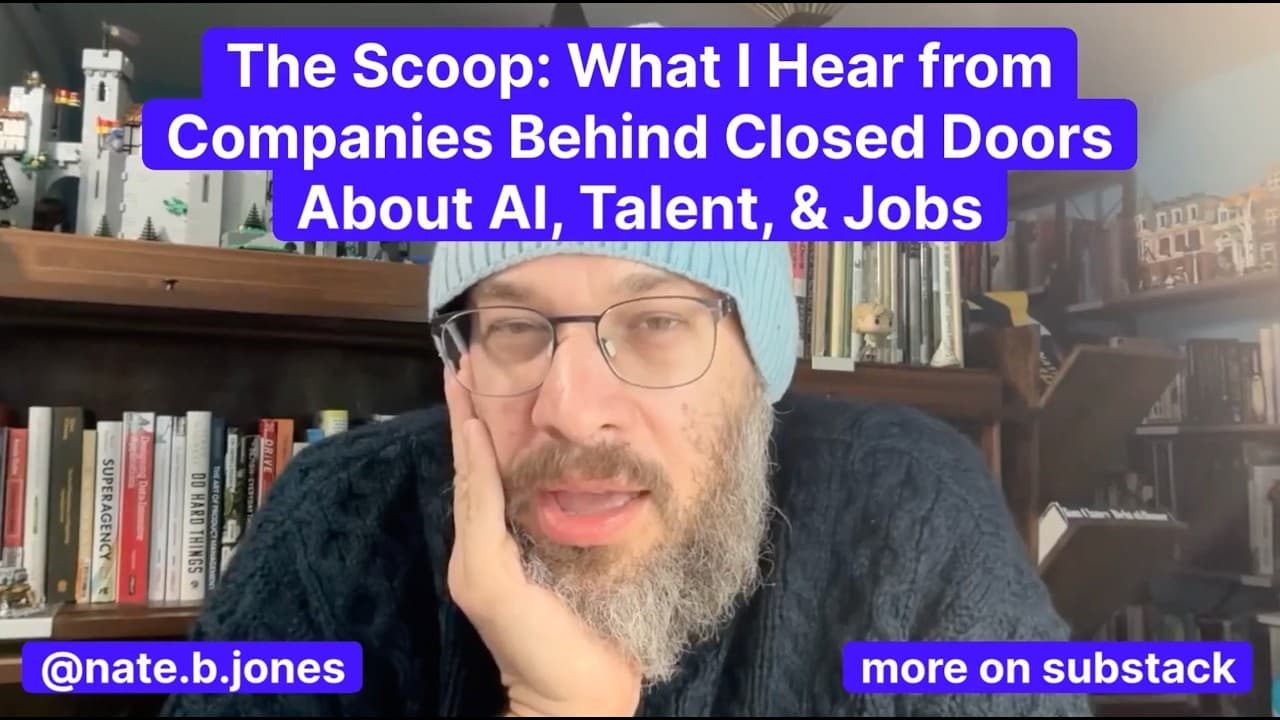
TL;DR
Juniors should push toward problem solving, using AI to demonstrate value beyond simple production, to avoid being labeled replaceable. Mid career should deepen domain expertise and map out AI aided prompts and task decomposition. Seniors can leverage deep experience while adopting AI, and hiring should mix levels to maximize broad expertise.
Transcript
These are the things that I wish we told employees more about AI. In other words, there's a lot of corporate communication going on about AI right now, but it's not all upfront. And I think it doesn't always help you in career growth. And having seen a lot of juniors, a lot of mid-career, a lot of senior folks grappling with the realities of an AI ... Read More
Key Insights
- AI value for juniors rests on problem solving, not just producing tasks, and requires demonstrating how AI expands output while preserving unique thinking. This approach helps prevent being seen as replaceable and supports career growth.
- Mid career growth depends on deepening domain expertise and choosing adjacent roles when necessary, while also actively socializing AI prompts and task decomposition to show proactive capabilities and reliable outputs.
- Seniors have the most grace in AI transitions, as their experience and system thinking are valuable, and hiring is shifting to include more senior profiles who can learn AI quickly and lead teams with deep knowledge.
- Effective AI adoption at work requires mapping out a clear skill trajectory for problem solving with AI, moving beyond generic tools to demonstrate business impact and measurable outcomes.
- OpenAI serves as an example of mixed level hiring, valuing fresh perspectives alongside seasoned experience to maximize problem solving and AI leverage.
- Problem framing and solution orientation are key competencies that will be rewarded as AI tools become standard, with juniors proving value through creative problem solving rather than routine tasks.
- Professionals should communicate the business impact of their AI assisted work, including how they validate outputs and ensure quality, to secure career stability across different levels.
- Organizations benefit from hiring a mix of junior, mid, and senior roles to balance AI acceleration with deep domain knowledge and system design capabilities.
- More videos from this channel:
- More from this channel: AI News & Strategy Daily | Nate B Jones
Install to Summarize YouTube Videos and Get Transcripts
Explore YouTube Video Summarizer or Get YouTube Transcript Extractor
Questions & Answers
Q: What should juniors focus on to avoid being replaceable
Juniors should push toward problem solving and show how they use AI to enhance capabilities beyond mere production. They need to demonstrate creative thinking, the ability to decompose tasks, and the capacity to deliver outcomes that cannot be easily replicated by AI alone. This approach helps establish unique value within the company and supports long term career stability.
Q: How can mid career professionals deepen their domain expertise
Mid career professionals should actively deepen their domain expertise by committing to a niche that differentiates them from juniors. They should map their skill trajectory with AI, showing how they prompt, decompose tasks, verify AI outputs, and apply insights within their domain. This builds a defensible competitive advantage and reduces risk of stagnation.
Q: What is the advantage of hiring seniors in AI driven organizations
Seniors bring extensive experience, deep domain knowledge, and robust problem solving that AI alone cannot replicate. Hiring practices are shifting to value these traits, with seniors able to learn AI quickly and apply it to complex systems. Their leadership enables teams to integrate AI effectively while maintaining strategic direction.
Q: Why is OpenAI cited in the discussion
OpenAI is cited because they actively hire junior engineers to blend fresh thinking with established practices. This approach recognizes that juniors can bring creative, out of the box perspectives on AI, while seniors contribute depth. The mix supports innovation and sustained performance across levels within AI driven organizations.
Q: How should juniors view career ladders in an AI era
Juniors should view career ladders as opportunities to grow through problem solving rather than only completing predefined tasks. They should seek roles that challenge them to reason, design solutions, and demonstrate value with AI as a tool to amplify capability. This mindset aligns early career progress with strategic impact.
Q: What role does problem solving play across career levels
Problem solving remains the core differentiator across levels. Juniors solve problems to prove value beyond production, mid career professionals solve domain related problems with AI aided methods, and seniors leverage experience to design robust, scalable solutions. AI is the accelerator, but problem framing and solution quality determine career trajectory.
Q: How can mid career professionals communicate their AI readiness
Mid career professionals should articulate how they socialize prompts, decompose tasks for AI, and verify outputs, linking these practices to business impact. They should document concrete examples of improved efficiency, reliability, and decision making enabled by AI, showing they can lead AI powered initiatives without sacrificing domain integrity.
Q: What is the recommended hiring mix for AI teams
The recommended hiring approach is to maintain a mix of levels, incorporating juniors for fresh perspectives and energy, mid level experts for domain continuity, and seniors for depth and leadership. This balance ensures strong problem solving, domain strength, and the ability to scale AI initiatives with experienced oversight.
Summary & Key Takeaways
-
A practical guide explains that junior workers must emphasize problem solving and AI aided productivity to prove value, rather than just producing outputs. It highlights the need for mid career individuals to deepen domain knowledge and to articulate how AI aids their problem solving and task decomposition. It also notes that seniors bring essential experience and should be integrated with AI in hiring to maintain balance.
-
The content argues that AI transitions require a rethinking of career ladders, prioritizing problem solving for juniors, domain expertise for mid-career professionals, and experiential leadership for seniors. It cites OpenAI as an example of hiring a mix of levels to leverage both AI and deep experience.
-
The overall message is that honest, targeted guidance across levels helps employees navigate AI driven changes, with emphasis on problem framing, proactive skill development, and a strategic view of how AI augments rather than replaces human work.
Read in Other Languages (beta)
Share This Summary 📚
Summarize YouTube Videos and Get Video Transcripts with 1-Click
Try YouTube Summary with ChatGPT & Claude or YouTube Transcript Generator
Explore More Summaries from AI News & Strategy Daily | Nate B Jones 📚






Summarize YouTube Videos and Get Video Transcripts with 1-Click
Try YouTube Summary with ChatGPT & Claude or YouTube Transcript Generator