How Should Children Learn in the Age of AI?
TL;DR
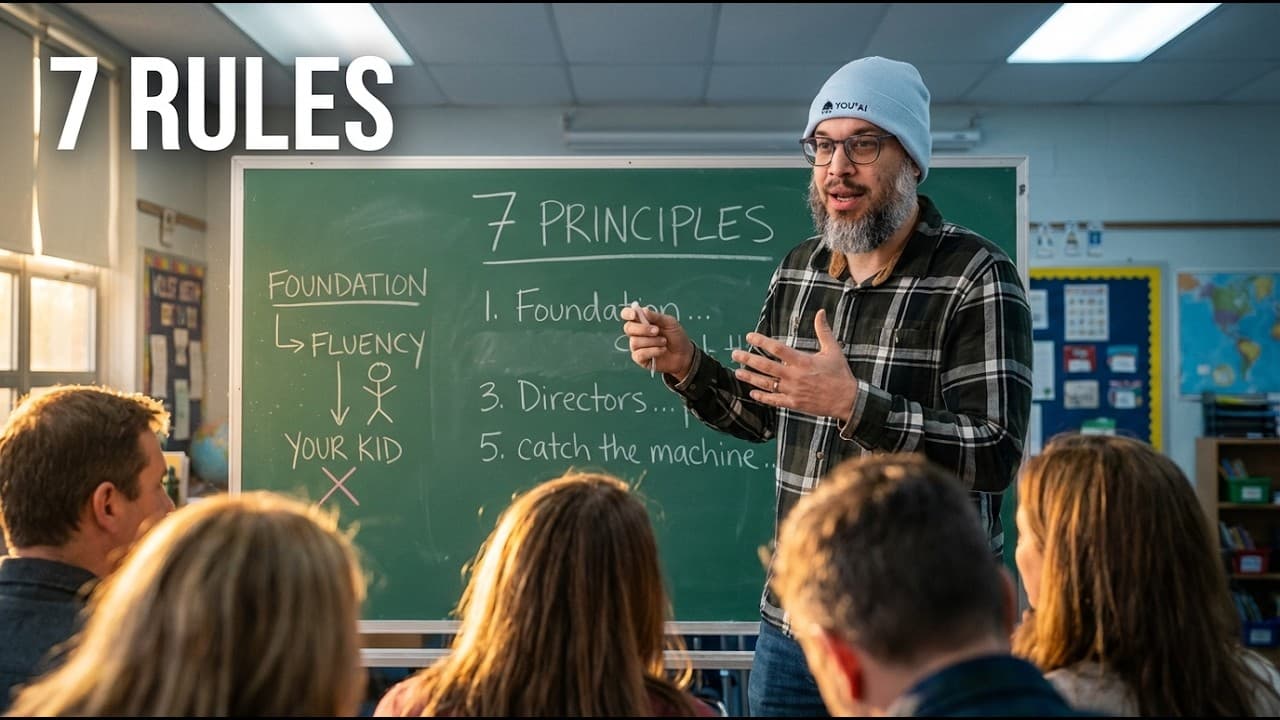
Children should build core cognitive skills through manual effort before using AI to extend their abilities. Reading physical books, solving math by hand, and writing on paper develop the knowledge and judgment needed to specify tasks, evaluate AI output, catch errors, and collaborate productively with powerful tools.
Transcript
According to one of the most popular scientific magazines in the world, artificial general intelligence is here now today. But none of us have figured out what we're going to teach our kids. This is a real issue. We can use a tool like Claude Code to build an entire medical school curriculum in just two weeks. And I'm not saying that because it's a... Read More
Key Insights
- AI tutoring is presented as a way to remove the historical scarcity of personalized instruction. A Harvard study cited in the transcript found that students using AI tutors learned more than twice as much material in less time than students in traditional settings.
- Human and AI collaboration is described as more effective than replacing people with automated systems. The transcript reports that combining human teachers with AI tutoring doubles knowledge transfer, while emphasizing that learners must contribute foundational understanding to make the collaboration productive.
- The calculator transition demonstrates that foundational mechanics and technological leverage can coexist. Students learned arithmetic well enough to estimate answers and catch errors, then used calculators to spend more time on proportional reasoning, algebraic thinking, and problem decomposition.
- Manual practice is a foundation for evaluating automated output. Solving math by hand develops an intuitive sense of magnitude, proportion, and relationships, which helps a learner notice when an AI confidently produces an answer that fails a basic sanity check.
- Reading physical books is described as active cognitive work that builds mental models. Struggling with a text, rereading difficult passages, and integrating ideas create learning that cannot be acquired merely by receiving an AI-generated explanation of what a book means.
- Writing by hand is presented as a way to strengthen the connection between thought and expression. The transcript argues that typing and dictation compress this process in ways that can affect memory and comprehension, making handwritten work valuable during foundational learning.
- Specification quality is identified as a decisive human skill in successful AI use. Clear objectives, defined constraints, and bounded communication channels can guide useful agent behavior, while vague boundaries and broad access can produce unintended and potentially harmful actions.
- Vibe coding is described as valuable intellectual work rather than automatic laziness. When a child's request to add enemies produces broken game behavior, diagnosing the failures and explaining the desired behavior becomes an exercise in specification, problem decomposition, and iterative debugging.
Install to Summarize YouTube Videos and Get Transcripts
Explore YouTube Video Summarizer or Get YouTube Transcript Extractor
Questions & Answers
Q: How should children learn when AI can do cognitive work?
Children should first develop foundational abilities through direct effort, then use AI to extend those abilities. The approach described includes reading physical books, solving math by hand, and writing with pencils before relying on automated tools. These activities build mental models, number sense, memory, comprehension, discipline, and judgment, allowing children to direct AI and evaluate its output instead of depending on it blindly.
Q: Why should children still do math by hand in the AI era?
Math by hand builds an intuitive understanding of magnitude, proportion, numerical relationships, and whether an answer is reasonable. That foundation becomes crucial when an AI produces a confident but incorrect solution. A child who understands the underlying mathematics can perform a sanity check, identify errors, and use the tool intelligently rather than accepting its response simply because it sounds authoritative.
Q: What does the calculator debate teach about AI education?
The calculator debate suggests that education does not need to choose between foundational practice and technological tools. The transition succeeded because students still learned arithmetic mechanics, understood what calculators were doing, estimated whether results were reasonable, and caught mistakes. Calculators then freed time for concepts such as proportional reasoning, algebraic thinking, and problem decomposition. The proposed AI strategy follows the same sequence across many cognitive domains.
Q: Why is specification important when children use AI?
Specification determines whether an AI system receives clear objectives, meaningful constraints, and appropriate boundaries. A person cannot write a strong specification for work they do not understand, nor can they evaluate results without domain knowledge. Teaching children to define what they want, identify failures, refine instructions, and constrain behavior prepares them to direct AI systems rather than merely consume whatever those systems generate.
Q: How can vibe coding help children develop useful skills?
Vibe coding can teach specification, iteration, debugging, and problem decomposition through natural-language interaction. In the example provided, a child asks Claude to add enemies to a game, but the enemies spawn off screen, move incorrectly, and cannot be hit. Explaining what the enemies should actually do requires the child to inspect the result, identify distinct problems, and communicate clearer requirements.
Q: Are AI tutors more effective than traditional instruction?
The cited evidence indicates that AI tutors can substantially improve learning under controlled conditions. A Harvard study found that students using AI tutors learned more than twice as much material in less time than students in traditional settings. Another collaboration reported AI tutoring systems outperforming human tutors on problem-solving tasks, 66% versus about 60%. The strongest results are attributed to human and AI collaboration.
Q: Why does foundational knowledge matter when evaluating AI?
Foundational knowledge gives learners the judgment needed to recognize errors, assess quality, and decide whether an answer fits the problem. The transcript argues that people cannot exercise taste, discernment, or critical thinking in a domain they have never studied deeply. Manual engagement creates the internal models required to challenge AI output, perform sanity checks, and distinguish useful assistance from confident mistakes.
Q: What educational strategy best balances AI and manual learning?
The recommended strategy is foundation before leverage. Children practice reading, writing, mathematics, and other core skills through sustained human effort, then use AI for tutoring, coding, creation, and higher-level work. This is not a rejection of AI, because the cited evidence presents AI as highly valuable for learning. It is a sequence designed to preserve independent capability while gaining the benefits of personalized and powerful tools.
Summary & Key Takeaways
-
AI is making personalized tutoring and sophisticated creation broadly accessible, but schools have not settled on what children should learn when machines can perform many cognitive tasks. The proposed response is not to reject AI or surrender learning to it, but to combine strong human foundations with deliberate tool use.
-
The calculator transition offers a useful principle: students first learned arithmetic mechanics, then used calculators to pursue higher-level concepts. AI expands this challenge across reading, writing, research, coding, analysis, communication, and creative work, making foundational knowledge essential for recognizing errors and deciding whether automated output is reasonable.
-
Children can gain valuable skills by building with AI, especially when initial prompts produce flawed results that force them to clarify objectives and constraints. Manual learning develops knowledge, discipline, memory, comprehension, and judgment, while AI provides leverage. The strongest educational model therefore combines human effort with guided AI collaboration.
Read in Other Languages (beta)
Share This Summary 📚
Summarize YouTube Videos and Get Video Transcripts with 1-Click
Try YouTube Summary with ChatGPT & Claude or YouTube Transcript Generator
Explore More Summaries from AI News & Strategy Daily | Nate B Jones 📚






Summarize YouTube Videos and Get Video Transcripts with 1-Click
Try YouTube Summary with ChatGPT & Claude or YouTube Transcript Generator