How OpenAI's 2026 Strategy Faces Its Real Test
TL;DR
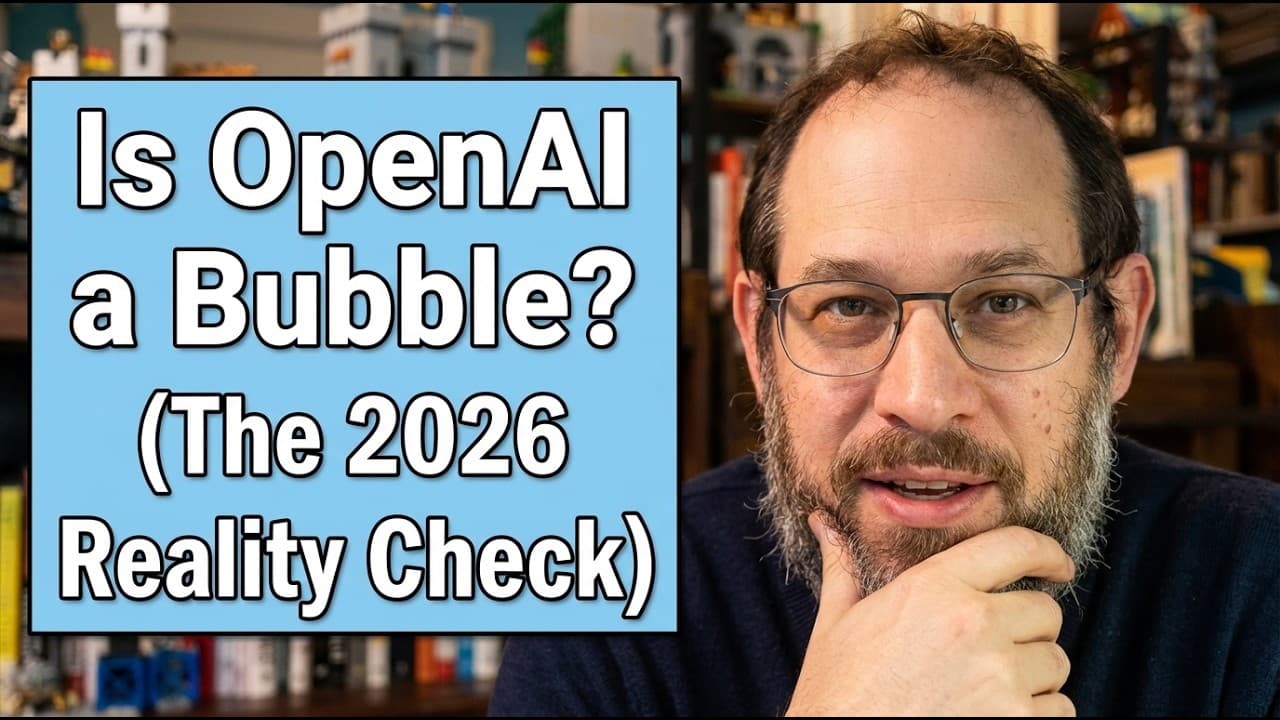
OpenAI's decisive 2026 test is whether it can allocate scarce compute profitably across consumer chat, frontier research, and enterprise work. Its distribution advantage remains valuable, but free users favor fast, inexpensive responses while enterprises demand governed, high-quality outcomes, creating conflicting priorities that require stronger unit economics and a credible path to long-term profitability.
Transcript
Most people are still talking about OpenAI the way they talked about Apple back in 2008, as if the whole story is who has the best device. Heading into 2026, I think that's the incorrect frame for the entire conversation around AI. So, in this executive briefing, I want to talk about the real question, the one that's strategic. If you assume that y... Read More
Key Insights
- OpenAI's central constraint is compute allocation, because consumer chat, enterprise workloads, and frontier research compete for the same scarce capacity. The strategic question is therefore not limited to which model performs best, but which users and tasks receive expensive intelligence under pressure.
- ChatGPT is described as an engagement platform serving a billion people, with only 5% willing to pay. That imbalance makes consumer unit economics difficult and encourages cheap, fast defaults, even when slower reasoning could produce more capable answers for users who know how to apply it.
- Enterprise demand is shifting toward delegation engines that can accept work and return finished outcomes. The speaker sees Codex as moving in this direction through autonomous agents, high-quality inference, and completed enterprise work products, initially in code and potentially later in other areas.
- OpenAI's distribution advantage is earned through continued consumer use rather than controlled through an operating system, device platform, or search channel. The company must repeatedly defend its usage habit as Google pushes Gemini through Search, Android, and Chrome and grows faster, according to the transcript.
- Free-user behavior can shape public understanding of artificial intelligence because inexpensive defaults expose many people to less capable models. A cited survey found that 66% or 67% of AI users thought answers were database retrievals or prescripted responses, illustrating weak mental models of the technology.
- OpenAI's two major compute priorities for 2026 are described as deep-inference research for science and medicine, and high-quality inference for enterprise customers. Both are paid allocations, while the scientific work also reflects the research mission and researchers' interest in difficult, consequential problems.
- OpenAI is trying to win three conflicting games at once: operating a frontier laboratory, maintaining a mass consumer platform, and building an enterprise productivity business. Each game needs usage and compute, so reallocations can look inconsistent even when they reflect rational responses to risks on different fronts.
- Long-term profitability is becoming a necessary test of OpenAI's strategy, not merely its ability to raise capital. Investors are expected to seek evidence that compute commitments, enterprise revenue, consumer economics, and research spending can eventually support positive cash flow and a sustainable business.
Install to Summarize YouTube Videos and Get Transcripts
Explore YouTube Video Summarizer or Get YouTube Transcript Extractor
Questions & Answers
Q: What is the real test of OpenAI's strategy in 2026?
The real test is whether OpenAI can allocate scarce compute across three competing businesses while establishing a credible path to long-term profitability. It must protect consumer distribution, support expensive frontier research, and deliver governed enterprise outcomes. Success depends less on winning model benchmarks alone and more on converting compute into paid, valuable work without weakening the consumer habit that supports its market position.
Q: Why is compute more important than model quality for OpenAI?
Compute determines which customers receive intelligence, how quickly responses arrive, how much reasoning occurs, and whether OpenAI can satisfy very large enterprise workloads. The transcript describes compute as both a consumer unit-economics constraint and an enterprise capacity constraint. Product defaults, plan limits, query routing, and the visibility of advanced experiences are consequently strategic allocation decisions, not merely interface or model-quality choices.
Q: Why does consumer ChatGPT create a unit-economics problem?
Consumer ChatGPT is described as serving a billion people while only 5% are willing to pay. Free users are price sensitive and often prefer fast responses, so expensive reasoning may add cost and latency without producing enough perceived value. OpenAI therefore has an incentive to use cheaper defaults for much of this audience and reserve more costly inference for paid research and enterprise applications.
Q: What does the faster ChatGPT default signal about OpenAI's priorities?
The rollback from slower reasoning by default in ChatGPT 5.2 is interpreted as evidence that cost and latency were not justified for free users. Many users appear to prefer faster, less capable responses. That choice conserves compute, but it can also limit what the public sees AI accomplish and reinforce shallow expectations about a technology whose underlying capabilities are advancing faster than its chat interface changes.
Q: How could enterprise delegation improve OpenAI's business model?
Enterprise delegation can create greater willingness to pay because customers receive completed work rather than conversational assistance alone. The desired system accepts a task, performs it autonomously, and returns a high-quality work product with appropriate governance. The speaker identifies Codex as an early example, particularly for code, and suggests that OpenAI may extend this outcome-oriented approach into additional enterprise work categories.
Q: Why must OpenAI continue defending consumer distribution?
OpenAI's consumer reach depends on an earned usage habit rather than ownership of a dominant search engine, browser, mobile operating system, or device platform. Google can distribute Gemini through Search, Android, and Chrome, while Apple controls the iPhone. OpenAI must therefore retain existing users and attract marginal users in a market where many people have already selected competing AI systems.
Q: Why does OpenAI's product strategy sometimes appear inconsistent?
The strategy can appear inconsistent because OpenAI is simultaneously pursuing frontier research, a mass consumer platform, and enterprise productivity. All three require compute, engineering attention, and active users, but their requirements conflict. Resource reallocations and changing quarterly emphasis are therefore presented as consequences of managing three strategic games at once, especially when one area develops a dangerous competitive position.
Q: What evidence would show that OpenAI is not a bubble?
The proposed evidence is durable enterprise demand, valuable delegated outcomes, effective compute allocation, and a believable route to positive cash flow and profitability. Raising additional capital is not treated as sufficient proof. OpenAI must demonstrate that customers will pay for high-quality inference at scale while the company continues funding consumer distribution, compute capacity, scientific research, and advanced model development.
Summary & Key Takeaways
-
OpenAI is portrayed as operating under significant constraints rather than following one unified product strategy. It must distribute limited compute among a large consumer audience, advanced research, and enterprise customers. These groups demand different combinations of price, speed, intelligence, capacity, governance, and reliability, making frequent reprioritization a predictable organizational response.
-
Consumer ChatGPT protects OpenAI's distribution advantage, but only 5% of its billion users are described as willing to pay. The remaining free audience often prefers faster responses and may not understand more advanced capabilities. Serving that audience with expensive reasoning therefore creates tension between engagement, public perception, and sustainable unit economics.
-
The proposed 2026 test centers on enterprise delegation, scientific research, and profitability. OpenAI must prove that customers will pay for systems that complete work, not merely assist through chat. It must also preserve consumer habits, fund compute capacity, pursue research ambitions, and present investors with a credible route toward positive cash flow.
Read in Other Languages (beta)
Share This Summary 📚
Summarize YouTube Videos and Get Video Transcripts with 1-Click
Try YouTube Summary with ChatGPT & Claude or YouTube Transcript Generator
Explore More Summaries from AI News & Strategy Daily | Nate B Jones 📚






Summarize YouTube Videos and Get Video Transcripts with 1-Click
Try YouTube Summary with ChatGPT & Claude or YouTube Transcript Generator