How to Tell Your AI Building Level and Grow
TL;DR
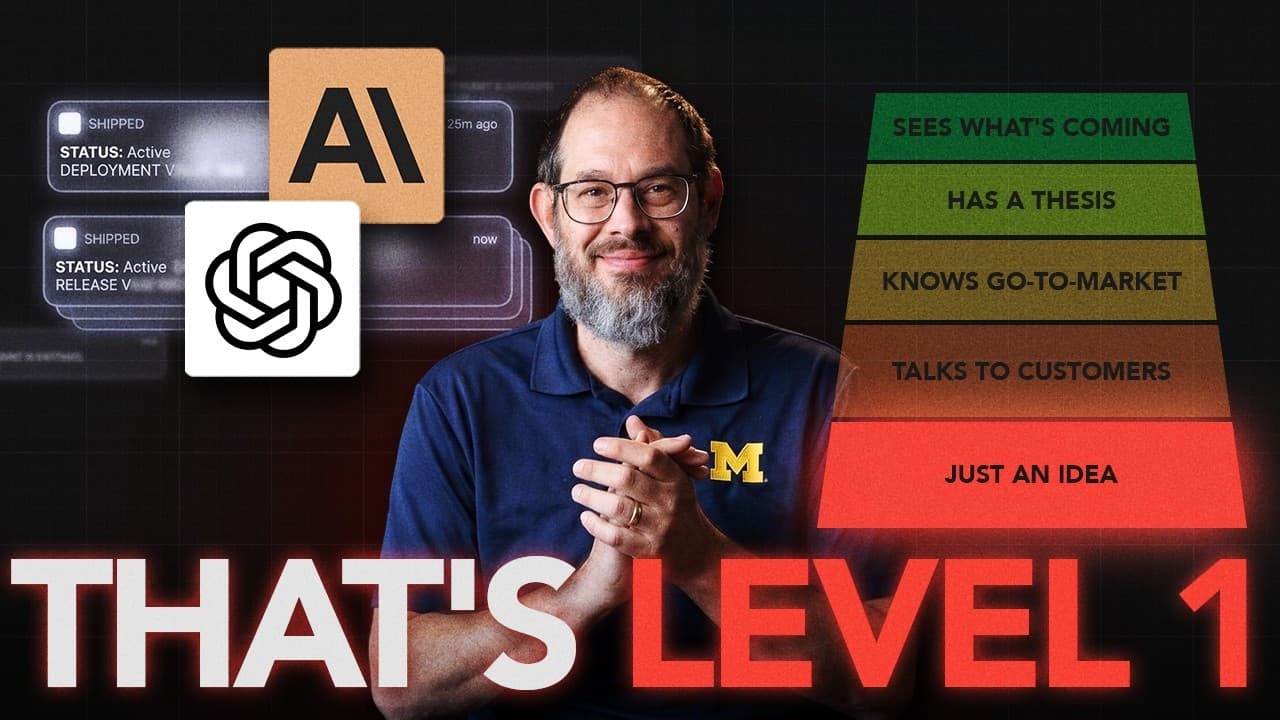
Level 1 is driven by passion for the idea, not market fit. Level 2 introduces customer feedback to steer the idea while maintaining a CRM focus. Level 3 adds go to market strategy and AI powered storytelling. Higher levels demand deep problem space knowledge and a forward looking AI thesis to scale.
Transcript
AI builders come to me and they are so discouraged a lot of the time and they're especially discouraged because of what Open AI and Anthropic launch all the time. It seems like every week they come out with something and it's not what you wanted to hear as a builder. I get it. We're going to talk about some of those stories later, but the first thi... Read More
Key Insights
- Level one builders are defined by passion for the idea and a narrow focus on the concept rather than market strategy.
- Level two builders stay open to changing the idea after talking with customers and can monetize through side gigs.
- Level three builders understand go to market and see AI as a tool to supercharge storytelling and distribution.
- Level four builders have a deep problem space understanding and a unique AI based thesis that disrupts the space.
- Level five builders anticipate AI advances in their domain and build to leverage emerging capabilities.
- AI moves fast, and level five builders foresee future capabilities like agentic tools and long running sessions.
- Successful AI startups leverage AI across the entire business, not just the product.
- The path from level one to level five is about increasing domain mastery and strategic use of AI, not just technical skill.
- More videos from this channel:
- More from this channel: AI News & Strategy Daily | Nate B Jones
Install to Summarize YouTube Videos and Get Transcripts
Explore YouTube Video Summarizer or Get YouTube Transcript Extractor
Questions & Answers
Q: What defines a level one AI builder, and why is this stage important to recognize?
A level one AI builder is defined by their passion for what AI can do and their idea taking over as their world. They focus on the concept itself rather than go to market or customer insights. Recognizing this stage helps founders avoid overcommitting to an idea without validating it against real customer needs or a scalable path to market.
Q: How does a level two builder differ from level one in terms of customer interaction?
A level two builder retains the passion for the idea but introduces openness to how the idea may shift after interacting with customers. They listen to feedback from multiple customers and adjust the concept accordingly, often turning this insight into a side gig or a more viable business as they refine their offering.
Q: What role does go to market play for level three builders?
Level three builders understand go to market as essential to success, focusing on distribution and telling their story effectively. They combine traditional entrepreneurship with AI powered strategies to reach customers, using methods like outbound messaging, voice models, storytelling podcasts, and social channels to scale awareness and sales.
Q: Why is a strong domain thesis important at level four?
At level four, a strong domain thesis is crucial because it shows deep understanding of the problem space and a unique AI based approach to attack it. This thesis remains stable despite new AI news and lab launches, enabling the founder to execute a differentiated, scalable strategy over time.
Q: What makes level five builders different in anticipating AI trends?
Level five builders stand out by forecasting AI capabilities that will emerge in 6 to 12 months within their space. They understand current and future tool capabilities, such as agentic use and context management, and position their business to capitalize on those upcoming developments rather than reacting to every new release.
Q: How does the video describe the impact of current lab launches on independent builders?
The video explains that while labs launch frequently, the real impact on independent builders depends on how well a founder understands their customer, their distribution strategy, and their domain, rather than reacting to every new model or feature. Long term success comes from a clear problem space and a resilient business thesis.
Q: What is the practical advice for builders to maximize time and effort in AI projects?
Builders should identify their current level, deeply understand their problem space, and develop a concrete AI thesis that can disrupt their domain. Focusing on how AI can support go to market, distribution, and customer understanding helps them turn insights into durable value, avoiding impulsive pivots driven by the latest model releases.
Q: What is the central message about AI building levels in the video?
The central message is that AI builders progress through five levels, from passionate idea creators to strategic, foresightful leaders who leverage AI to transform their market. Success hinges on deep domain knowledge, practical distribution strategies, and a forward looking AI thesis that anticipates future capabilities rather than merely adopting the latest technology.
Summary & Key Takeaways
-
Level 1 builders are in love with their idea and fail to consider market or go to market needs, risking long term success.
-
Level 2 builders listen to customers, adjust their approach, and can generate six figure side gigs by aligning the idea with actual user needs.
-
Level 3 combines traditional go to market with AI enabled distribution, showing how AI can amplify storytelling and customer outreach to win customers.
Read in Other Languages (beta)
Share This Summary 📚
Summarize YouTube Videos and Get Video Transcripts with 1-Click
Try YouTube Summary with ChatGPT & Claude or YouTube Transcript Generator
Explore More Summaries from AI News & Strategy Daily | Nate B Jones 📚






Summarize YouTube Videos and Get Video Transcripts with 1-Click
Try YouTube Summary with ChatGPT & Claude or YouTube Transcript Generator