How Does Cramer's Rule Solve Linear Systems?
TL;DR
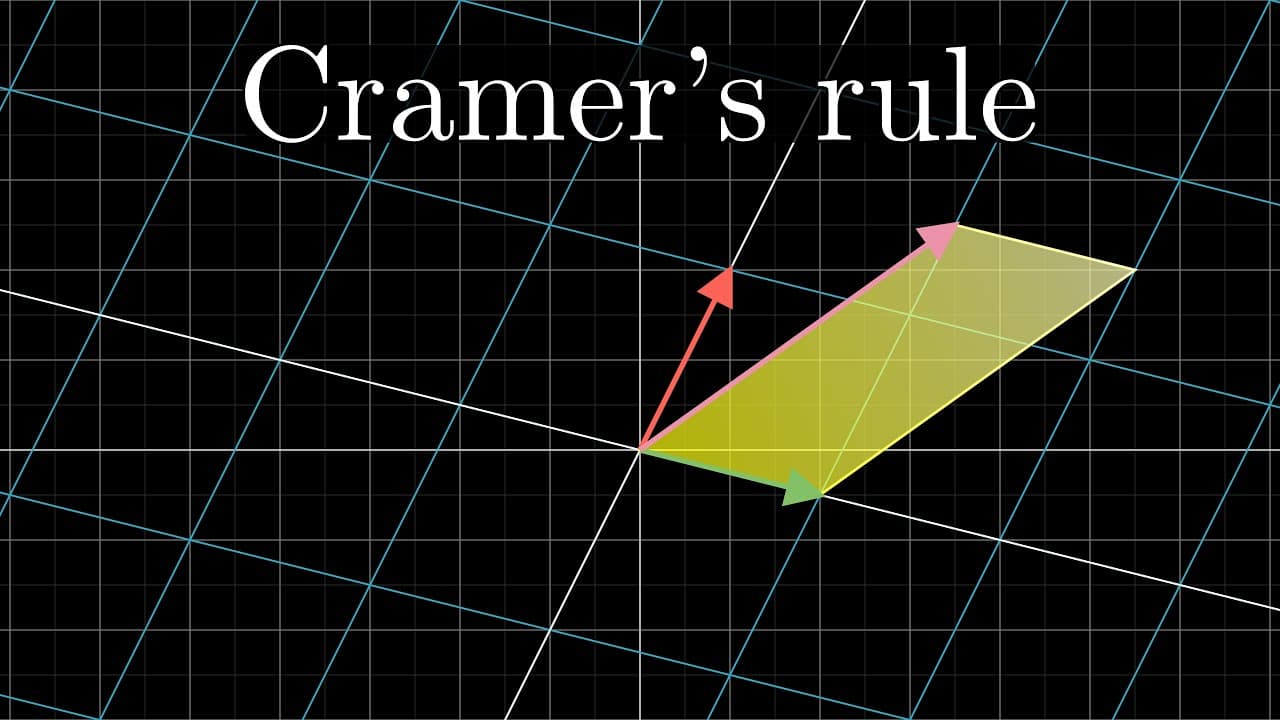
Cramer's rule finds each unknown by dividing the determinant of a column-replaced matrix by the determinant of the original matrix. Geometrically, it works because coordinates can be represented as signed areas or volumes, and a linear transformation scales all such measurements by the same determinant. The original determinant must be nonzero for the solution to be unique.
Transcript
In a previous video I've talked about linear systems of equations, and I sort of brushed aside the discussion of actually computing solutions to these systems. And while it's true that number crunching is typically something we leave to the computers, digging into some of these computational methods is a good litmus test for whether or not you actu... Read More
Key Insights
- A linear system is a transformation puzzle in which a known matrix sends an unknown input vector to a known output vector. Solving it means determining the coefficients of the matrix columns whose linear combination equals that output.
- A nonzero determinant means the transformation does not collapse space into a lower dimension. Every input then has exactly one output, every output has exactly one input, and the system considered here has a unique solution.
- Dot products are not generally preserved by linear transformations. Vectors pointing in similar directions can be pulled apart, perpendicular basis vectors can lose perpendicularity, and stretching can increase dot products, so transformed dot products usually cannot directly recover the original coordinates.
- Orthonormal transformations preserve dot products because their basis vectors remain perpendicular and retain unit lengths. For systems using such matrices, each unknown coordinate can be found by taking the dot product of the output vector with the corresponding matrix column.
- A coordinate can be represented as a signed area. In two dimensions, the parallelogram spanned by the first basis vector and an unknown vector has signed area equal to the unknown vector's y-coordinate.
- A three-dimensional coordinate can be represented as a signed volume. Combining a vector with the two standard basis vectors outside the desired coordinate direction forms a parallelepiped whose signed volume equals that coordinate, provided the vector order is chosen correctly.
- The determinant is the common factor by which a matrix transformation scales all signed areas or volumes. This shared scaling makes area-based and volume-based coordinate descriptions useful even when lengths, angles, and dot products change.
- Cramer's rule recovers an unknown by replacing its corresponding matrix column with the known output vector, taking the altered determinant, and dividing by the original determinant. In the example, the resulting ratios give x equals 3 and y equals 2.
Install to Summarize YouTube Videos and Get Transcripts
Explore YouTube Video Summarizer or Get YouTube Transcript Extractor
Questions & Answers
Q: How does Cramer's rule solve a linear system?
Cramer's rule solves a square linear system by computing determinant ratios. To find an unknown coordinate, replace the corresponding column of the original matrix with the known output vector, calculate the determinant of that altered matrix, and divide it by the determinant of the original matrix. This procedure assumes the original determinant is nonzero, which ensures a unique input for the given output.
Q: Why does Cramer's rule use determinants?
Cramer's rule uses determinants because a matrix transformation scales every signed area, or every signed volume in higher dimensions, by the same factor. That factor is the determinant of the transformation matrix. An unknown coordinate can itself be represented as a signed area or volume, so its transformed measurement equals the coordinate multiplied by the original determinant. Dividing reverses that scaling.
Q: What is the geometric meaning of a linear system?
A linear system can be interpreted as a known matrix transforming an unknown input vector into a known output vector. Each matrix column records where one standard basis vector lands. The output is therefore a linear combination of those columns, with the unknown input coordinates serving as coefficients. Solving the system means finding precisely which coefficients produce the known output vector.
Q: Why must the original determinant be nonzero?
A nonzero determinant means the matrix transformation continues to span the full dimension of its input space instead of compressing everything into a lower-dimensional space. Under this condition, every input maps to exactly one output and every output comes from exactly one input. It also makes division by the original determinant possible when applying Cramer's rule to recover each unknown coordinate.
Q: Why can dot products not usually solve the transformed system directly?
Dot products generally change under linear transformations. Two vectors with a positive dot product can be pulled apart until their transformed versions have a negative dot product, while perpendicular basis vectors can cease to be perpendicular. Transformations may also stretch vectors and increase their dot products. Consequently, dotting the known output with transformed basis vectors usually does not reproduce the unknown input coordinates.
Q: When can dot products directly recover the unknown coordinates?
Dot products can directly recover the coordinates when the system's matrix represents an orthonormal transformation. Such transformations preserve dot products, keep basis vectors perpendicular, and maintain their unit lengths. In that special case, dotting the known output vector with the first matrix column gives x, while dotting it with the second column gives y. These transformations correspond to rigid motion without stretching or squishing.
Q: How can signed area represent a vector coordinate?
In two dimensions, place the first standard basis vector beside the unknown vector to form a parallelogram. Because the basis vector has length 1, the parallelogram's height is the unknown vector's y-coordinate, making its signed area equal to y. Similarly, the parallelogram spanned by the unknown vector and the second basis vector has signed area equal to x, with ordering preserving signs.
Q: How does the geometric argument extend to three dimensions?
In three dimensions, a coordinate can be encoded as the signed volume of a parallelepiped. To represent the z-coordinate, combine the unknown vector with the first and second standard basis vectors. Their unit square forms the base, while the relevant height is z. Other coordinates are obtained by combining the vector with all basis vectors except the one for the desired direction, while respecting vector order and the right-hand rule.
Summary & Key Takeaways
-
A linear system can be viewed as a known matrix transforming an unknown input vector into a known output vector. The matrix columns show where the input basis vectors land, so solving the system means finding the coefficients that combine those columns into the output. The discussion focuses on matrices with nonzero determinants.
-
Dot products reveal coordinates in the standard basis, but general linear transformations do not preserve dot products. Orthonormal transformations are a special exception because they keep basis vectors perpendicular and at unit length. For general systems, signed parallelogram areas provide an alternative description of coordinates that interacts predictably with matrix transformations.
-
Every area or volume produced by a linear transformation is scaled by the determinant of its matrix. Cramer's rule uses this fact by replacing one matrix column with the known output vector. Dividing the altered determinant by the original determinant recovers the corresponding coordinate of the unknown input vector.
Read in Other Languages (beta)
Share This Summary 📚
Summarize YouTube Videos and Get Video Transcripts with 1-Click
Try YouTube Summary with ChatGPT & Claude or YouTube Transcript Generator
Explore More Summaries from 3Blue1Brown 📚



Summarize YouTube Videos and Get Video Transcripts with 1-Click
Try YouTube Summary with ChatGPT & Claude or YouTube Transcript Generator