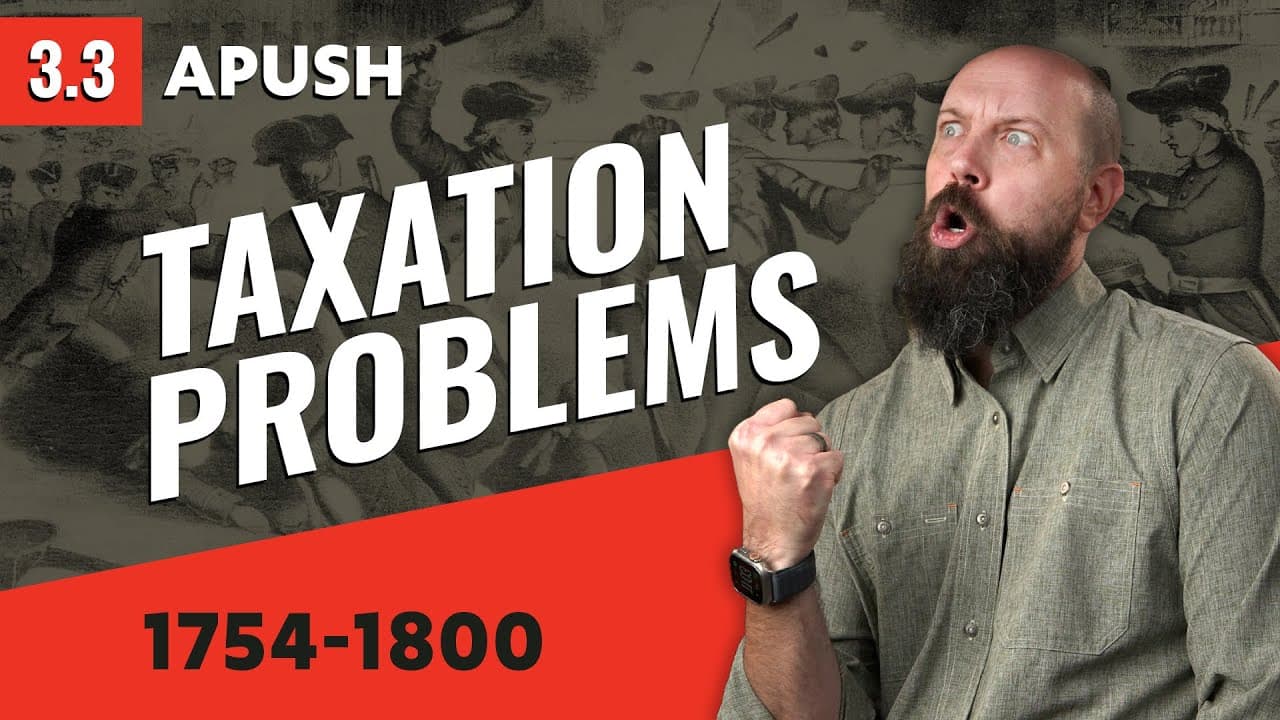
How did British taxes spark colonial resistance
TL;DR
Grenville’s plan reasserted imperial control by enforcing existing laws, continuing wartime policies, and taxing the colonies. The Stamp Act, Sugar Act, and Currency Act provoked protests, leading to boycotts and the repeal of some acts, while Parliament asserted its authority through the Declaratory Act. Representation and local governance became central to colonial pushback.
Transcript
My goodness, you can almost smell the beginning of the American Revolution. But put your patient pants on because we still have to talk about yet another cause that led to that great confilration of liberty and independence, namely the British taxation policy. So, if you're ready to get them brain cows milked, let's get to it. Okay. Now, if you've ... Read More
Key Insights
- Grenville reasserted imperial control by enforcing existing laws and continuing wartime measures.
- The Sugar Act, Currency Act, and Stamp Act imposed taxes and regulatory changes to raise revenue and curb smuggling.
- Colonists argued taxation without representation and advanced the idea of local representation over distant Parliament.
- Virtual representation was claimed by Britain as a justification for taxation in the colonies.
- Resistance organized through groups like the Sons of Liberty and the Daughters of Liberty.
- Nonimportation and boycotts under the Townshend Acts diminished British revenue and pressured repeal.
- The Stamp Act Congress represented formal colonial protest and petitioning Parliament for repeal.
- The Declaratory Act asserted Parliament’s authority to legislate for the colonies despite protests.
- More videos from this channel:
- More from this channel: Heimler's History
Install to Summarize YouTube Videos and Get Transcripts
Explore YouTube Video Summarizer or Get YouTube Transcript Extractor
Questions & Answers
Q: How did Grenville plan to raise revenue after the French and Indian War?
Grenville aimed to raise revenue by enforcing existing laws that colonists had ignored due to salutary neglect, continuing wartime policies such as the Quartering Act, and pushing new taxes like the Sugar Act, Currency Act, and Stamp Act. These measures increased enforcement and reduced colonial economic freedom, intensifying tensions as colonists faced higher costs and stricter controls.
Q: What was the Sugar Act intended to do and how did colonists respond?
The Sugar Act lowered some taxes on imported molasses but increased effort to collect revenue, tightening enforcement to close loopholes used by smugglers. Colonists resisted via protests and boycotts, feeling the act was a step toward taxation without representation and an infringement on colonial trade, sparking early calls for rights as British subjects.
Q: Why was the Stamp Act particularly provocative to the colonists?
The Stamp Act was the first direct tax on the colonies and signaled a shift in how Parliament taxed colonial inhabitants. It affected everyday items like newspapers and diplomas, provoking widespread concern about taxation without representation and prompting organized opposition in the form of petitions, congresses, and boycotts.
Q: What is meant by virtual representation and how did colonists view it?
Virtual representation was Britain’s claim that Parliament represented all English subjects, even colonists who were not members. Colonists rejected this, arguing that true representation required local, colonial participation in governance and legal reform, which they believed safeguarded their rights as British subjects.
Q: How did colonial protests organize themselves against British policies?
Protests formed through groups such as the Sons of Liberty and the Daughters of Liberty, which mobilized opinion, delivered speeches, and published pamphlets. Committees of correspondence enabled rapid information sharing across colonies, coordinating action and reinforcing a common stance against imperial taxation and governance.
Q: What role did the Boston Massacre play in escalating tensions?
The Boston Massacre provided a dramatic incident used by patriots to frame British rule as tyrannical, fueling anti-British sentiment and propaganda. It intensified calls for repeal of oppressive acts and heightened support for collective colonial rights, contributing to a harder line against Parliament and imperial authority.
Q: How did Parliament respond after colonial resistance, particularly regarding taxation?
Parliament repealed the Stamp Act and the Sugar Act, signaling some concession to colonial pressure. However, it issued the Declaratory Act to assert continued control and the right to legislate for the colonies in all cases. This combination showed both friction and insistence on imperial authority.
Q: What long-term effect did these events have on colonial thinking about independence?
While most colonists initially sought to preserve rights within the British framework, protests shifted debates toward asserting local governance and rights, setting the stage for more radical calls for independence. The combination of economic hardship, symbolic acts of resistance, and political petitions gradually reframed colonial goals.
Summary & Key Takeaways
-
The video explains how Britain used taxation and enforcement of laws after the French and Indian War to tighten control over the colonies and raise revenue. It highlights the Sugar Act, Currency Act, and Stamp Act as ignition points for colonial resistance. It also covers the role of groups like the Sons of Liberty and the Virginia resolves in mobilizing opposition.
-
The content traces the progression from economic hardship and perceived taxation without representation to organized protests, boycotts, and formal petitions such as the Stamp Act Congress. It notes the repeal of certain acts and the ongoing assertion of parliamentary power through the Declaratory Act.
-
The video concludes with the Boston Massacre as a propaganda moment that intensified resistance, the repeal of most Townshend duties, and the continued conflict over British authority, setting the stage for further colonial demands for rights and representation.
Read in Other Languages (beta)
Share This Summary 📚
Summarize YouTube Videos and Get Video Transcripts with 1-Click
Try YouTube Summary with ChatGPT & Claude or YouTube Transcript Generator
Explore More Summaries from Heimler's History 📚


Summarize YouTube Videos and Get Video Transcripts with 1-Click
Try YouTube Summary with ChatGPT & Claude or YouTube Transcript Generator