How to Simulate Phase Transitions in Fluids
TL;DR
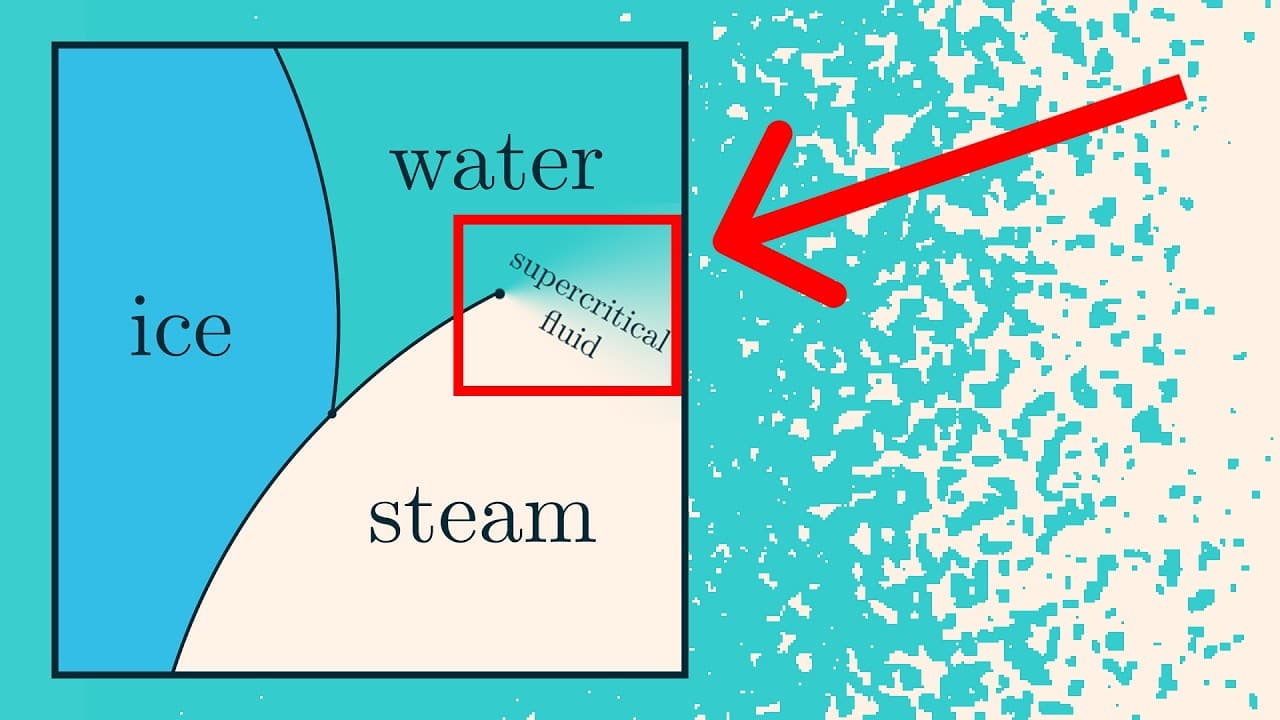
Phase transitions in fluids can be simulated using a discretized model that incorporates the Boltzmann distribution. By varying parameters like temperature and chemical potential, the simulation mimics real-world phase changes between liquid and gas states. The model uses randomness to approximate the microstates of the system, allowing for insights into phase behavior and transitions.
Transcript
[Submit subtitle corrections at criblate.com] This is a video about phase transitions. Our main goal will be to study a simulation of a discretized fluid model, which has a phase transition as the parameters are varied. That's what you're looking at right now, and it's called the liquid vapor model. To understand how this simulation works, we'll ne... Read More
Key Insights
- Phase transitions are changes in the equilibrium states of matter, not chemical reactions.
- The liquid vapor model simulates phase transitions by adjusting temperature and chemical potential.
- The Boltzmann distribution describes the probability of a system's microstate based on energy and temperature.
- Free energy minimization explains the different phases of matter and their transitions.
- Temperature is defined as the quantity that equalizes when systems exchange energy.
- Chemical potential is used in simulations to adjust molecule density, serving as a proxy for pressure.
- Phase diagrams illustrate how varying parameters affect a system's phase state.
- Universality suggests that specific model details are less important than fundamental microscopic rules.
Install to Summarize YouTube Videos and Get Transcripts
Explore YouTube Video Summarizer or Get YouTube Transcript Extractor
Questions & Answers
Q: How to simulate phase transitions in a fluid?
Simulating phase transitions in a fluid involves using a discretized model that incorporates parameters like temperature and chemical potential. The model uses the Boltzmann distribution to determine the probability of different microstates, allowing it to mimic real-world transitions between liquid and gas phases. Adjusting these parameters helps simulate the equilibrium behavior of the system.
Q: What is the Boltzmann distribution?
The Boltzmann distribution is a probability distribution that describes the likelihood of a system's microstate based on its energy and temperature. It is proportional to the exponential of the negative energy of the microstate divided by the temperature. This distribution is crucial for understanding how phase transitions can arise as temperature varies.
Q: Why is randomness used in simulating phase transitions?
Randomness is used to approximate the microstates of a system due to the impracticality of calculating every possible microstate deterministically, especially when dealing with a large number of particles. It serves as a proxy for our uncertainty about the true microstate, allowing the simulation to focus on the overall statistical behavior rather than individual particle dynamics.
Q: What is the role of temperature in phase transitions?
Temperature plays a critical role in phase transitions by influencing the probability distribution of microstates and determining how energy and entropy compete to minimize free energy. It equalizes when systems exchange energy, guiding the system towards equilibrium and affecting whether the system behaves more like a gas or a liquid.
Q: How does chemical potential relate to phase transitions?
Chemical potential is used to control the density of molecules in a simulation, serving as a proxy for pressure. It equalizes when systems exchange molecules, influencing the phase state by favoring microstates with more or fewer molecules based on its value. This parameter helps simulate phase transitions without directly manipulating pressure.
Q: What is the principle of universality in phase transitions?
Universality is the idea that the specific details of a model are less important than the fundamental microscopic rules that govern macroscopic behavior. It suggests that similar phase transition behaviors can be observed across different systems, even with significant simplifications, as long as the core principles are retained.
Q: How does the liquid vapor model simulate phase transitions?
The liquid vapor model simulates phase transitions by using a discretized grid where blue pixels represent molecules and white pixels represent empty spaces. By adjusting temperature and chemical potential, the model mimics real-world transitions between gas and liquid phases, demonstrating changes in density and the formation of droplets or bubbles during transitions.
Q: What are the key phases observed in the liquid vapor model?
In the liquid vapor model, two key phases are observed: the gas phase at high temperatures, where molecules are dispersed and entropy is high, and the liquid phase at low temperatures, where molecules clump together, minimizing energy. The model also illustrates a supercritical fluid phase, where the transition between liquid and gas occurs smoothly without a distinct phase change.
Summary & Key Takeaways
-
The video explores how phase transitions in fluids can be simulated using a discretized model. By adjusting parameters such as temperature and chemical potential, the simulation can mimic real-world phase changes between liquid and gas states. The Boltzmann distribution is key to understanding the probability of different microstates in this model.
-
Phase transitions involve changes in equilibrium behavior, and the liquid vapor model illustrates this by simulating the transition between gas and liquid phases. The model uses randomness to approximate the microstates of the system, allowing for insights into phase behavior and transitions.
-
The video also discusses the principle of universality, which posits that specific details of a model are less important than the fundamental microscopic rules that govern macroscopic behavior. This concept helps in understanding why simplified models can still accurately simulate complex real-world phenomena.
Read in Other Languages (beta)
Share This Summary 📚
Summarize YouTube Videos and Get Video Transcripts with 1-Click
Try YouTube Summary with ChatGPT & Claude or YouTube Transcript Generator
Explore More Summaries from 3Blue1Brown 📚
Summarize YouTube Videos and Get Video Transcripts with 1-Click
Try YouTube Summary with ChatGPT & Claude or YouTube Transcript Generator