What Were the Most Interesting CES Tech Demos?
TL;DR
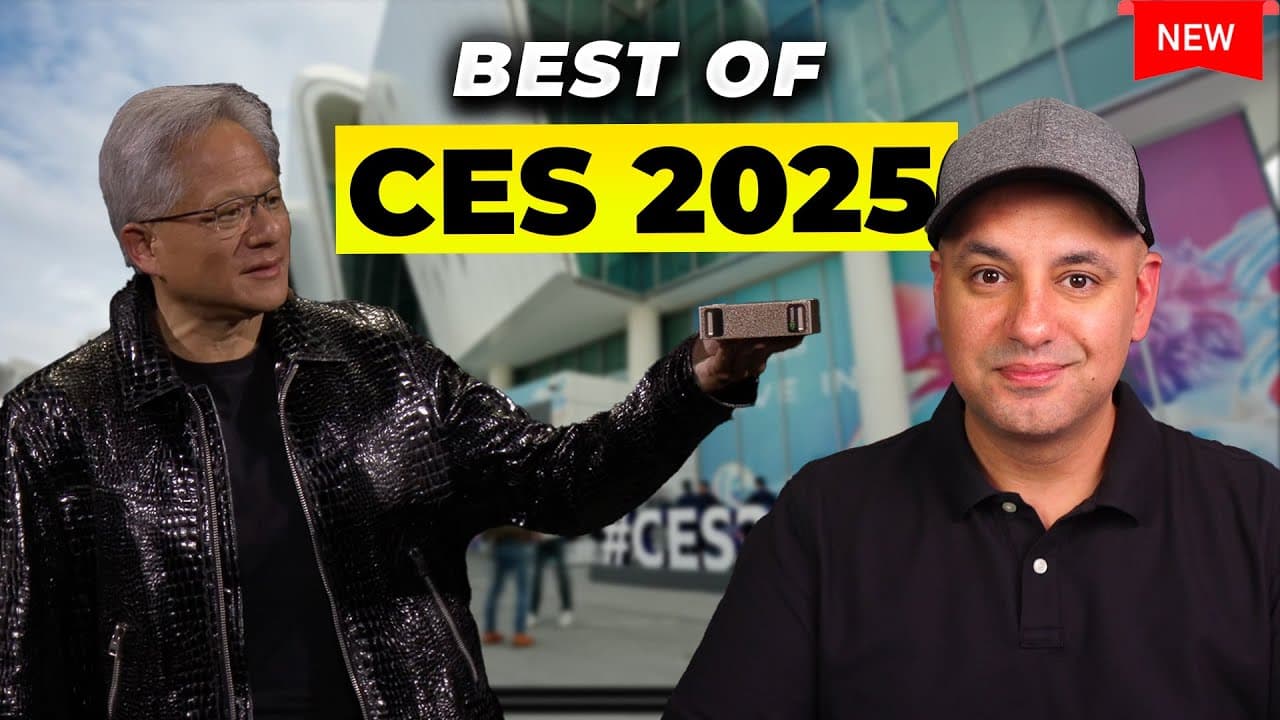
AI moved beyond software at CES, appearing in graphics hardware, robots, health monitoring, vehicles, glasses, televisions, security systems, and household devices. The most practical demonstrations automated familiar tasks or assisted people, while several attention-grabbing concepts, including a health mirror, robotic suit, and paintball-firing camera, remained experimental, unusual, or difficult to evaluate for everyday use.
Transcript
I finally got a chance to attend my very first CES out in Las Vegas which 141,000 people attended from all over the world this year and there were some really interesting upgrades in the world of tech there were a ton of Robotics and a whole lot of AI and I mean a lot of AI I even saw AI mattress and AI water thanks for NVIDIA for flying me and my ... Read More
Key Insights
- NVIDIA's GeForce RTX 50 Series is designed to improve demanding workloads such as gaming, video editing, and running AI models locally. The presenter viewed stronger graphics processing as particularly valuable for computers used to operate local AI software without depending entirely on remote services.
- NVIDIA Cosmos is a platform for accelerating physical AI development in areas such as robotics and autonomous vehicles. Its generative world foundation models create virtual environments, predict possible futures, support reinforcement learning, and let developers test model behavior across multisensor views before real-world deployment.
- NVIDIA AI Blueprints provides workflows for building and deploying custom AI agents that can reason, plan, take actions, analyze documents, and summarize findings. The keynote presented these specialized agents as coordinated digital workers that could operate together under organizational management structures resembling conventional teams.
- Unitree's robots demonstrate two different directions for accessible robotics. The G1 humanoid has a human-like form and movement, while the Go2 robot dog supports voice interaction and remote control. Their demonstrations were entertaining, but the presenter did not identify a clear practical personal use.
- The Withings Omnia smart mirror is a concept for comprehensive health monitoring through AI, sensors, and connected data. It is intended to track areas such as heart rate, sleep quality, and metabolic health, then use a personal AI assistant to interpret information and provide personalized guidance.
- The Roborock Saros Z70 is a robot vacuum with an arm that can move light objects before cleaning. This mechanism addresses a familiar limitation of robot vacuums, which may be obstructed by items left on the floor and otherwise require people to prepare the room.
- The electric salt spoon uses a mild electrical current to make food taste saltier without adding more salt or sodium. It could help people following sodium-restricted diets, although the demonstrated process required holding each bite briefly while the device delivered the electrical stimulation.
- Wearable assistance appeared in entertainment, information access, and physical labor. The bHaptics vest produces adjustable physical feedback during compatible VR games, Halliday smart glasses display translations, navigation, and teleprompter text, and exoskeleton concepts aim to support strength, mobility, or lifting tasks.
Install to Summarize YouTube Videos and Get Transcripts
Explore YouTube Video Summarizer or Get YouTube Transcript Extractor
Questions & Answers
Q: What were the main technology trends demonstrated at CES?
AI and robotics were the dominant themes across the demonstrations. AI appeared in graphics hardware, autonomous-system development, health monitoring, smart glasses, televisions, security cameras, plant care, and coordinated software agents. Robotics extended from humanoids and robot dogs to vacuums and lawnmowers. Electric vehicles, wearable assistance, immersive gaming equipment, and unconventional display technology also received significant attention.
Q: How does NVIDIA Cosmos support robots and autonomous vehicles?
NVIDIA Cosmos supports physical AI development by generating virtual worlds that represent real physical environments and possible future events. Developers can use these simulated worlds for reinforcement learning, AI feedback, testing, and model validation. The platform can also generate information in real time across multisensor views, helping a system compare possible paths before selecting an appropriate action.
Q: What can NVIDIA AI Blueprints help developers build?
NVIDIA AI Blueprints provides workflows for creating and deploying custom AI agents. These agents can perform reasoning, planning, and actions, while also working as knowledge-focused tools that analyze large collections of documents and summarize useful findings. The keynote described a model in which specialized agents handle specific responsibilities and cooperate as members of the same organizational team.
Q: What practical problem does the Roborock Saros Z70 solve?
The Roborock Saros Z70 addresses the problem of small objects blocking a robot vacuum's cleaning path. An arm extends from the top of the vacuum and can pick up items weighing up to half a pound before cleaning the area. This could reduce the amount of manual floor preparation required before starting an automated cleaning cycle.
Q: How does the Withings Omnia smart mirror monitor health?
The Withings Omnia smart mirror combines AI, health sensors, and integrated data to provide broad health monitoring. The concept is intended to track heart rate, sleep quality, metabolic health, and related information. A personal AI assistant then helps the user review that data, understand patterns, and receive personalized guidance, although the presenter expected affordability and availability to take time.
Q: How does the electric salt spoon make food taste saltier?
The electric salt spoon delivers a mild electrical current that changes the perception of flavor, making food taste saltier without adding more salt or sodium. It is presented as a possible tool for people following sodium-restricted diets. The demonstration also revealed a usability tradeoff, since each bite had to be held briefly before the electrical effect occurred.
Q: What features do Halliday AI smart glasses provide?
Halliday AI smart glasses place a small display in the wearer's field of view while maintaining the appearance of ordinary glasses. Their demonstrated functions included real-time translation, navigation, teleprompter text, and other live updates. The glasses weigh 35 grams and were presented with a price of $489 for their planned launch later that year.
Q: Which CES products showed the clearest everyday usefulness?
The products with the clearest everyday roles improved tasks people already perform. The robot vacuum moves small obstacles before cleaning, the lawnmower automates yard maintenance, smart glasses provide translation and navigation, and the haptic vest adds physical feedback to compatible VR games. Health monitoring, lifting assistance, and reduced-sodium flavor enhancement also address recognizable needs, though some remained concepts or felt unusual.
Summary & Key Takeaways
-
NVIDIA presented graphics processors for gaming, video editing, and locally operated AI models, along with Cosmos tools for developing physical AI. Its generative world foundation models can simulate environments, predict possible outcomes, support reinforcement learning, and help developers test autonomous vehicles and robots through generated scenarios and multisensor views.
-
Robotics appeared in humanoid, animal-like, cleaning, and lawn-care forms. Unitree demonstrated a human-shaped robot and a voice-controlled robot dog, while Roborock showed a vacuum with an arm for moving light objects. Mammotion demonstrated an autonomous mower capable of handling steep terrain and maintaining properties of different sizes.
-
Consumer concepts blended AI with health, accessibility, entertainment, and smart-home control. Products included a health-monitoring mirror, haptic VR clothing, low-sodium flavor technology, lightweight smart glasses, AI-enabled televisions, exoskeletons, automated plant care, advanced security cameras, electric vehicles, and a transparent wireless television whose practicality may depend on individual needs.
Read in Other Languages (beta)
Share This Summary 📚
Summarize YouTube Videos and Get Video Transcripts with 1-Click
Try YouTube Summary with ChatGPT & Claude or YouTube Transcript Generator
Explore More Summaries from Skill Leap AI 📚



Summarize YouTube Videos and Get Video Transcripts with 1-Click
Try YouTube Summary with ChatGPT & Claude or YouTube Transcript Generator