Is ChatGPT's o1 Model Better Than Custom GPT?
TL;DR
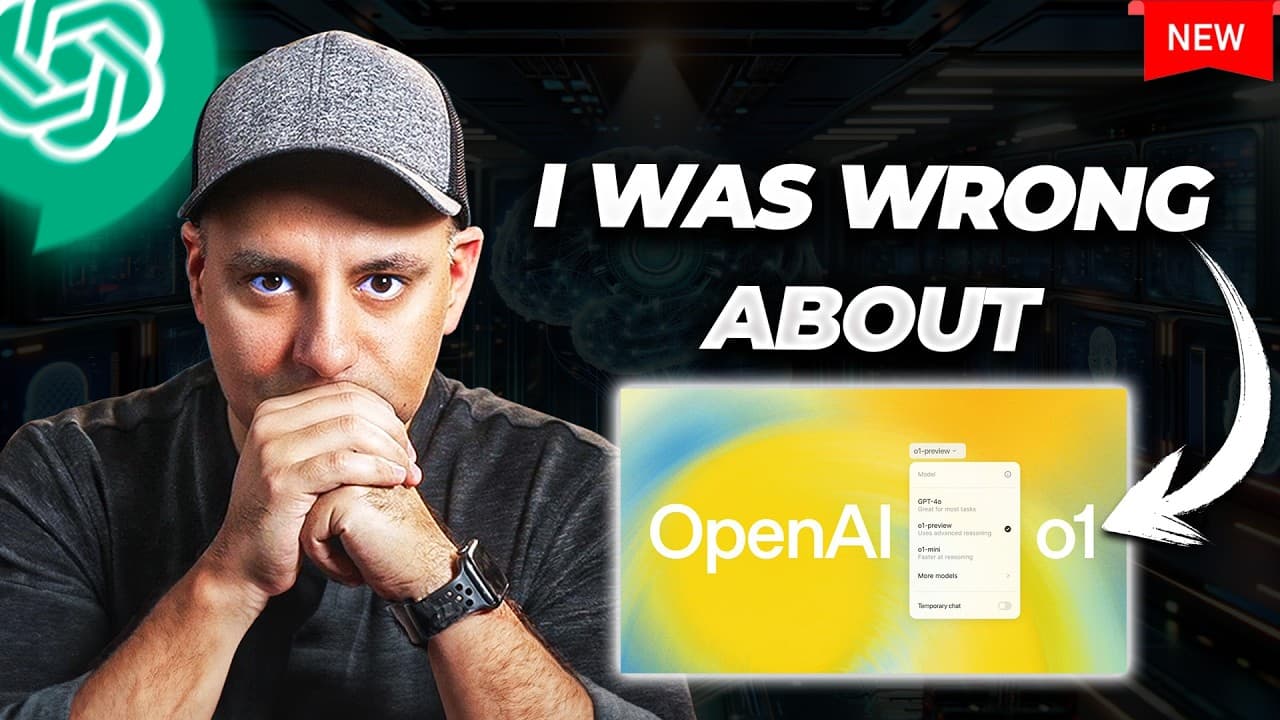
The new ChatGPT o1 model, initially thought to be superior, performed similarly to a custom GPT clone using Chain of Thought prompting. In tests involving IQ and math questions, both models had similar accuracy, with the o1 model slightly outperforming in math. However, the expected significant improvement was not evident.
Transcript
the new model inside of chat gpt1 preview may not be as good as I thought when I first tested it I had more time to test it I switched between a couple of different accounts they actually reset how many times you could use it they reset the limit because a lot of people ran out very quickly so I did some more testing and in this video I'm going to ... Read More
Key Insights
- The new ChatGPT o1 model is designed to think through problems using Chain of Thought prompting.
- Custom GPTs can be created with specific instructions to mimic the o1 model's reasoning process.
- In IQ tests, both the o1 model and the custom GPT clone performed equally well.
- The o1 model showed a slight advantage in math questions, but not as significant as expected.
- The Chain of Thought prompting involves understanding the problem, breaking down reasoning, explaining steps, and reviewing the thought process.
- The initial impression of the o1 model being a major improvement was challenged by further testing.
- Both models struggled with certain math problems, indicating potential limitations in complex reasoning tasks.
- The o1 model's performance in benchmarks suggested a greater improvement than observed in practical tests.
Install to Summarize YouTube Videos and Get Transcripts
Explore YouTube Video Summarizer or Get YouTube Transcript Extractor
Questions & Answers
Q: How does the ChatGPT o1 model perform in IQ tests?
In IQ tests, the ChatGPT o1 model performed similarly to a custom GPT clone using Chain of Thought prompting. Both models answered most questions correctly, demonstrating comparable reasoning abilities in this area. The results suggest that the o1 model does not significantly outperform a well-configured custom GPT in IQ-related tasks.
Q: What is Chain of Thought prompting in AI models?
Chain of Thought prompting is a technique used in AI models to enhance reasoning by structuring the thought process. It involves understanding the problem, breaking down the reasoning process into logical steps, explaining each step, arriving at a final answer, and reviewing the thought process for errors. This approach aims to improve the transparency and accuracy of AI responses.
Q: Did the o1 model show significant improvement in math tests?
The o1 model showed a slight improvement in math tests compared to a custom GPT clone, but not as significant as initially expected. While it outperformed the custom GPT in some math questions, both models struggled with certain complex problems, indicating that the expected leap in performance was not fully realized.
Q: Can custom GPTs mimic the o1 model's reasoning process?
Yes, custom GPTs can be configured to mimic the o1 model's reasoning process by incorporating specific instructions for Chain of Thought prompting. This involves guiding the model to think through problems step-by-step, providing detailed explanations, and reviewing the reasoning process to ensure logical conclusions.
Q: What were the initial impressions of the o1 model's performance?
Initially, the o1 model was perceived as a significant advancement over existing models, particularly in reasoning and math tasks. However, further testing revealed that while it performed slightly better in math, the overall improvement was not as substantial as anticipated. The model's performance in practical tests did not fully align with benchmark expectations.
Q: How did the custom GPT clone perform in the tests?
The custom GPT clone, designed with Chain of Thought prompting, performed comparably to the o1 model in both IQ and math tests. It answered most questions correctly, matching the o1 model's accuracy in IQ tasks and showing only minor differences in math performance. This suggests that with proper configuration, custom GPTs can achieve similar reasoning capabilities.
Q: What limitations were observed in the o1 model's performance?
The o1 model, despite its enhancements, faced limitations in solving certain complex math problems. Both the o1 model and the custom GPT struggled with tasks requiring intricate reasoning, indicating areas where future improvements are needed. The anticipated significant leap in performance was not observed in practical tests, highlighting potential challenges in complex problem-solving.
Q: What is the significance of the o1 model's Chain of Thought prompting?
The Chain of Thought prompting in the o1 model is significant for its potential to enhance AI reasoning by structuring the thought process. It aims to improve accuracy and transparency by guiding the model to think through problems logically and systematically. While it showed some advantages, the expected major improvements over previous models were not fully realized in practical applications.
Summary & Key Takeaways
-
The new ChatGPT o1 model uses Chain of Thought prompting to improve reasoning but performed similarly to a custom GPT clone in IQ and math tests. Both models showed comparable accuracy, with the o1 model slightly better in math, but not significantly.
-
Custom GPTs can be tailored to mimic the o1 model by incorporating specific instructions for step-by-step reasoning. This approach helps in understanding and solving problems logically, although the expected leap in performance was not observed.
-
The o1 model was initially perceived as a major advancement, but further testing revealed only slight improvements over existing models. Both the o1 model and the custom GPT struggled with certain complex tasks, highlighting areas for future enhancement.
Read in Other Languages (beta)
Share This Summary 📚
Summarize YouTube Videos and Get Video Transcripts with 1-Click
Try YouTube Summary with ChatGPT & Claude or YouTube Transcript Generator
Explore More Summaries from Skill Leap AI 📚





Summarize YouTube Videos and Get Video Transcripts with 1-Click
Try YouTube Summary with ChatGPT & Claude or YouTube Transcript Generator