How does AI raise the bar for engineering
TL;DR
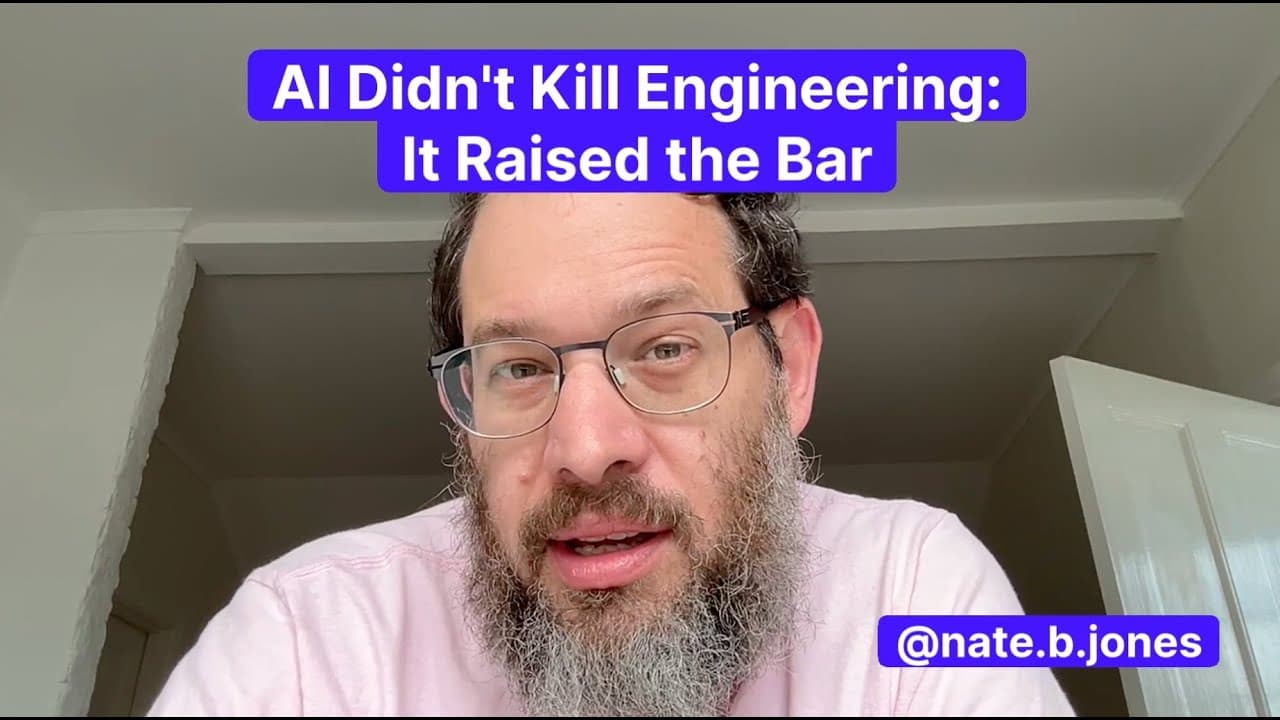
AI makes engineering more essential and complex, serving as a force multiplier for trained engineers rather than a replacement for them. Vibe coding and automation accelerate work but require engineers to uphold core human responsibilities such as translating intent into specifications, guaranteeing probabilistic behavior, and designing for scale, safety, and cost. The future of engineering hinges on strong foundational skills and disciplined practices.
Transcript
This is a love letter to engineering. I firmly believe that AI makes engineering more essential, not less. And I'm going to tell you why in detail because I think that people who aren't engineers don't understand this. And I think increasingly junior engineers are afraid. Because they have not experienced what it's like in detail to work with senio... Read More
Key Insights
- AI increases engineering importance by expanding the need for invariants, interfaces, safety cases, and reliability under load.
- The core shift is from who can code to who can engineer, with AI amplifying trained engineers rather than replacing them.
- Humans must translate intent into correct specifications and name invariants, hazards, and success criteria.
- Effective prompting becomes an engineering skill that grows with engineering understanding.
- Engineers must write guarantees for probabilistic systems and define boundaries that are deterministic.
- Understanding emergent behaviors at scale is a uniquely human skill necessary for large systems.
- Economic engineering requires managing intelligence like a utility and balancing latency, quality, and cost.
- Demos without production readiness fail due to lack of observability and robust design.
- More videos from this channel:
- More from this channel: AI News & Strategy Daily | Nate B Jones
Install to Summarize YouTube Videos and Get Transcripts
Explore YouTube Video Summarizer or Get YouTube Transcript Extractor
Questions & Answers
Q: What is the main claim about AI and engineering in this video
The main claim is that AI does not kill engineering but raises its bar and makes it more essential. AI acts as a force multiplier for trained engineers while changing the discipline toward greater emphasis on system design, safety, and governance. This shift means engineers are needed more than ever to manage complexity and scale.
Q: How does vibe coding relate to engineers according to the speaker
Vibe coding can produce working software but is not a substitute for engineering. It tends to democratize coding, yet it mainly serves as rocket fuel for trained engineers who understand architectural intent and system interactions. Non engineers may struggle with the limitations of coding in production environments, while engineers leverage AI to compress expertise.
Q: What human responsibilities do engineers retain
Engineers retain several key responsibilities, including translating human intent into correct specifications with clear invariants and success criteria, writing guarantees for probabilistic systems, thinking at scale to anticipate emergent behaviors, and managing trade offs among latency, quality, and cost to ensure reliable operation in production.
Q: Why is it said that AI has a blast radius for failures in production
Because AI can write code and influence complex systems, failures can propagate more widely than with hand written code. This makes the responsibility to guarantee outcomes and boundaries even more critical, as small probabilistic errors can lead to large, observable impacts in production when systems scale.
Q: What does the speaker say about the skill of prompting
Effective prompting is framed as an engineering skill that improves with deeper engineering understanding. The better the engineer understands system design and constraints, the more accurately prompts can guide AI to generate safe, reliable, and useful outputs.
Q: What is meant by thinking at scale and emergent behavior
Thinking at scale involves understanding how massive, interconnected systems behave under stress and how small changes can lead to large, unpredictable outcomes. Emergent behavior at large scale requires intuition and expertise to identify bottlenecks and prevent systemic failures.
Q: What does the speaker mean by economic engineering
Economic engineering means treating intelligence like a utility, optimizing for latency, quality, and cost, and designing degraded experiences that preserve value under constraints. It emphasizes practical trade offs and resilience in production environments.
Q: What are the three laws for AI era engineering mentioned
The three laws are: No invariants in a design means it is not engineered; If it is not measurable in production, it is not built; If you cannot explain a failure, you do not own the system. These guide disciplined, reliable engineering in the AI era.
Summary & Key Takeaways
-
AI elevates engineering by requiring invariants, interfaces, safety cases, and reliability under load. The shift is from code generation to robust system design and governance.
-
AI acts as a multiplier, widening the gap between who can code and who can engineer, favoring trained engineers who understand architecture and scale.
-
Humans remain responsible for translating intent, writing guarantees on probabilistic systems, thinking at scale, and managing trade offs between latency, quality, and cost.
Read in Other Languages (beta)
Share This Summary 📚
Summarize YouTube Videos and Get Video Transcripts with 1-Click
Try YouTube Summary with ChatGPT & Claude or YouTube Transcript Generator
Explore More Summaries from AI News & Strategy Daily | Nate B Jones 📚






Summarize YouTube Videos and Get Video Transcripts with 1-Click
Try YouTube Summary with ChatGPT & Claude or YouTube Transcript Generator