How Does Fractal Dimension Measure Roughness?
TL;DR
Fractal dimension measures how a shape’s mass or box count changes when its scale changes, so the dimension need not be a whole number. Perfect self-similarity makes the calculation simple, but it is not required: broader notions such as box-counting and Hausdorff dimension can describe irregular natural forms, including coastlines, while preserving the roughness that smoother geometric models neglect.
Transcript
Who doesn't like fractals? They're a beautiful blend of simplicity and complexity, often including these infinitely repeating patterns. Programmers in particular tend to be especially fond of them, because it takes a shockingly small amount of code to produce images that are way more intricate than any human hand ever could hope to draw. But a l... Read More
Key Insights
- Fractal dimension is a measure of how a shape’s mass changes when the shape is scaled. If scaling lengths by a factor changes mass by that factor raised to d, then d serves as the shape’s dimension, even when d is not an integer.
- Perfect self-similarity is not required for a shape to be treated through fractal geometry. Self-similar constructions are useful teaching models because their smaller copies make scaling relationships easy to count, but restricting fractals to those constructions contradicts Mandelbrot’s broader effort to model natural roughness.
- The Sierpinski triangle is approximately 1.585-dimensional because it contains three copies scaled by one half. Its dimension d satisfies one half raised to d equals one third, which is equivalent to calculating the logarithm base two of three.
- The von Koch curve is approximately 1.262-dimensional because it consists of four identical copies, each scaled by one third. Its dimension is therefore the logarithm base three of four, derived by matching the geometric scaling factor to the corresponding reduction in mass.
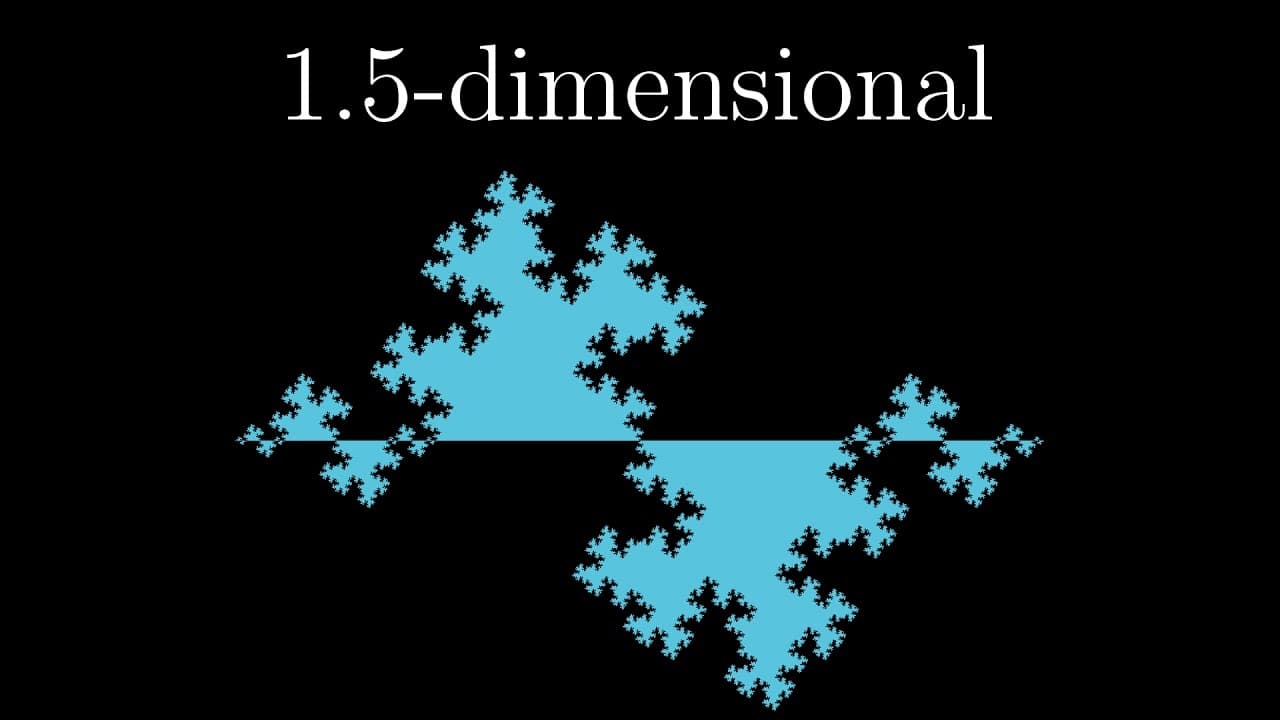
- A right-angled variation of the Koch curve is exactly 1.5-dimensional because it contains eight copies scaled by one fourth. The relevant equation is one fourth raised to d equals one eighth, giving d as the logarithm base four of eight.
- A fractional-dimensional shape can resist ordinary measurements such as length and area. The Sierpinski triangle has infinite length and zero area, so neither conventional measure describes it appropriately. Its fitting measure would instead be the 1.585-dimensional analog of length.
- Box counting estimates dimension by covering a shape with a grid and counting every box that touches it. When the shape or grid scale changes, the growth in the number of occupied boxes reveals the exponent associated with its dimension.
- A fractal can have an integer dimension under Mandelbrot’s definition. The defining comparison is that its Hausdorff dimension exceeds its topological dimension, so fractional numerical values are common but not mandatory. The boundary of the Mandelbrot set and the Sierpinski pyramid are cited as dimension-two examples.
Install to Summarize YouTube Videos and Get Transcripts
Explore YouTube Video Summarizer or Get YouTube Transcript Extractor
Questions & Answers
Q: What is fractal dimension?
Fractal dimension is a way to describe how a geometric shape’s mass changes as the shape is scaled. If resizing every length by a factor causes mass to change by that factor raised to d, then d is interpreted as the dimension. Unlike the dimensions used in elementary geometry or linear algebra, this exponent can be any positive real number rather than only a counting number.
Q: Why are fractals not necessarily self-similar?
Perfectly self-similar shapes are convenient examples, but they represent only a restricted part of fractal geometry. Mandelbrot’s broader goal was to model roughness in nature without smoothing away important fine details. Exact smaller copies make scaling calculations especially clear, yet broader definitions based on dimension can also handle irregular shapes that do not reproduce themselves perfectly at every scale.
Q: How is the dimension of the Sierpinski triangle calculated?
The Sierpinski triangle contains three smaller copies of itself, and each copy has half the original side length. Scaling by one half therefore reduces its mass to one third. Its dimension d must satisfy one half raised to d equals one third. Rewriting the relationship asks what power of two equals three, so d is log base two of three, approximately 1.585.
Q: How is the dimension of the von Koch curve calculated?
The von Koch curve is assembled from four identical smaller copies, with each copy scaled to one third of the original. The reduced copy has one fourth of the original mass, so its dimension d satisfies one third raised to d equals one fourth. This is equivalent to asking what power of three equals four, producing log base three of four, approximately 1.262.
Q: Why can a fractal have a fractional dimension?
Dimension can be interpreted as the exponent connecting a change in scale to a change in mass. For ordinary objects, this exponent is one for a line, two for a square, and three for a cube. A fractal can have a different scaling relationship. Three half-sized Sierpinski triangles form the original, so the required exponent lies between one and two rather than being a whole number.
Q: Why do ordinary length and area fail for the Sierpinski triangle?
The Sierpinski triangle lies in a plane, but its scaling behavior does not match that of an ordinary two-dimensional region or a one-dimensional line. Its length is infinite, while its area is zero. Neither measurement therefore captures its mass appropriately. The suitable concept is a measure corresponding to its approximately 1.585-dimensional scaling behavior, positioned between conventional length and area.
Q: How does box counting measure dimension?
Box counting begins by covering the surrounding space with a grid and counting all boxes that touch the shape. The shape or the grid scale is then changed, and the new number of occupied boxes is compared with the original count. For a disk scaled by two, the count should increase approximately by four, reflecting the square relationship expected for a two-dimensional object.
Q: What is Mandelbrot’s definition of a fractal?
Mandelbrot’s stated definition treats a fractal as a shape whose Hausdorff dimension is greater than its topological dimension. Topological dimension remains an integer and loosely classifies curve-like objects as one-dimensional and surface-like objects as two-dimensional. Hausdorff dimension resembles box-counting dimension, but uses balls instead of boxes and is more general, although it is harder to describe.
Summary & Key Takeaways
-
Fractal geometry was motivated by a practical need to model roughness that ordinary smooth geometry can neglect. Although perfectly self-similar constructions such as the Sierpinski triangle and von Koch curve provide clear examples, fractals are not limited to shapes containing exact reduced copies of themselves. Fractional dimension is the more important underlying idea.
-
Dimension can be understood through scaling: when a shape is resized by a factor, its mass changes by that factor raised to its dimension. A line, square, and cube therefore have dimensions one, two, and three. Applying the same rule gives the Sierpinski triangle a dimension of approximately 1.585.
-
Self-similarity dimension is intuitive but too restrictive for general shapes, since even an ordinary disk cannot be reconstructed from exact smaller disk copies. Box counting provides a broader approach by covering a shape with a grid and observing how the number of touching boxes changes with scale. Hausdorff dimension offers a more general definition.
Read in Other Languages (beta)
Share This Summary 📚
Summarize YouTube Videos and Get Video Transcripts with 1-Click
Try YouTube Summary with ChatGPT & Claude or YouTube Transcript Generator
Explore More Summaries from 3Blue1Brown 📚
Summarize YouTube Videos and Get Video Transcripts with 1-Click
Try YouTube Summary with ChatGPT & Claude or YouTube Transcript Generator